What each licence includes
| Feature | Free | Pro |
|---|---|---|
| Packaging profiles: weight in grams across 8 LUCID material types | ✔ | ✔ |
| Profile per product, per category (Pro), and separately per shipment | ✔ | ✔ |
| Shipment packaging counted per order or per line item | ✔ | ✔ |
| Snapshot at order time: changing the carton doesn't rewrite filed reports | ✔ | ✔ |
| Period report in kilograms to three decimal places | ✔ | ✔ |
| Order count shown next to the figure — see whether it's even plausible | ✔ | ✔ |
| CSV export that German Excel opens without complaint | — | ✔ |
| Recalculation of existing orders for a chosen period | — | ✔ |
| German interface — read by an accountant, not a developer | ✔ | ✔ |
| HPOS and block checkout, works only through the WooCommerce API | ✔ | ✔ |
Verpackungsmengen für LUCID (VerpackG) is a WooCommerce module for the German market: it works out the packaging weight of every order by LUCID material type and produces a ready Mengenmeldung, which the seller enters into LUCID and the dual system’s dashboard.
Why the store needs this
Anyone shipping packaged goods to Germany must report packaging weight — from the very first parcel. In practice this weight is usually worked out in Excel from memory: how much that carton weighed and how many went out over the year. The module takes the figure straight from orders.
Packaging profiles
A profile is packaging with a weight for each material: “Karton M” = 320 g of paper plus 12 g of plastic for tape. A profile is attached to a product, a category, or set separately for the shipment itself. Changed the carton? Edit the profile, not hundreds of product cards.
The material types are the same as in LUCID: glass; paper, cardboard; ferrous metals; aluminium; plastic; beverage cartons; other composites; other materials.
Report and CSV
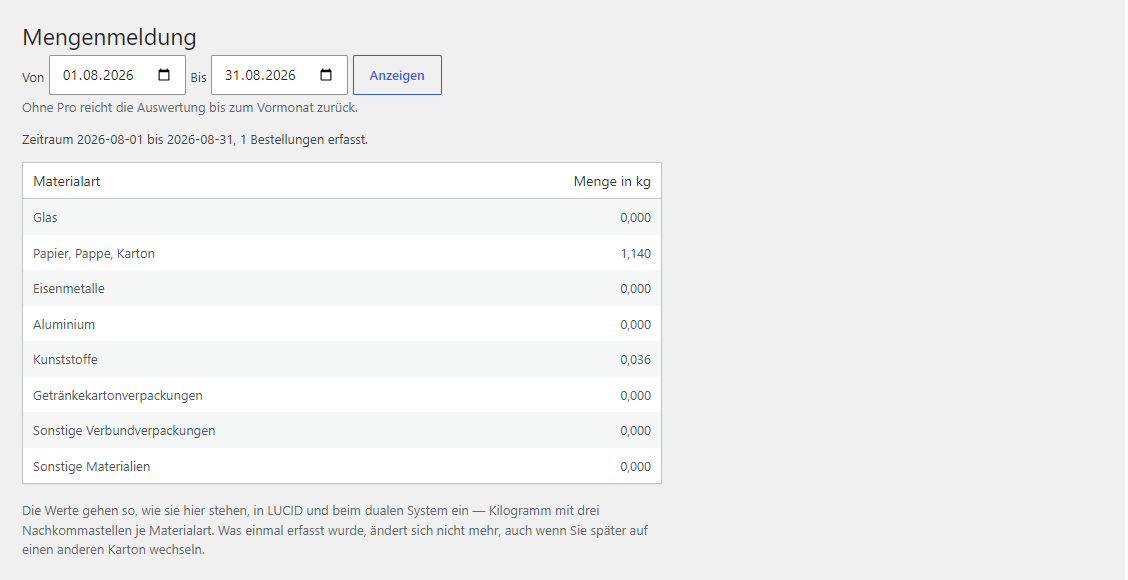
Pick a period and get a table by material type in kilograms to three decimal places, plus the order count, so you can see straight away whether the figure is even plausible. In Pro the same report exports to CSV, which German Excel opens without complaint.
Compatibility
WooCommerce 6.0+, WordPress 6.2+, PHP 7.4+, HPOS. The module’s interface is in German — it’s read by a German accountant, not a Ukrainian team.
Who actually needs this
If you sell into Germany, you’re required to register with LUCID and file a Mengenmeldung annually (or quarterly, for large volumes): how many kilograms of packaging of which material type you put on the market.
The problem isn’t the report itself, but where the figures come from. The typical route is opening Excel at year-end and guessing from memory how many boxes, how much film and filler there were. It’s slow, it doesn’t match reality, and the responsibility for the figures is yours.
How it works, step by step
1. You describe your packaging profiles once: how many grams of each of the eight LUCID material types go into this box, this bag, this filler.
2. A profile is assigned to a product, to a category (in Pro), or set separately for the shipment itself.
3. When an order comes in, the module calculates packaging from its contents and records a snapshot into the order itself.
4. At the end of the period you open the report, pick dates and get the kilograms for each material type.
5. The figures go into the Mengenmeldung, and the CSV stays with you as proof of the calculation.
The snapshot is the key detail
The module doesn’t calculate the report “on the fly” from current profiles. It stores the result at the moment of the order.
This matters: if you switched to a lighter box in March and changed the profile, February’s orders must stay calculated with the old box. A module that recalculates retroactively from current profiles quietly rewrites reporting you’ve already filed — and the discrepancy surfaces during an audit, not in your admin.
What the admin gets
A dedicated packaging profiles screen: name, weight in grams across the eight types. Then profile assignment to products, and in Pro to categories too, so you don’t have to set thousands of items by hand.
The shipment’s own packaging (box, tape, filler) is counted either once per order or per line item — depending on how you actually pack.
The report shows kilograms to three decimal places, with the order count next to it that the figure is built from. This lets you sanity-check the result without opening the database.
What the module doesn’t do
It doesn’t file the report for you and has no LUCID integration: filing stays your action in the dashboard. The module covers exactly the part that’s impossible to do accurately by hand — tracking grams per order over a period.
It also doesn’t invent weights. If profiles are described roughly, the report will be exactly as accurate as the profiles are.
Free version and Pro
The free version covers packaging profiles, assignment to products and to shipments, a snapshot at order time, and a period report broken down by material type. There are no time limits or ads in the admin.
Pro adds category-level profiles (one action instead of a thousand) and CSV report export.
Pricing
The Pro licence is 990 UAH, for one site. The licence is annual: once it ends, the module keeps calculating — only updates and support stop. This matters here specifically: the list of material types and reporting requirements change, and without updates the module will eventually drift from the form.
Technical requirements
WordPress 6.2 and newer, WooCommerce, PHP 7.4 and newer. Compatible with HPOS. The module calls no external services — everything is calculated locally, order data never leaves.
Under the hood
The packaging snapshot lives in the order’s meta fields, so it survives a theme change, WooCommerce updates and the move to HPOS. The report is built by querying these meta fields over a date range, with no separate table and no nightly cron jobs.
The material types are hard-coded to exactly the eight from the LUCID form — the module doesn’t let you invent your own, because that would make the report unfileable.
How to install
1. Upload the archive under “Plugins → Add New → Upload Plugin” and activate it.
2. WooCommerce → Packaging — describe the packaging profiles you actually use.
3. Assign profiles to products (to categories in Pro) and set the shipment profile.
4. Place a test order and check that its packaging snapshot appears.
5. WooCommerce → Packaging report — pick a period and check the kilograms.
Frequently asked questions
Does the module file data with LUCID itself?
No. The register doesn't accept machine submissions from stores — the obligated party enters the figures themselves. The module gives exactly the numbers asked for, in the right units.
What about orders placed before installation?
Recalculation in Pro recomputes the chosen period using current profiles. If packaging was different back then, create a separate profile with the weight from that time and recalculate the period with it.
Is shipment packaging counted per order or per product?
It's switchable. If you ship bulky items individually, count per line item: three products in an order will produce three cartons.
Why a snapshot instead of recalculating on the fly?
Because the reporting has already been filed. If you switch to a lighter carton next year, last year's figure must not change retroactively — otherwise you won't be able to explain the discrepancy in an audit.
How many sites can be activated with one key?
One. The licence is annual: once it ends, the module keeps working, only updates and support stop.
Questions about the module?
Message us on Telegram — we reply within the working day. We will help with setup, compatibility and key activation.
No reviews yet. Be the first — right below.
Leave a review
Reviews are moderated before publication, which usually takes up to 24 hours.
No questions yet. Ask one — we answer within 24 hours.
Ask a question
We usually reply within 24 hours during working hours.
Buying the module
—