















OpenCart
1 290 UAH839 UAH≈ €17
Black November: −35% on all modules until 30 November Black November: −35% until 30 November Choose a module
 Website auditA PDF report by email in 3 minutesCheck a website
Everyday tasks
Image compressorSize, quality and WebP in bulkQR generatorLink, Wi-Fi, payment to IBANVAT calculator20, 14, 7% and amount in wordsTransliterationOfficial Ukrainian standardWebsite checks
PHP and pluginsPHP version, WordPress, pluginsGoogle Merchant feedFields, prices, GTIN, imagesDomain emailSPF, DKIM, DMARC, blacklistsAI search readinessllms.txt, bots, markupAll 9 toolsEnter at least 2 characters

Facturis Online invoices from OpenCart 4.x, 3.x, 2.3 orders, CUI at the checkout; Pro adds automation, payments, storno, stock, e-Factura. Lifetime licence.
The free version works with no time limit. Pro adds the rest of the features in the table.


At the OpenCart checkout the buyer sees the fields “CUI”, “Reg. Com.” and “CNP”: the module creates them with the “Create the fields” button for all customer groups, not compulsory.

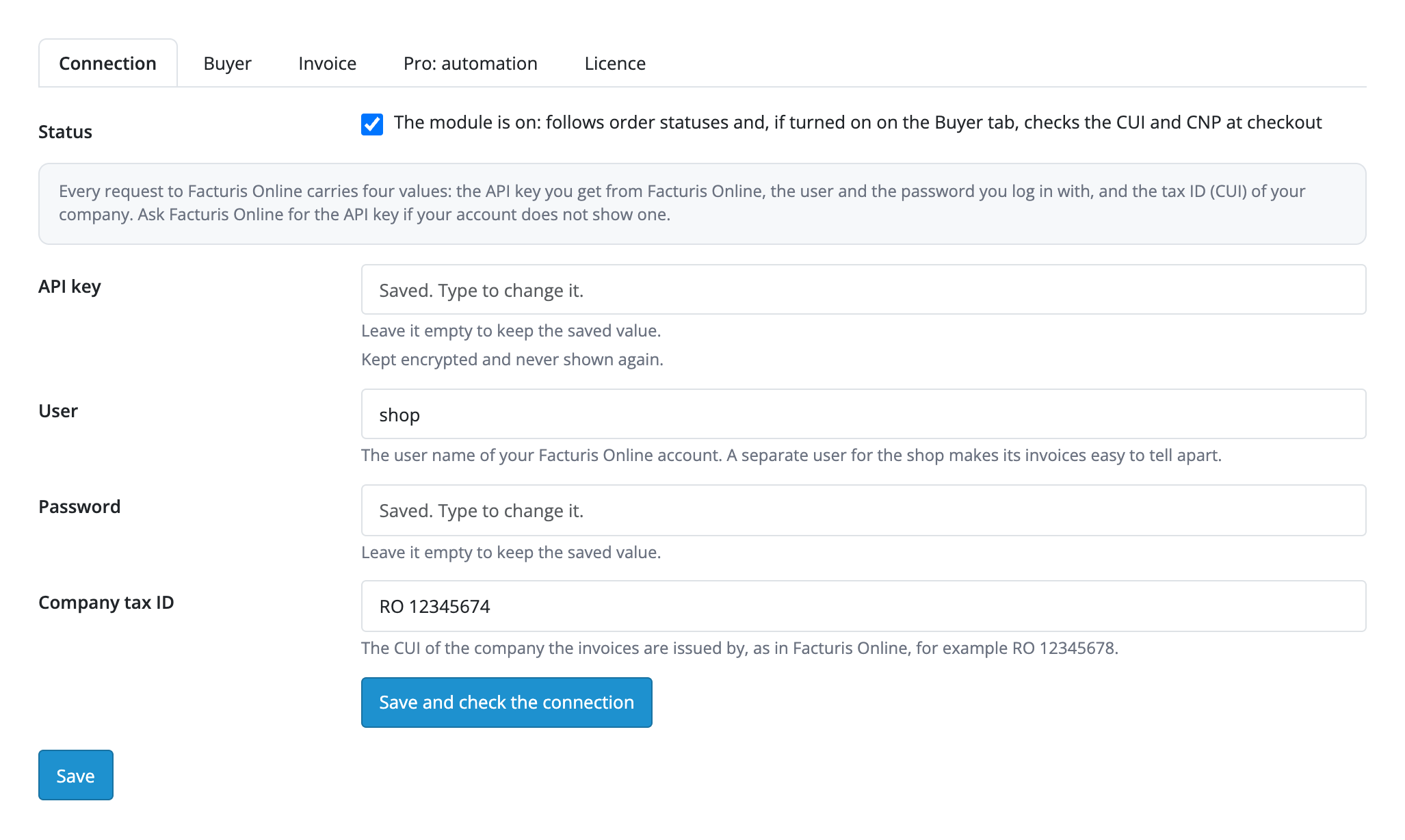
Extensions → Extensions → Modules → Facturis Online Invoices: the tabs “Connection”, “Buyer”, “Invoice”, “Pro: automation” and “Licence”.

An invoice is issued by itself when an order reaches the status you choose.

A fresh install is the free version, nothing switches on by itself. The “Try Pro for 7 days” button → e-mail → the key right in the window and by e-mail.

Moving the site? Unlink the licence on the old domain and activate it on the new one yourself. A staging copy (staging., dev.) works with the same key and does not take a site slot. For studios — keys for 5 or 25 sites, or unlimited.
 OpenCart 4.0.2.0–4.1.x, 3.0.x or 2.3.0.2; PHP 7.0+ for 2.3, the cURL extension.A Facturis Online account with API access: the API key, the user, the password and the company CUI.The “Region / State” field at the checkout must be compulsory: a Romanian invoice (and e-Factura) needs the county.A series in Facturis Online, if you do not want the default series of the account.
For OpenCart 4.x, 3.x and 2.3: Facturis Online invoices from orders through API v2.0, fields for the CUI, the register number and the CNP with a check at the checkout, an invoice by a…


Facturis Online Invoices for OpenCart 4.x, 3.x and 2.3 issues an invoice (factură) from an order in the Romanian service Facturis Online through its API v2.0. The buyer gives a CUI, a trade register number or a CNP at the checkout, and the invoice appears in your Facturis account with the right buyer, rows and VAT (TVA) rates.
What you need from Facturis. A Facturis Online account with API access. Every request carries four values: the API key (Facturis Online issues it), the user, the password and the tax ID (CUI) of your company.
At the OpenCart checkout the buyer sees the fields “CUI”, “Reg. Com.” and “CNP”: the module creates them with the “Create the fields” button for all customer groups, not compulsory. A buyer who gives a CUI gets an invoice for a company (persoană juridică); one who does not gets it as a private person.
The check-digit test of the CUI and CNP at the checkout can be turned on on the “Buyer” tab: a wrong number is refused with an error next to the field. It applies to buyers in Romania only, an empty field is allowed, and a buyer in another country with their own VAT number is not tested as a Romanian CUI.
Extensions → Extensions → Modules → Facturis Online Invoices: the tabs “Connection”, “Buyer”, “Invoice”, “Pro: automation” and “Licence”. The “Connection” tab holds the API key, the user, the password and the company CUI. “Save and check the connection” tests the login and shows the company and the number of invoices issued today. The key and the password are stored encrypted and never sent back to the page.
The “Invoice” tab: the series (empty means the default series of the account), the days to pay, the codes of the payment methods paid after the order (cash on delivery, bank transfer), VAT payer or not, VAT rates from the order taxes or one rate for everything, the text in the invoice observations, and a request log.
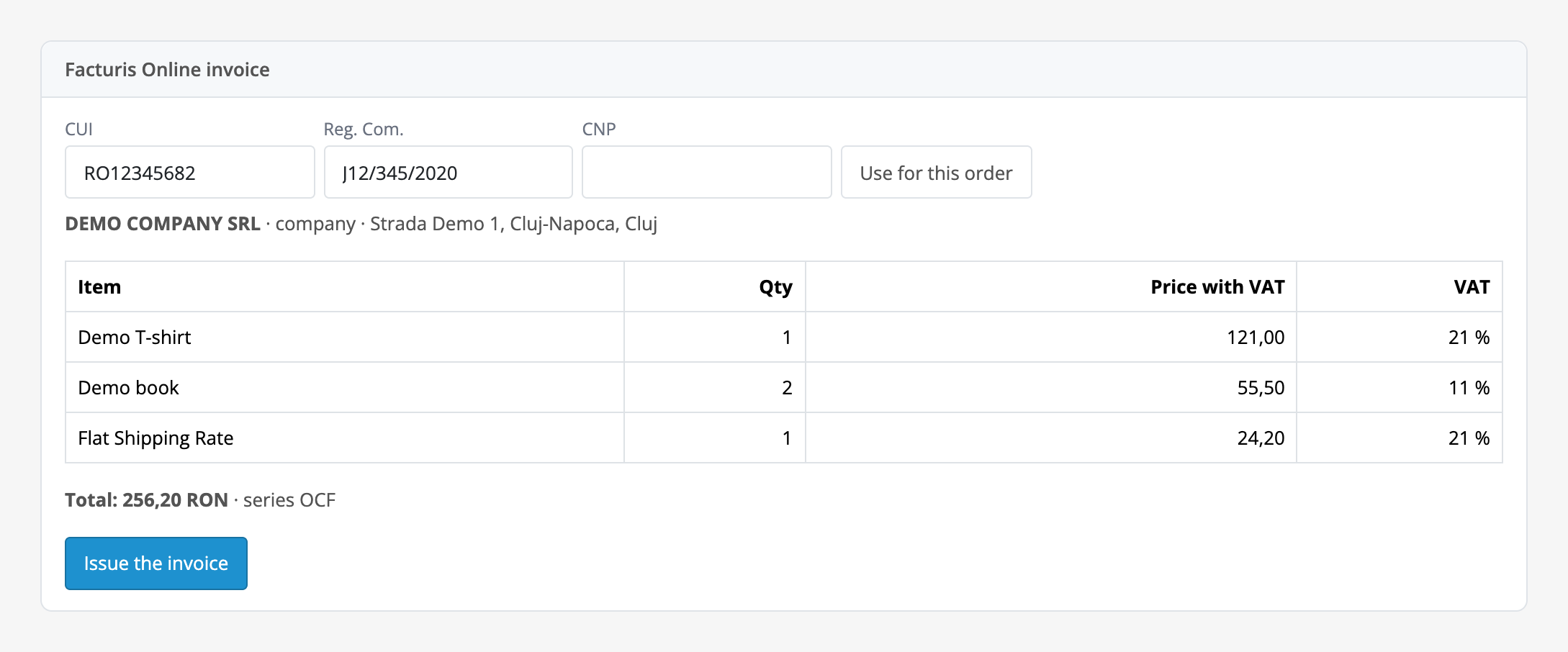
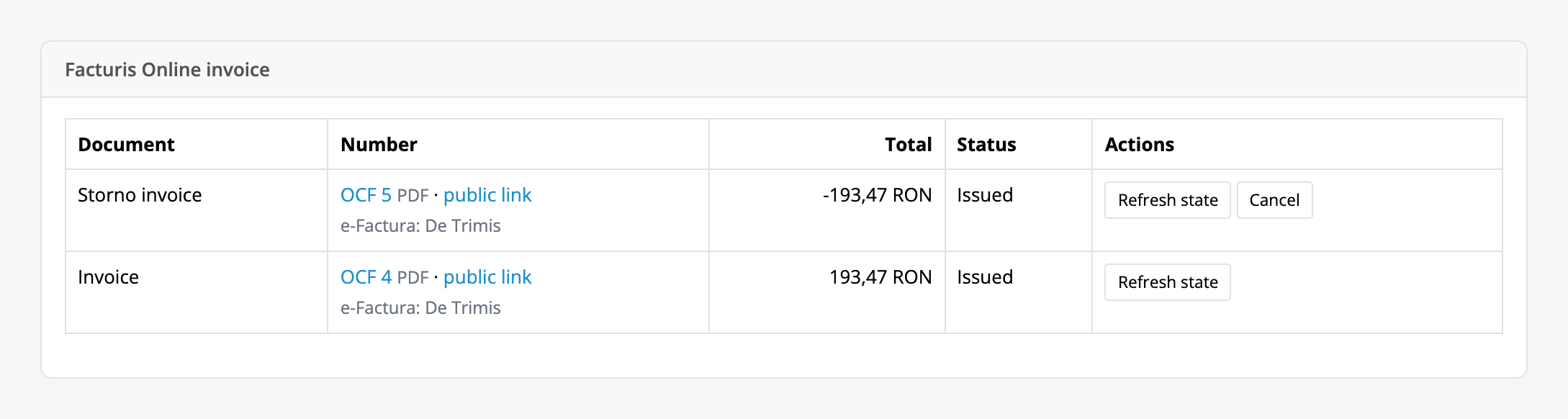
The order page gets a “Facturis Online invoice” box: the buyer’s CUI, Reg. Com. and CNP (they can be corrected for this order with “Use for this order”), a preview of the rows with the price including VAT and the rate, the total and the series, and the “Issue the invoice” button. After issuing it shows the number, the PDF link, the public link and the e-Factura state. The box warns when a Bucharest address has no sector, when a private buyer has no street, or when a company name has no CUI; without a county or a city the invoice is not sent, and the module says why.
An invoice is issued by itself when an order reaches the status you choose. Orders paid at the checkout are recorded in the payments register of Facturis right away, paired with the invoice, and the invoice gets the status “Platită”. Cash on delivery and bank transfer follow an order status or the “Record payment” button.
For cash methods the invoice comes together with a receipt (chitanță) and as paid, with its own receipt series. The rows of the invoice are tied to the Facturis catalogue by SKU, Model or EAN, with the gestiune and the punct de lucru, so the stock in Facturis goes down.
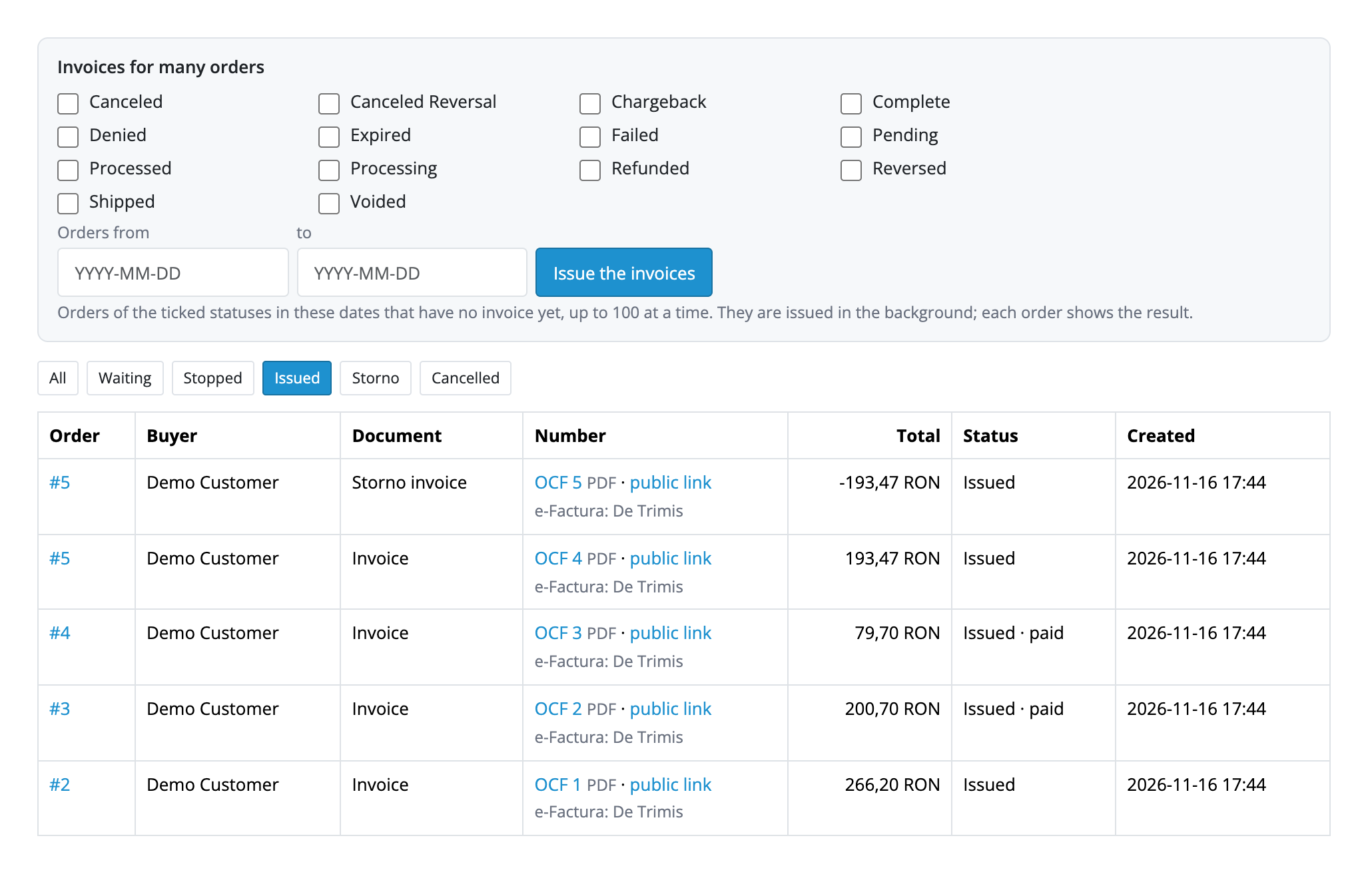
A storno on the whole invoice (the rows of the original with their quantities turned over) and cancelling (Anulată) work by button or by order status; private buyers and storno can get their own series. The e-Factura (SPV) state that Facturis returns is refreshed with the “Refresh state” button. The “Facturis invoices” entry under Sales lists all invoices with filters, and the mass run issues invoices for orders by status and date, up to 100 at a time.
Didn't find the answer? Message us on Telegram and we'll reply within a business day.
 @catcode_support
Setup, compatibility, activation
No, it is an independent integration through the public API of Facturis Online. Facturis is a trademark of its owner.
API access and the API key from Facturis Online, plus the user and the password you log in with and the CUI of your company. Facturis Online issues the API key.
Yes, the Facturis API wants the login and the password in every request. The key and the password are stored encrypted. We advise a separate Facturis user for the shop, so its invoices are easy to tell apart.
The e-Factura (SPV) state shows in the order and is refreshed by a button (Pro). The buyer address has to be complete: with a sector for Bucharest, with a county and a city for everybody; the module warns, or stops the invoice with an explanation, when something is missing.
Yes, in Pro: for the payment methods you mark as cash, the invoice comes together with a chitanță and as paid.
The module looks up the invoice already made by the order reference and writes its number down. If it could not establish that for certain, it does not issue a second invoice and asks you to check by hand in Facturis Online.
OpenCart 4.0.2.0–4.1.x, 3.0.x and 2.3.0.2 — three separate archives in one product.
Yes, for OpenCart one payment and a lifetime licence, for two sites.
No reviews yet. Be the first.
No questions yet. Ask one — we answer within 24 hours.
We build custom modules for WordPress, WooCommerce, OpenCart and Shopify. Tell us about the task and we'll prepare an estimate.
Order a custom module
—
Charged in UAH; your bank converts it to your currency. EUR price is approximate.

CatCode assistant
Just now


CatCode assistant
Online

I’ll help with your website task
Describe your website task — I’ll find a ready-made module or pass it to a developer for an estimate. Modules, custom features, layout, integrations, speed, migration, technical SEO.