















OpenCart
1 290 UAH839 UAH≈ €17
Black November: −35% on all modules until 30 November Black November: −35% until 30 November Choose a module
 Website auditA PDF report by email in 3 minutesCheck a website
Everyday tasks
Image compressorSize, quality and WebP in bulkQR generatorLink, Wi-Fi, payment to IBANVAT calculator20, 14, 7% and amount in wordsTransliterationOfficial Ukrainian standardWebsite checks
PHP and pluginsPHP version, WordPress, pluginsGoogle Merchant feedFields, prices, GTIN, imagesDomain emailSPF, DKIM, DMARC, blacklistsAI search readinessllms.txt, bots, markupAll 9 toolsEnter at least 2 characters

Konduto for OpenCart 4.x, 3.x, 2.3: fraud analysis of orders, the score and the recommendation in the order. Automatic analysis and lists in Pro. Lifetime licence. An unofficial module.
The free version works with no time limit. Pro adds the rest of the features in the table.


Nothing new: the checkout does not change, and the buyer does not wait for Konduto.

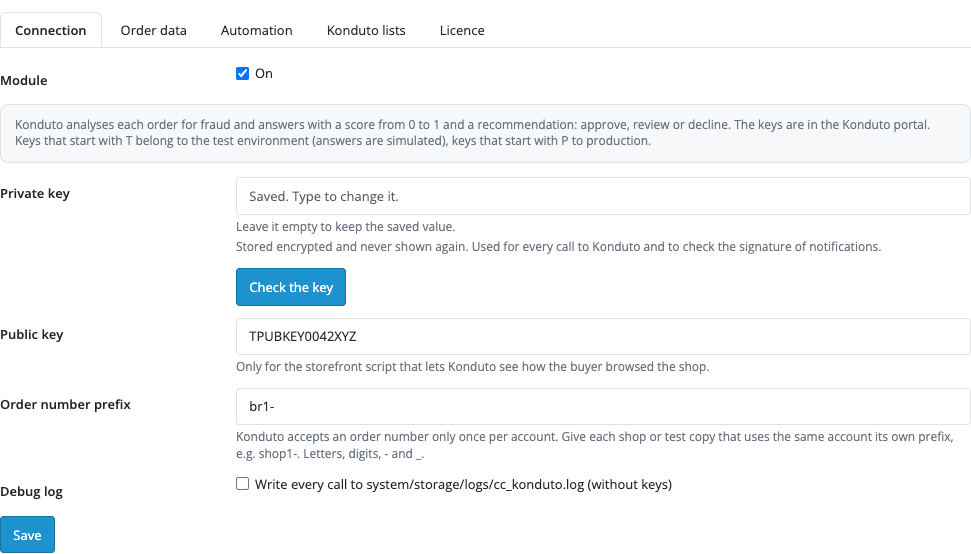
Extensions → Extensions → Modules → Konduto Antifraud: the tabs “Connection”, “Order data”, “Automation”, “Konduto lists” and “Licence”.

The base version is free. Pro costs 990 UAH, a one-time payment, lifetime licence.

A fresh install is the free version, nothing switches on by itself. The “Try Pro for 7 days” button → e-mail → the key right in the window and by e-mail.

Moving the site? Unlink the licence on the old domain and activate it on the new one yourself. A staging copy (staging., dev.) works with the same key and does not take a site slot. For studios — keys for 5 or 25 sites, or unlimited.
 OpenCart 4.0.2.x and 4.1.x, 3.0.x or 2.3.0.2; PHP 7.0+ for 2.3 and 3.x, the cURL extension.A Konduto account and contract: the public and private keys from the Konduto portal.For the webhook (Pro) the notification address has to be given to Konduto support, and the shop must be reachable from the internet over HTTPS, out of maintenance mode and with Konduto’s POST requests not blocked.Automatic sending without a delay works on PHP-FPM; without it orders go on the next admin page, a payment callback or a cron request to the address in the settings (every 5 minutes).CPF/CNPJ needs a field at the checkout, for example from the Brazilian Checkout Fields module.
For OpenCart 4.x, 3.x and 2.3: analysis of an order in Konduto from the order panel (score, recommendation, Konduto status, rules and lists, location, device), an encrypted key with a…

Konduto Antifraud for OpenCart 4.x, 3.x and 2.3 sends the orders of your shop to Konduto, a Brazilian fraud analysis service, and shows the answer in the order itself: a risk score from 0 to 1, a recommendation (approve, review or decline), the rules and lists that fired, the buyer’s location and device. The module is made for shops that sell in Brazil: the buyer’s CPF/CNPJ, addresses with a CEP, reais, Pix, boleto and cards. The module interface is in English and português (pt-BR).
An unofficial module. Konduto is a trademark of its owner; this is an independent integration made by CatCode, not a Konduto product. The analysis itself is paid on the Konduto side: you need your own Konduto account and contract, and Konduto sets the prices and the terms, not the module.
Nothing new: the checkout does not change, and the buyer does not wait for Konduto. The order goes to the analysis after the buyer has been shown the “order placed” page (on a server with PHP-FPM; without it, on the next admin page, a payment callback or a cron request). The Konduto script in the storefront, which sees how the buyer moved through the shop (Pro), is switched on in the settings; telling buyers about it under LGPD is the shop’s job.
Extensions → Extensions → Modules → Konduto Antifraud: the tabs “Connection”, “Order data”, “Automation”, “Konduto lists” and “Licence”. On “Connection” you enter the private key from the Konduto portal: it is stored encrypted and never shown again, and the “Check the key” button asks Konduto whether it accepts the key. The key prefix shows the environment: T is test, P is production. The order number prefix is needed because Konduto accepts an order number only once per account: give each shop or test copy that uses the same account its own prefix.
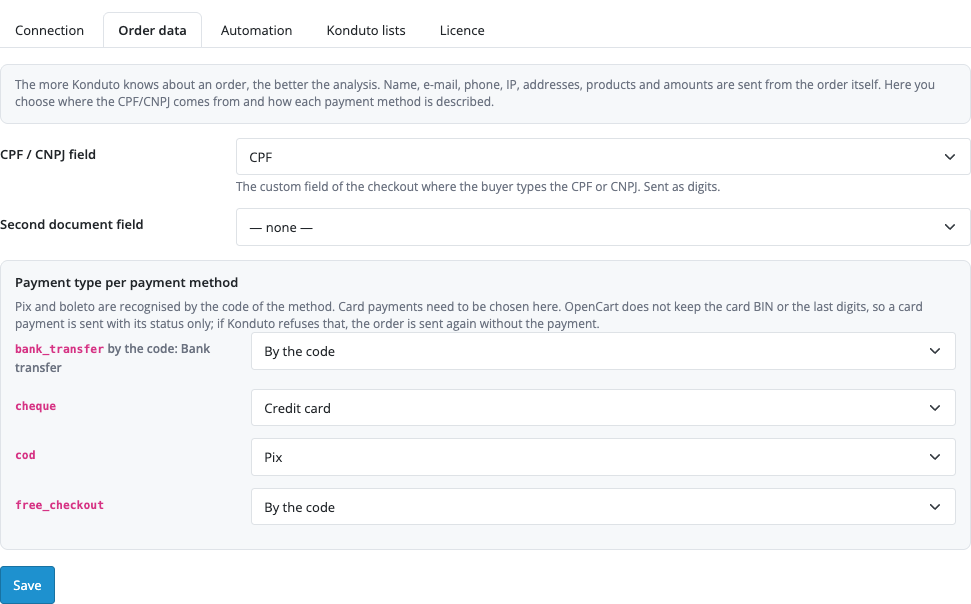
On the “Order data” tab you choose where the buyer’s CPF/CNPJ comes from: a custom checkout field or our Brazilian Checkout Fields module (document, house number, neighbourhood). The name, e-mail, phone, IP, addresses, products and amounts come from the order itself. Each payment method gets a payment type for Konduto: Pix and boleto are recognised by the method code, a card (credit or debit) you choose yourself. OpenCart does not keep the card BIN or the last digits, so a card payment is sent with its status; if Konduto refuses that, the order is sent again without the payment block.
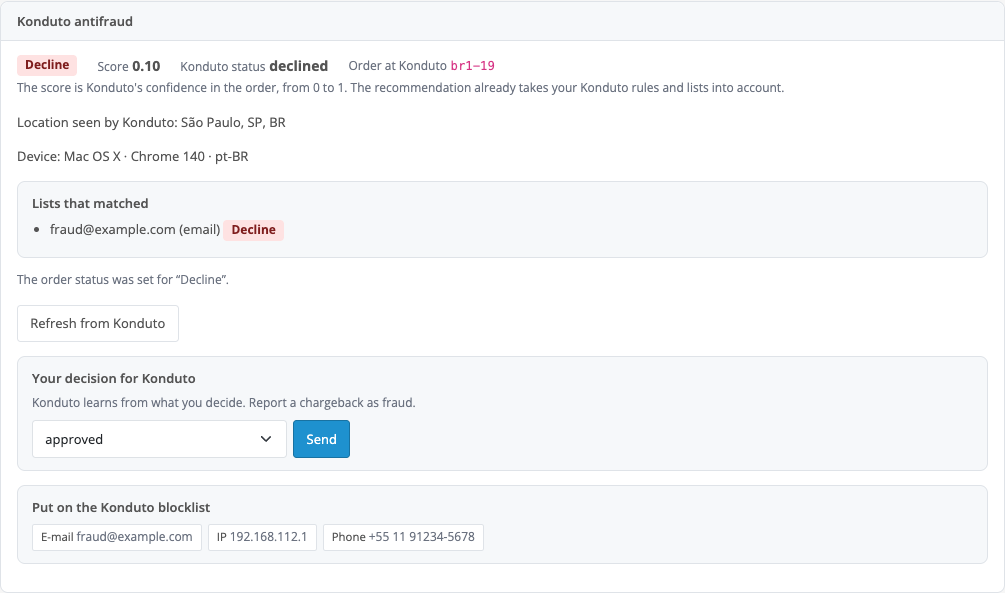
The order gets a “Konduto antifraud” panel. The “Analyse with Konduto” button sends the order; the panel answers with the score, the recommendation, the Konduto status, the rules or lists that fired, the location and the device, and a line stays in the order history. A second click does not duplicate anything: the module says that the order is already analysed. “Refresh from Konduto” pulls the current status. A network error, a 5xx error or Konduto’s request limit do not lose the order: the module sends it again, and when an answer got lost on the way it fetches the result with a request instead of creating a duplicate.
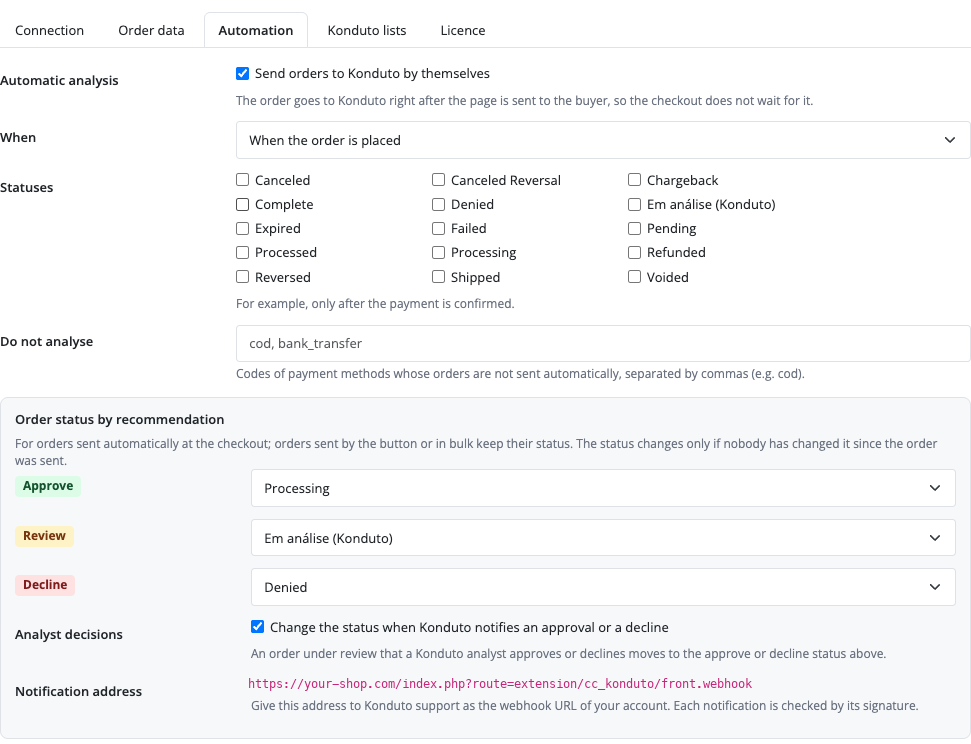
Pro: automatic analysis. The order goes to Konduto when it is placed or when it reaches the statuses you choose (for example, after the payment is confirmed); payment methods that need no analysis (for example, cod) are left out with a list. The order status can follow the recommendation: approve, review, decline; by default the status is kept, and it changes only if nobody changed it by hand while the analysis ran. Decisions of Konduto analysts arrive through a webhook with a signature check and move an order that waited for review to the approve or decline status. The shop’s decisions go back to Konduto: a completed order as approved, a cancelled one as cancelled, a chargeback as fraud, or by hand from the panel.
Lists and the order list (Pro). The Konduto blocklist, allowlist and review list are managed from the admin (e-mail, phone, IP, CPF/CNPJ and other values), and the order has buttons for a quick block of the buyer’s e-mail, CPF/CNPJ, IP and phone. A separate page, Sales → Konduto antifraud, shows the analysed orders with filters (review, declined, approved, waiting, failed), a 30-day summary and a button that queues the recent orders Konduto has not seen yet (their status does not change).
Didn't find the answer? Message us on Telegram and we'll reply within a business day.
 @catcode_support
Setup, compatibility, activation
No, it is an independent integration made by us. Konduto is a trademark of its owner.
Yes, on the Konduto side: it is a paid service billed under your contract with Konduto. The module, its free version and Pro do not include the price of the analysis.
A Konduto account: the public and private keys from the portal. Keys with the prefix T belong to the test environment, P to production.
No. The order goes to the analysis after the buyer has been shown the confirmation page.
In the free version no, it only shows the recommendation. In Pro the status follows the recommendation if you choose the statuses; by default the status is kept.
From a custom checkout field you choose on the "Order data" tab, or from our Brazilian Checkout Fields module.
OpenCart 4.0.2.x, 4.1.x, 3.0.x and 2.3.0.2: three separate archives in one product.
Yes, for OpenCart it is one payment and a lifetime licence for two sites.
No reviews yet. Be the first.
No questions yet. Ask one — we answer within 24 hours.
We build custom modules for WordPress, WooCommerce, OpenCart and Shopify. Tell us about the task and we'll prepare an estimate.
Order a custom module
—
Charged in UAH; your bank converts it to your currency. EUR price is approximate.

CatCode assistant
Just now


CatCode assistant
Online

I’ll help with your website task
Describe your website task — I’ll find a ready-made module or pass it to a developer for an estimate. Modules, custom features, layout, integrations, speed, migration, technical SEO.