SEO Templater — bulk meta tag generation for WooCommerce
Один шаблон із плейсхолдерами замість тисяч написаних руками мета-тегів: title, description і H1 для товарів і категорій, попередній перегляд «було → стало» і застосування пачками без таймаутів.

What each licence includes
| Feature | Free | Pro |
|---|---|---|
| Meta title, meta description and H1 templates for products and categories | ✔ | ✔ |
| About 25 placeholders: {name}, {category}, {brand}, {price}, {sku}, {store}, and more | ✔ | ✔ |
| An empty variable is removed together with its extra separator | ✔ | ✔ |
| Optional blocks [ SKU {sku}. ] disappear entirely if the variable is empty | ✔ | ✔ |
| Title suffix for pages 2+ — pagination doesn't duplicate the first page | ✔ | ✔ |
| "Before → after" preview with highlighting for length overruns | ✔ | ✔ |
| "Fill empty fields only" mode — manual meta tags aren't overwritten | ✔ | ✔ |
| Applying in batches with a progress bar and "Stop" button | ✔ | ✔ |
| Integration with Yoast SEO and Rank Math; without an SEO plugin, its own fields and output in wp_head | ✔ | ✔ |
| Canonical without filter_*/orderby/UTM, noindex for filters and pagination | — | ✔ |
| Rules by category or brand with priority | — | ✔ |
| Auto-regeneration schedule and rollback of the last run | — | ✔ |
SEO Templater for WooCommerce describes the title, description and H1 as a formula with placeholders — and applies it across the whole catalogue. Filling in meta tags by hand for several thousand products isn’t realistic, and without them pages end up competing with each other in search results.
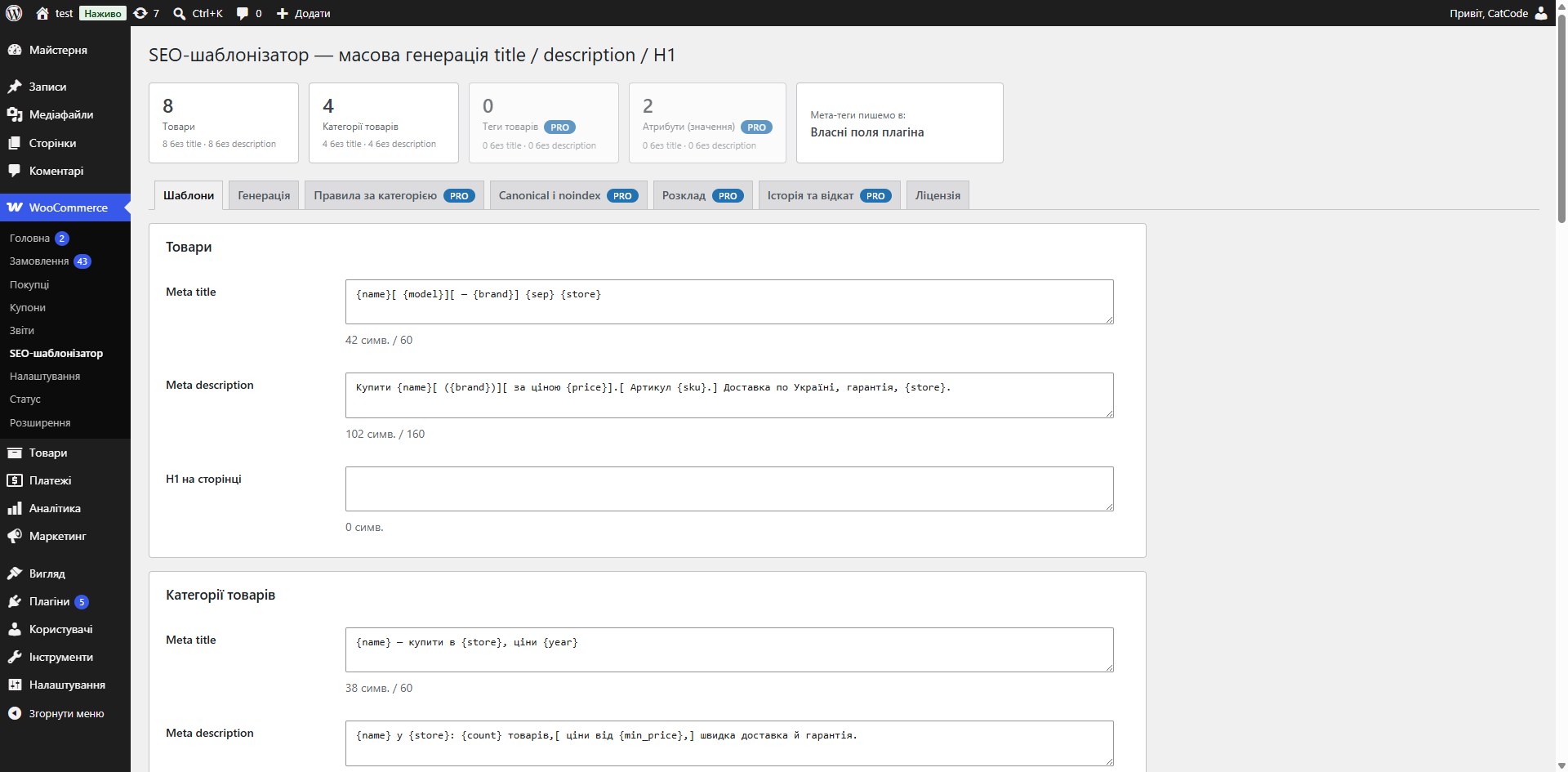
Templates instead of manual work
Separate formulas for products and product categories, and in Pro also for tags and attribute values. About 25 placeholders: name, category, brand, price, SKU, store name, model, attribute, option, product count, minimum price, availability, year, page number, separator. Templates are compatible with the OpenCart version of the module: {product_name}, {manufacturer}, {store_name}, {attribute:Colour} behave the same way.
An empty variable doesn’t leave a gap in the string: it’s removed together with its separator, and an optional block such as [ SKU {sku}. ] disappears entirely. Title and description length is controlled with trimming at a word boundary.
Preview first, then write
The “Preview (dry run)” shows a “before → after” list and highlights any length overruns — nothing is written yet. Applying then runs in batches with a progress bar and a “Stop” button. “Fill empty fields only” mode protects anything you wrote by hand.
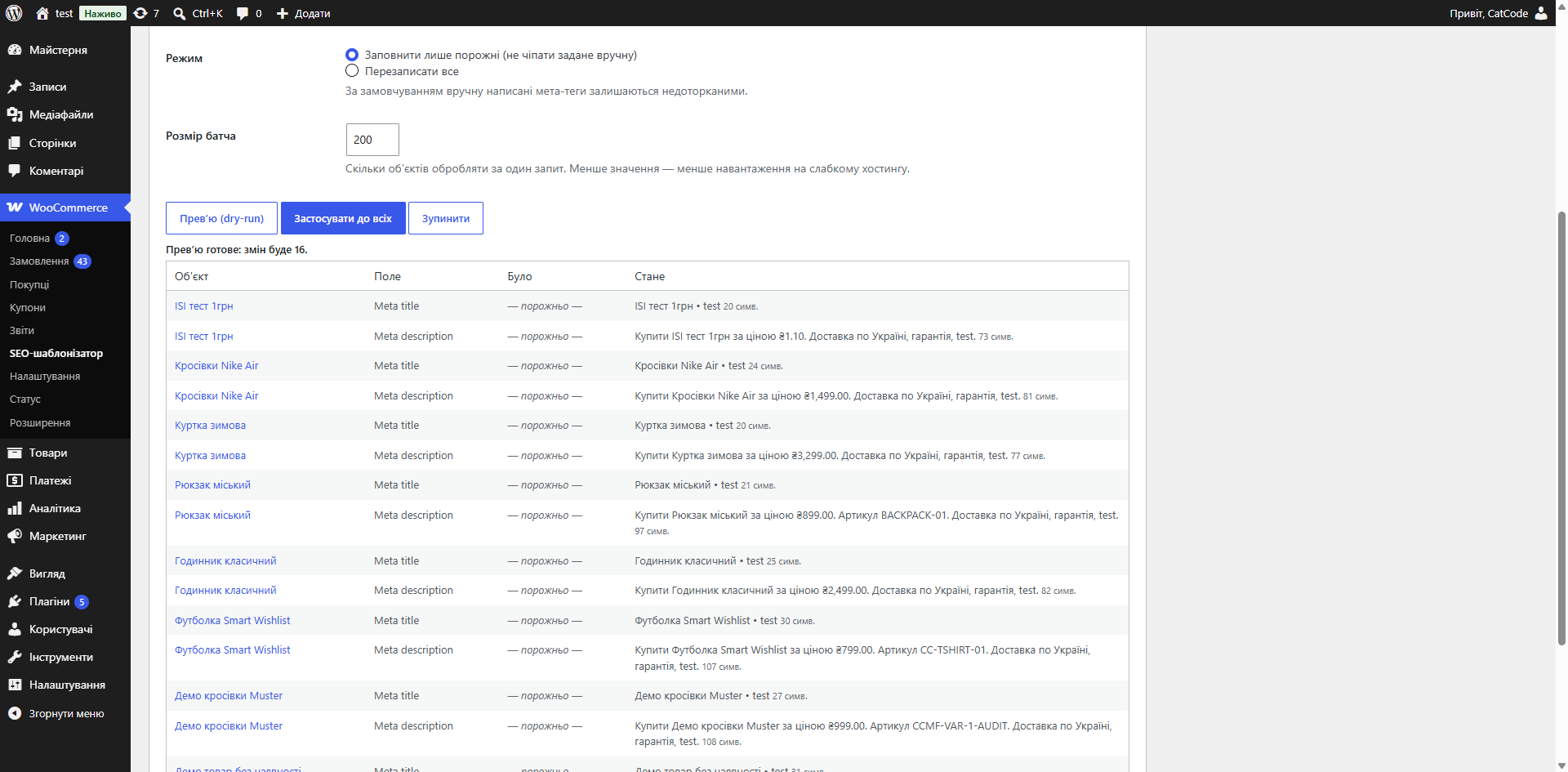
Where the meta tags get written
If Yoast SEO or Rank Math is active, values are written straight into their fields, so your usual tools and checks keep working as before. If there’s no SEO plugin, the module keeps its own fields and prints <title> and <meta name="description"> itself.
What’s free and what’s Pro
A fresh install is simply the free version: title, description and H1 templates for products and categories, preview, and a run of up to 200 objects at a time. Nothing Pro switches itself on. Pro fields stay in place — greyed out, with a Pro badge and one line explaining what they give you, so you see a boundary rather than an empty spot.
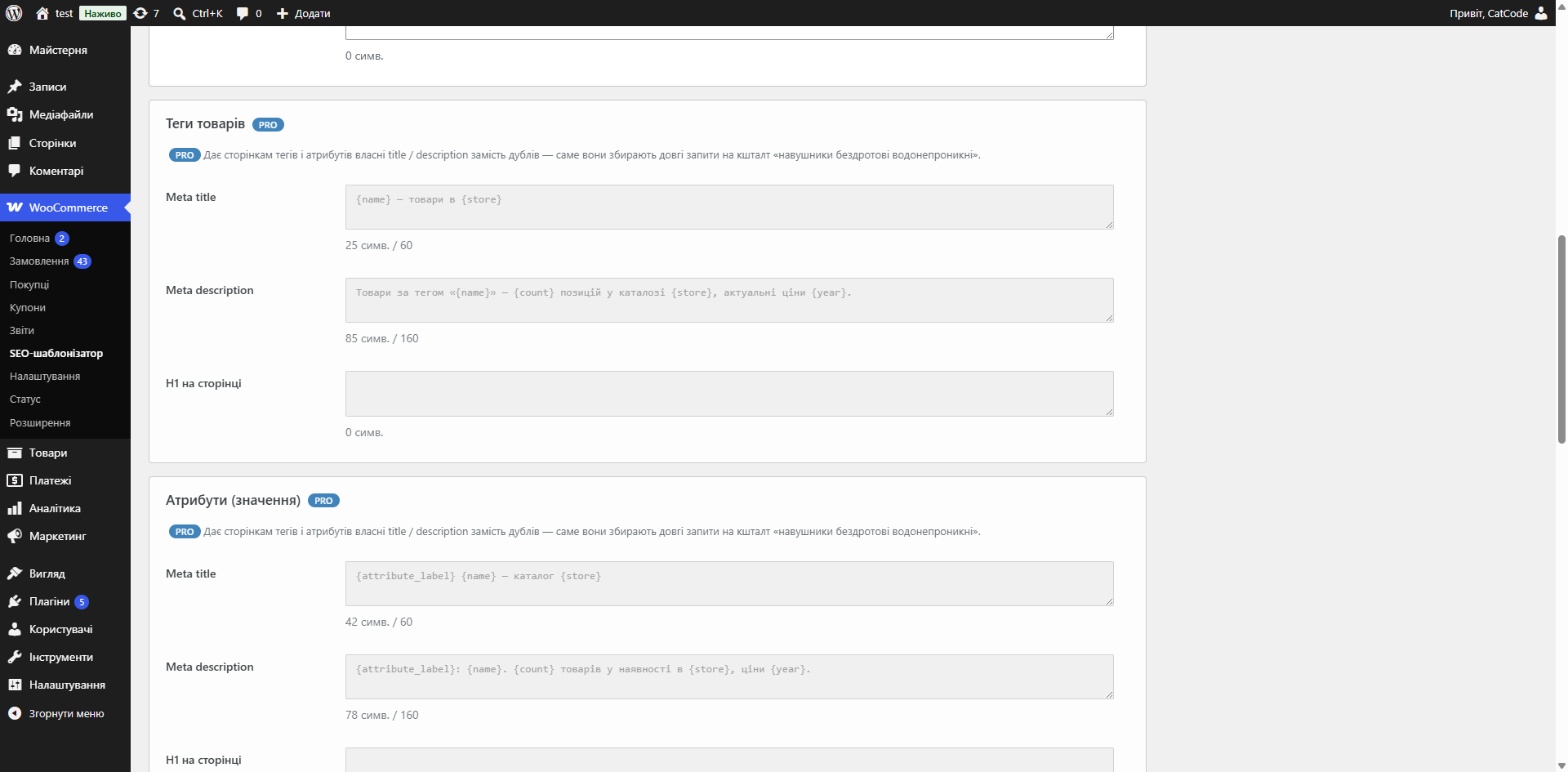
You can take seven days of Pro for free, but only on your own click: “Licence” tab → “Try Pro for 7 days” → e-mail. The licence server issues a genuine 7-day key, sends it to you by e-mail and switches Pro on right away. No card is needed, nothing is charged, there’s no auto-renewal. Once the trial ends, the free tier keeps working with no time limit, and meta tags already generated stay in place.
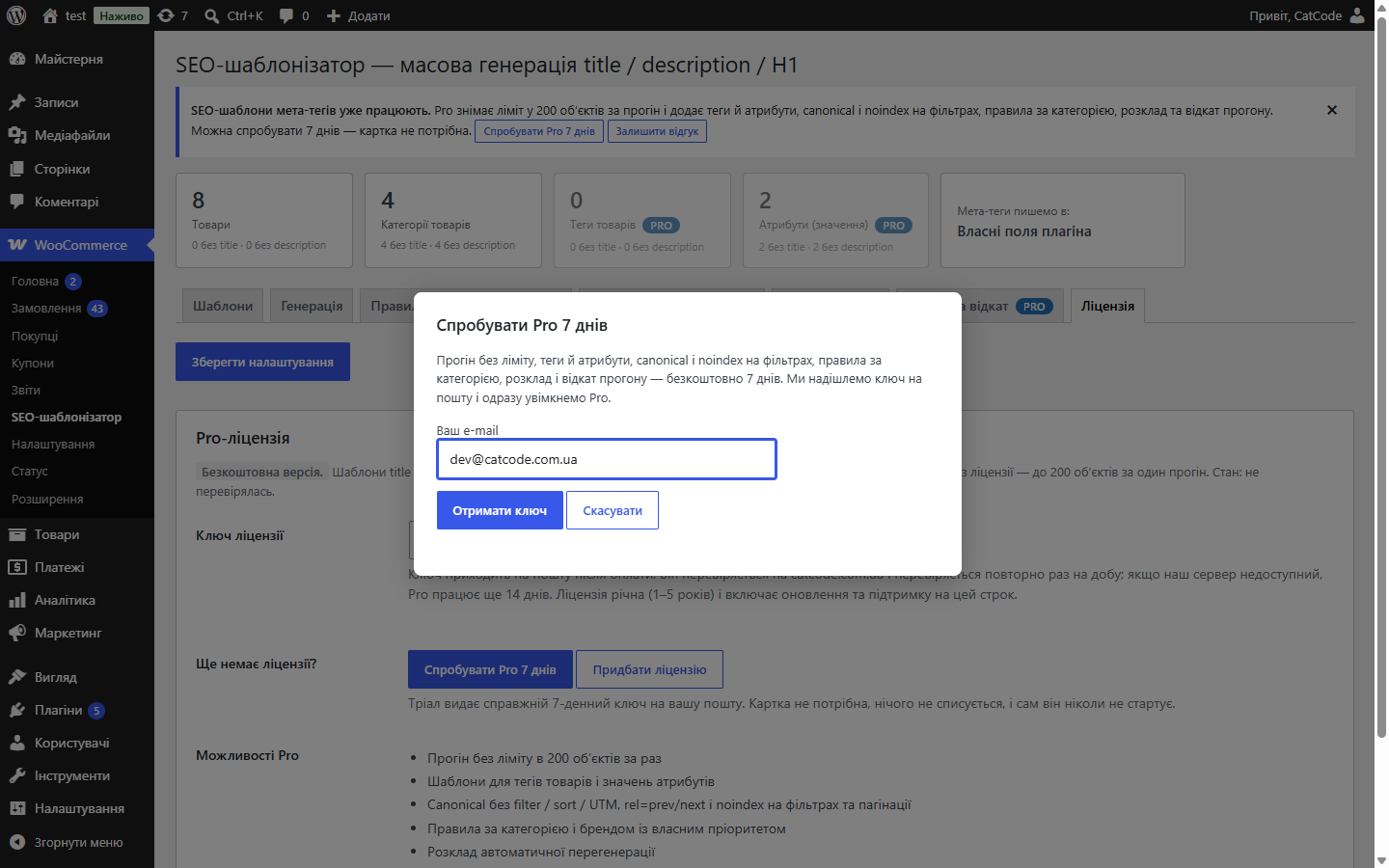
A purchased key is entered on the same tab and is verified at catcode.com.ua — on saving, and then once a day after that. If our server is temporarily unreachable, Pro keeps working for another 14 days. The “Release licence” button detaches the key from this store so you can move it to another one. The licence runs for a year (1–5 years) and includes updates and support for that period.
Canonical and technical SEO (Pro)
rel=canonical stripped of filter_*, orderby, min_price, max_price and UTM tags; self-canonical or canonical to the first page; rel=prev/rel=next; noindex for filters, sorting, pagination and search. Plus rules by category or brand with priority, an auto-regeneration schedule, and a one-click rollback of the last run.
Why a store needs this
Nobody writes meta tags by hand for a thousand products. So most stores either leave the title empty (and Google pulls something from the page as best it can) or use the same one across the whole catalogue — which means duplicates, and search engines cut visibility for those.
A template solves this once: you describe the rule, and every product gets its own unique title and description, assembled from its own data.
How it works, step by step
1. You write a template out of variables: product name, category, brand, price, store name.
2. Choose what to apply it to — the whole catalogue, a category, or a selection.
3. Look at the preview on real products: exactly what will come out before anything is written.
4. Run the write. Meta tags land in your SEO plugin’s fields, not in a parallel store.
Preview first, then write — and why it matters
A mistake in a template applied to a thousand products means a thousand identical or truncated titles. Fixing it takes another run, and by then Google has already recrawled the catalogue.
That’s why writing here is always two steps: first you see the result on a sample, and only then do you give the command to write.
Pricing
A Pro licence is 890 UAH, per site. The licence runs for a year: once it ends, meta tags already written don’t disappear, only updates and support stop.
Technical requirements
WordPress 6.2 or newer, WooCommerce, PHP 7.4 or newer. Works alongside Yoast, Rank Math or AIOSEO — the plugin writes into their fields rather than competing with them for output.
Under the hood
Meta tags are written into the same meta fields your SEO plugin reads. So the result shows up both in its interface and in its page analysis — and if you ever remove the templater, the tags stay in place.
The run goes in batches rather than one request, so a large catalogue doesn’t time out the site.
How to install
1. Upload the archive via “Plugins → Add New → Upload Plugin” and activate it.
2. Write a title and description template.
3. Check the preview on a dozen products.
4. Run the write and check a few cards in your SEO plugin.
Version history
1.1.0 — title and description templates built from product variables, applied to the catalogue or a selection, preview before writing, writes into Yoast / Rank Math / AIOSEO fields, canonical and technical SEO in Pro, batched run for large catalogues.
Frequently asked questions
Will the plugin overwrite meta tags I wrote by hand?
No, not unless you switch the mode to "overwrite everything" yourself. By default only empty fields are filled.
What if I don't like the result?
The "History and rollback" tab has "Roll back last run". Previous values are kept for every run (Pro).
Will it handle a catalogue of 20,000 products?
Yes. Generation runs in AJAX batches with a progress bar rather than one long request, so max_execution_time doesn't matter.
Where exactly are the meta tags stored?
If Yoast SEO or Rank Math is active — in their fields, so all your usual tools keep working. Without an SEO plugin, the plugin keeps its own fields and outputs the title and description itself.
Why is H1 stored separately?
SEO plugins have no field for H1, and rewriting the product name for the sake of a heading would break the catalogue, cart and e-mails. So H1 lives in its own field and is only inserted into the page heading.
Questions about the module?
Message us on Telegram — we reply within the working day. We will help with setup, compatibility and key activation.
No reviews yet. Be the first — right below.
Leave a review
Reviews are moderated before publication, which usually takes up to 24 hours.
No questions yet. Ask one — we answer within 24 hours.
Ask a question
We usually reply within 24 hours during working hours.
Buying the module
—