3DPlast — an online store for a Ukrainian manufacturer of 3D-printing filament
OpenCart-магазин виробника пластикових монониток для 3D-принтерів (ABS / PETG / PLA / Нейлон) з мульти-мовою UK/RU/EN, dual B2C+B2B-pricing, кешбек-програмою 2% від суми чека, програмою повернення котушок як знижки на наступне замовлення, і позиціюванням найбільшого спонсора ЗСУ. Виробництво у Вишгороді, Київська обл.
3DPlast is Ukraine’s largest manufacturer of plastic filament for 3D printers (PLA, ABS, PETG/CoPET, Nylon) in 1.75 and 2.85 mm diameters and 0.75 / 0.85 / 2.5 / 3.0 kg spool weights. Production is based in Vyshhorod, Kyiv region, at 7/1 Naberezhna St. The stack is OpenCart with a custom theme, catalog/view/theme/3dplast, jQuery 3.7 + Bootstrap + Slick + Swiper, UK/RU/EN multilingual support, dual B2C+B2B pricing (every product card carries a “wholesale and retail” pill), a cumulative 2% cashback programme with a 120-day bonus expiry, and a category-unique spool return programme offering a discount on the next order (15–30 UAH per empty spool). The site simultaneously carries a product catalogue, an engineering reference blog (filament specs and temperature guides), and a “largest supporter of the Armed Forces of Ukraine” positioning marker — in three USP cards, in the About section, and in a dedicated menu item, “3Dplast helps”.
A hero slider with branded promos instead of a stock “Welcome” banner
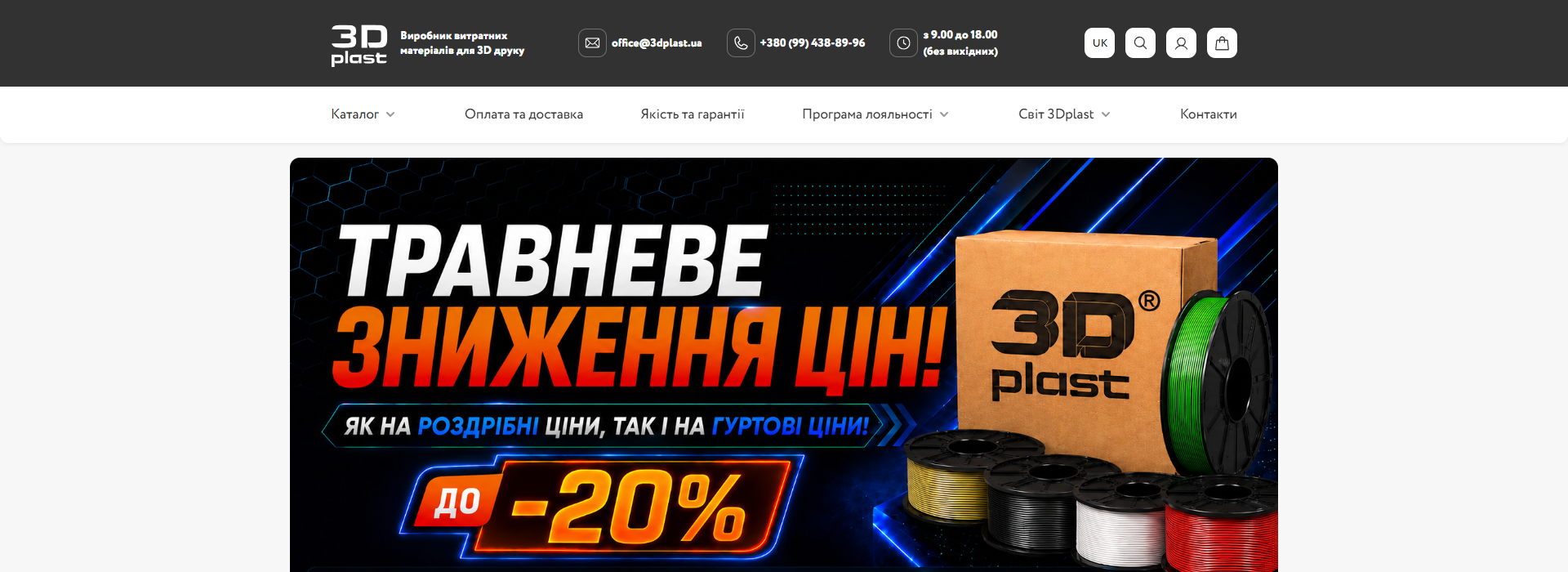
The first screen is a slick carousel with 2 promo slides, each a full, high-fidelity render with its own compositional language, not a cosmetic variation on one template. Slide 1 — “May price cuts! Up to -20% on both retail and wholesale prices” in a dark-tech style (blue geometric rays, a hexagonal grid, neon gradients), with a large branded kraft box of 3Dplast filament on the right, holding 6 spools in different colours (yellow, black, white, red plus two greens and a black one on the box). Below the banner is a ribbon of 6 trust badges (In stock / Consistent quality for professionals and hobbyists / Reliable packaging / Delivery across Ukraine or pickup / Customer support / A wide choice of PLA PETG colours). Slide 2 — “Promotional offers -15%” in a bright, kid-friendly style: ABC letters made of multi-coloured filament with a rainbow trail of 8 spools. This isn’t one promo style stretched over 2 slides — it’s two different brand vocabularies: a serious, technical B2B one and a fun, consumer-facing B2C one. One site serves both audiences, and the slider reflects that.
A catalogue of 4 filament types with 2-tier sub-categorisation by spool geometry
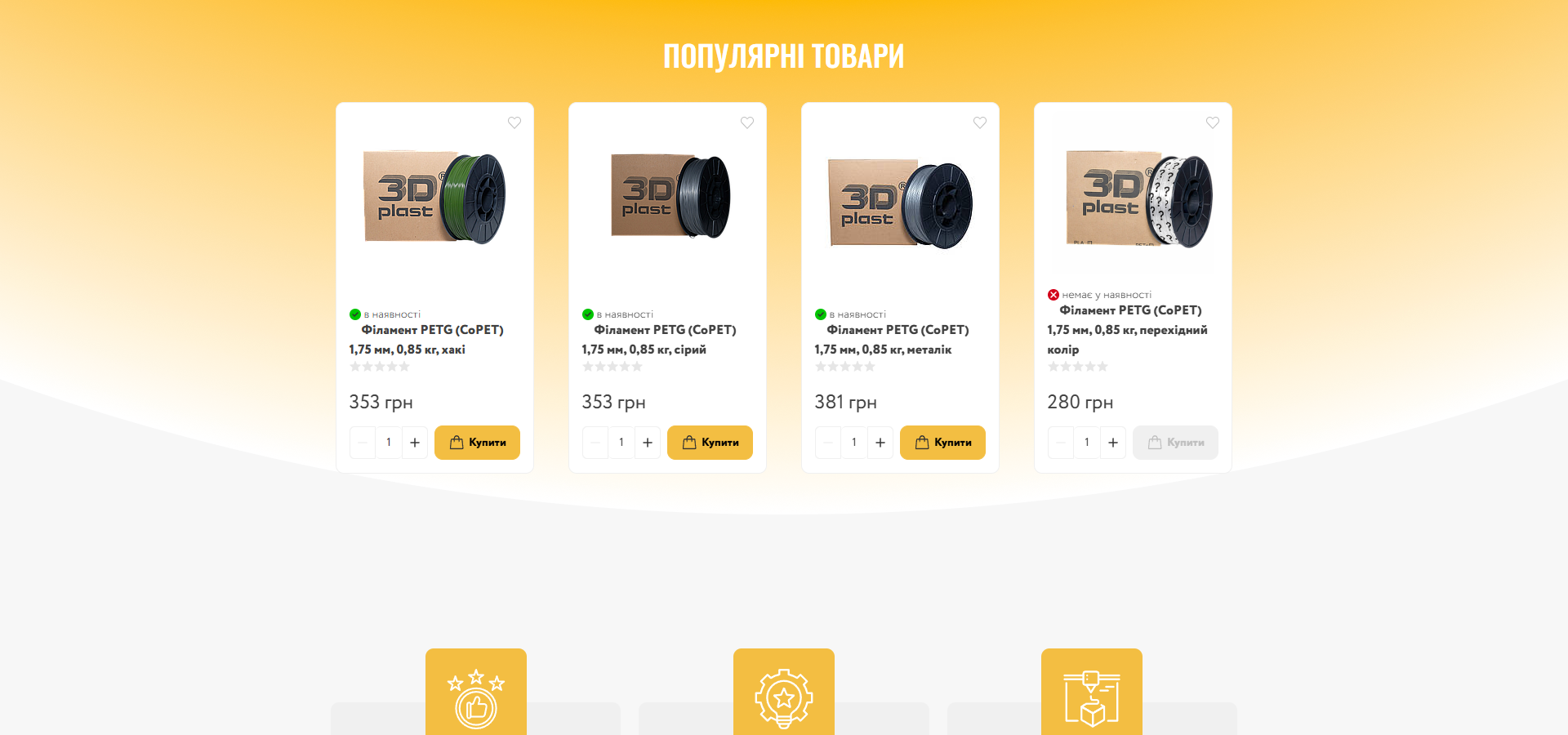
The catalogue holds 4 material types: ABS filament, PETG filament, PLA filament, and a separate Nylon line (currently shown only through blog articles, not yet as its own category). Each type branches out in a mega-menu into 2-tier sub-categories by physical spool geometry: filament diameter (1.75 mm / 2.85 mm) × weight (0.75 / 0.85 / 2.5 / 3.0 kg). For example: PETG 1.75 mm, 0.85 kg (29 SKUs), PETG 1.75mm 3.0kg (26), PETG 2.85 mm, 0.85 kg (0). The numbers next to each sub-category are the SKU count in that combination (shown BEFORE the click), immediately revealing which sizes are actively produced (29 SKUs for PETG 1.75/0.85 — the full colour range across 29 shades) and which are currently paused (2.85 mm has 0 SKUs in both weights). This is an honest catalogue signal: the catalogue isn’t “tidied up for appearances”, it shows the real assortment, including temporarily empty lines.
A product page with a dual-pricing “wholesale and retail” pill — one SKU, two audiences
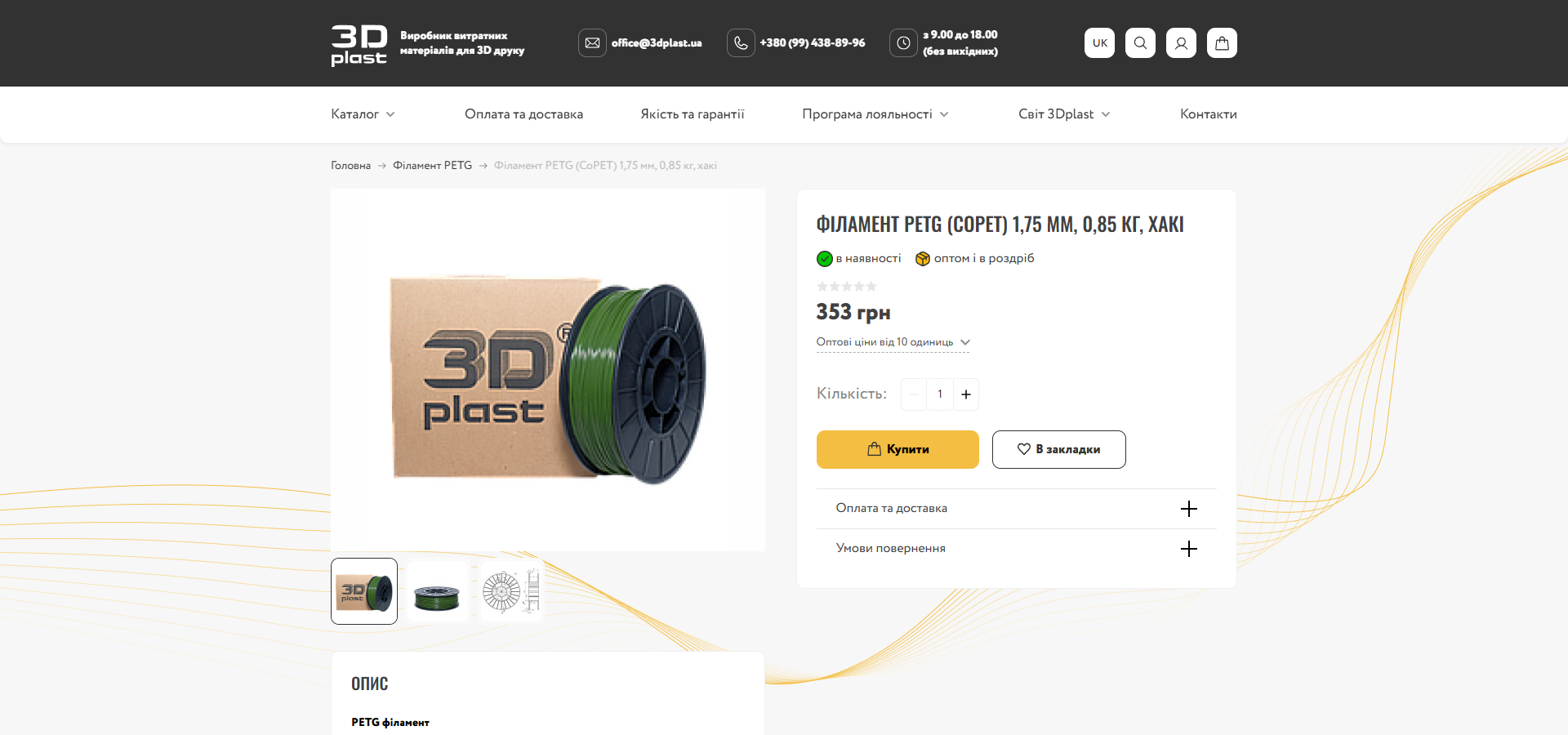
A single product page (for example, PETG (CoPET) Filament, 1.75 mm, 0.85 kg, khaki, 353 UAH) has one key engineering detail in the upper-right block next to the title — two pill badges: green “in stock” with a checkmark, and yellow “wholesale and retail” with a 3D-cube icon. This isn’t a cosmetic badge — it’s a guarantee that this specific SKU serves both a single-master purchase (one hobbyist buys 1 spool for 353 UAH via LiqPay) and a dealer bulk purchase (a 3D-print shop buys 50 spools via bank transfer). Below the price is a disclosure link, “Wholesale prices from 10 units”, with a chevron that expands the wholesale price list right on the product card (without going through “contact a manager”). A classic mistake of Ukrainian manufacturers is gating price access behind registration (“you have to be a registered dealer to see wholesale prices”) — here it’s the opposite: the prices are open, right on the page, for everyone.
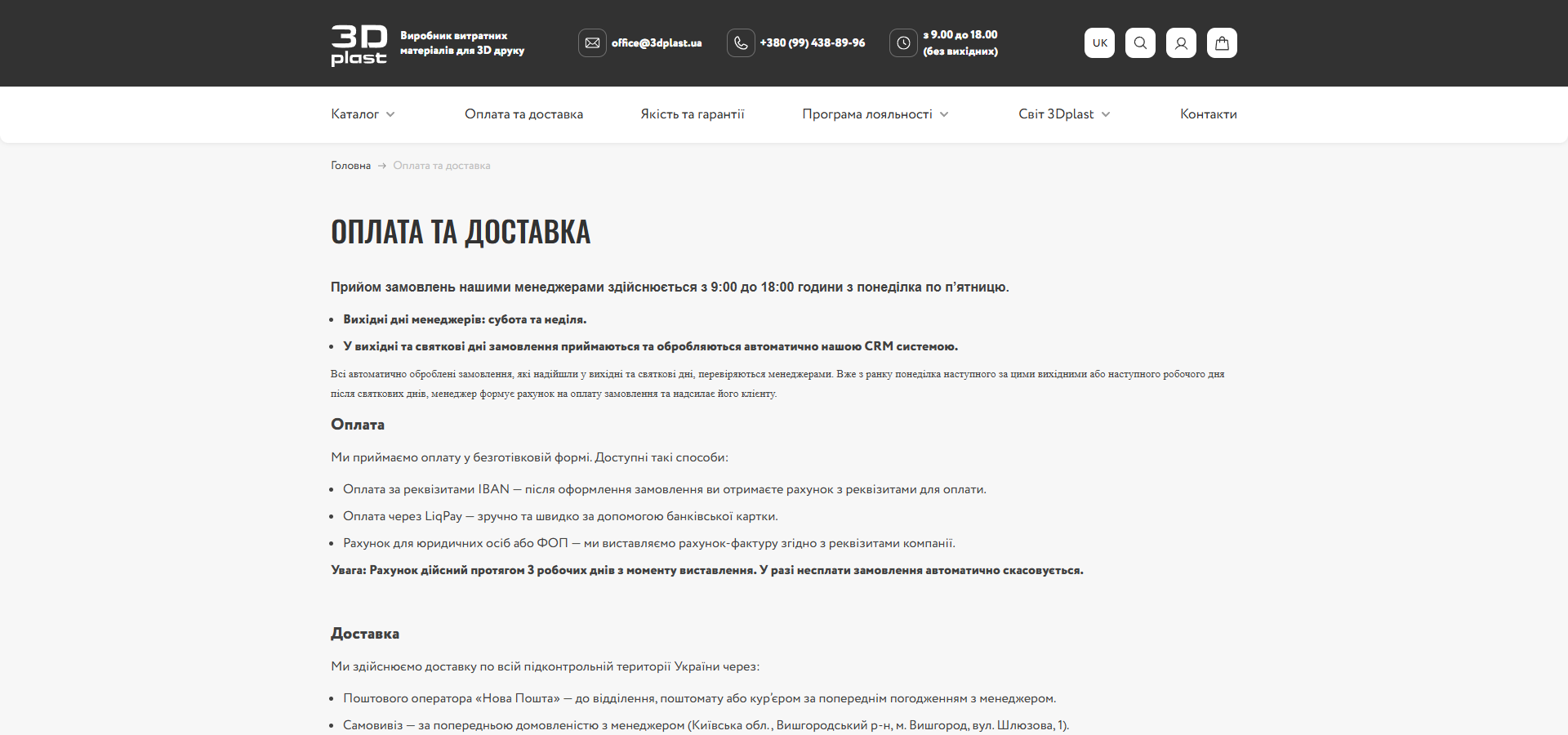
/delivery-payment and /return pages directly onto the product page, without leaving it. A hobbyist who sees the 353 UAH price and decides to buy gets, right there, “Nova Poshta delivery, LiqPay payment, 1–2 day delivery, same-day if ordered before 13:30” — without leaving the purchase flow to check the policies. This reduces friction by 1–2 steps, especially for a first-time buyer who doesn’t yet know the company’s policies.Engineering-rich product descriptions — a temperature profile + 5+3+5 pros/cons/uses
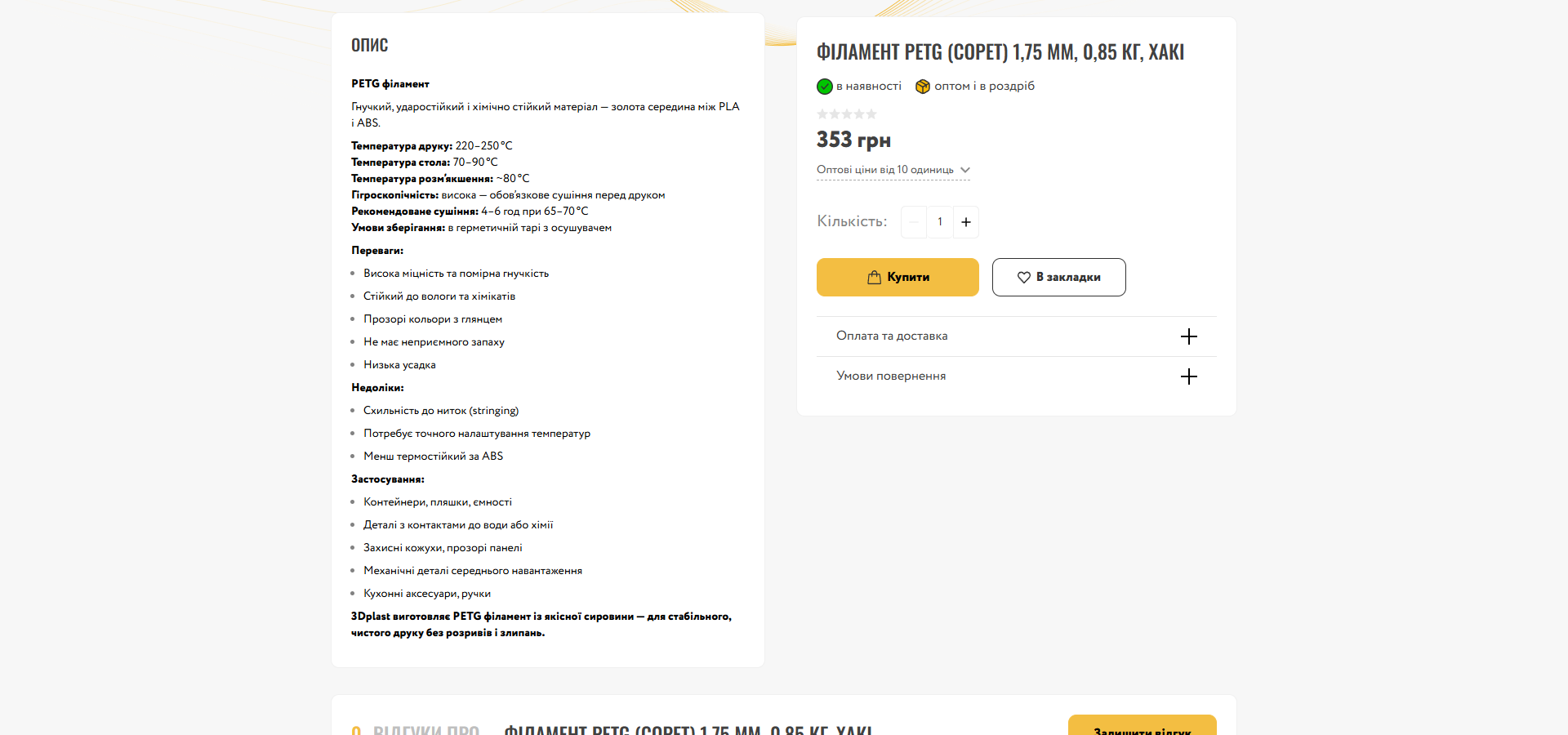
The description on a specific PETG SKU isn’t marketing copy urging “buy the best” — it’s a full engineering data sheet in 6 sections: a short tagline (“Flexible, impact-resistant and chemically resistant — the sweet spot between PLA and ABS”), a temperature profile with 6 parameters (printing 220–250°C, bed 70–90°C, softening ~80°C, hygroscopicity “high — drying required before printing”, recommended drying 4–6 hours at 65–70°C, storage “in an airtight container with a desiccant”), a list of 5 advantages (high strength + moderate flexibility, resistance to moisture/chemicals, glossy transparent colours, no unpleasant odour, low shrinkage), 3 drawbacks (a tendency to string, requires precise temperature tuning, less heat-resistant than ABS), and 5 use cases (containers/bottles, water/chemical-contact parts, protective housings/clear panels, medium-load mechanical parts, kitchen accessories/handles). The description closes with a manufacturer’s claim: “3Dplast makes PETG filament from high-quality raw material — for a stable, clean print without breaks or clogging.”
Checkout with no separate /cart/ page — a 3-step accordion with OTP login and Nova Poshta by default
There’s no classic OpenCart /cart/ page with a table of items — the URL ?route=checkout/cart redirects instantly to /checkout/, where EVERYTHING — reviewing the cart, choosing delivery, choosing payment — sits in one 3-step accordion page. On the right — a sticky “Order information” block with the items (thumbnail + name + qty with ±buttons + line price + a trash icon to remove), a “Enter a coupon code” field with a separate “Apply” button, a “Subtotal” line, a target indicator, “Points to be earned: +22” (a live cashback callout reading the 2%-of-total formula and showing expected bonus points BEFORE payment), a bold “Total due” line, and the final CTA, “Place order”. On the left — 3 steps: 1. Already registered? Log in, 2. Delivery address (with Nova Poshta already selected), 3. Payment methods.
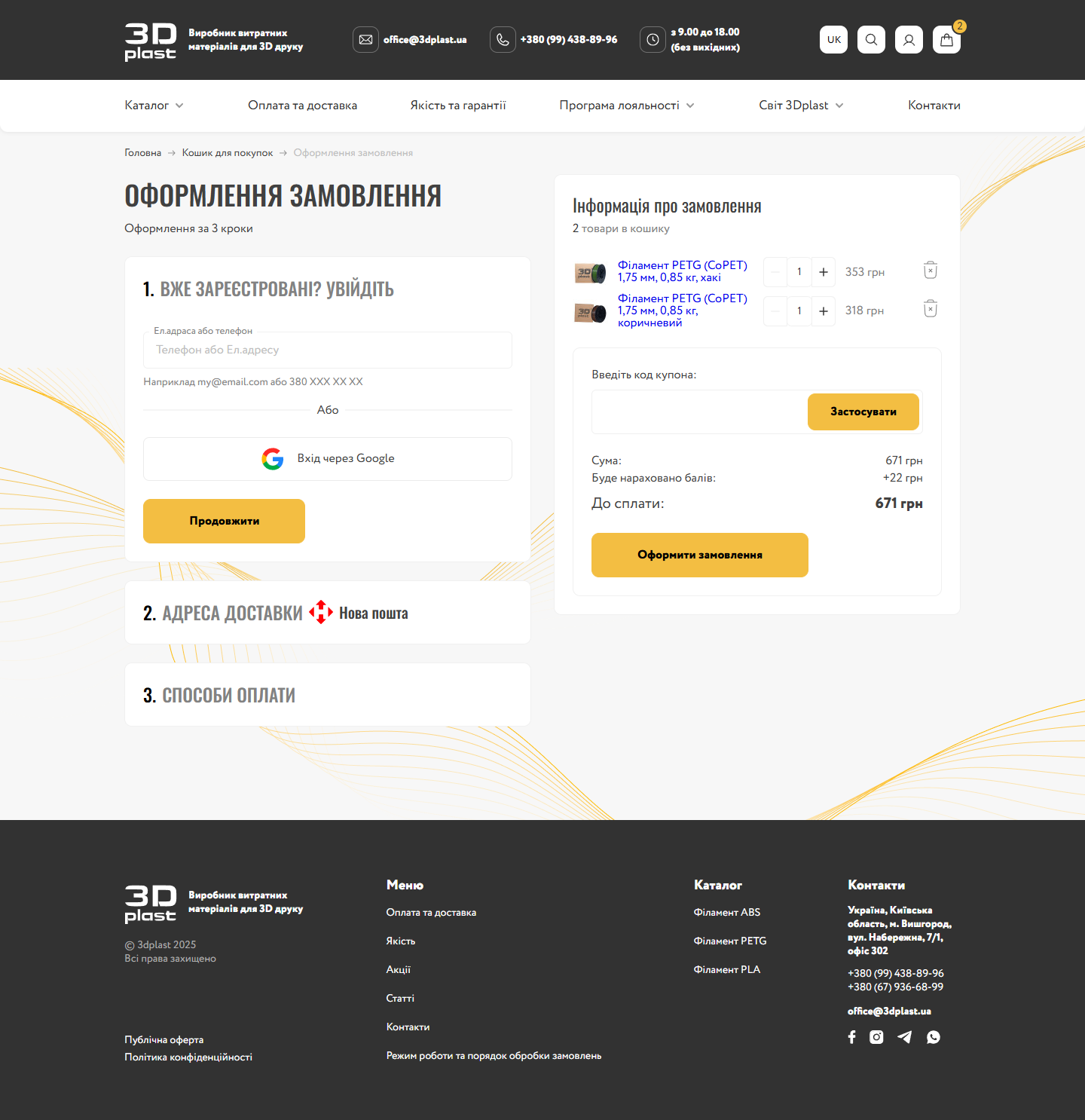
Step 1 isn’t the classic pair of “log in” + “register” — it’s a passwordless OTP flow: one field, “Email or phone” (accepting either format, with the hint “e.g. my@email.com or 380 XXX XX XX”), a “Sign in with Google” button as an alternative, and a “Continue” CTA. On “Continue”, the system checks whether that contact already exists — if it does, it sends a 6-digit code to the email/SMS and reveals a new field, “Verification code XXXXXX”, with the hint “A login code has been sent to your email” and a “Log in” button. If the contact doesn’t exist, the same mechanism creates a new account. There’s no separate /account/register page with “password / confirm password” fields, and no /account/login with an “email + password” pair: authorisation is all folded into one inline checkout step, through OTP, with no password at all. This is a radical simplification, typical of the 2024–2025 e-commerce pattern: a password is unneeded friction — the user forgets it, confuses cases, resets it, gives up; a one-time code removes 100% of that frustration. Google Sign-In is added as a second option for anyone who doesn’t want to wait for an email.
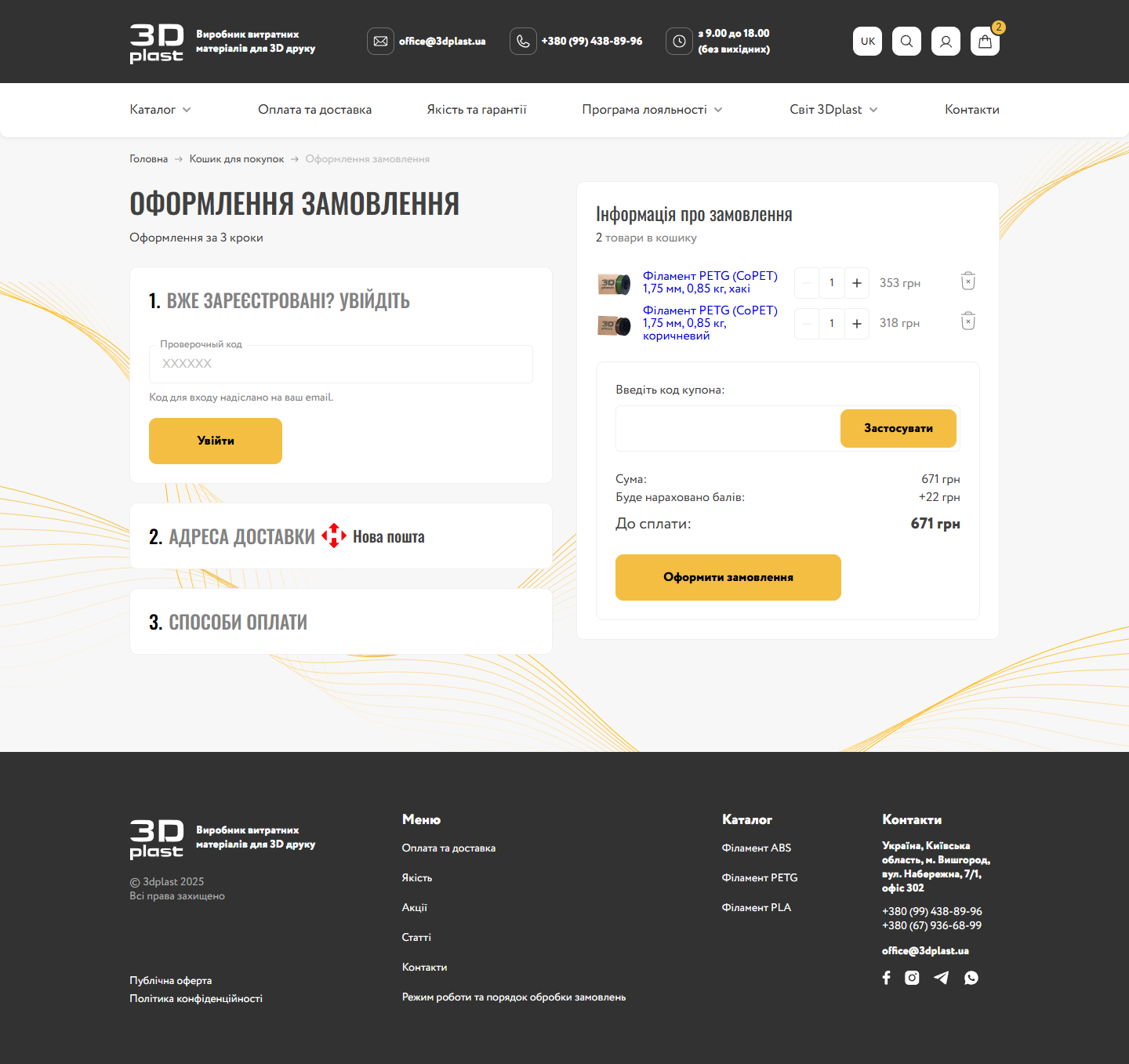
/account/login/sso with a full page reload — this inline state is preserved perfectly instead. Also notice that the cart sidebar with “Subtotal 671 / +22 points / Total due 671 / [Place order]” stays visible the whole time through login — conversion isn’t muted during the auth step, it stays hanging right in front of the user as an incentive to finish the order.3 USPs with the “largest supporter of the Armed Forces” phrasing as the third brand value
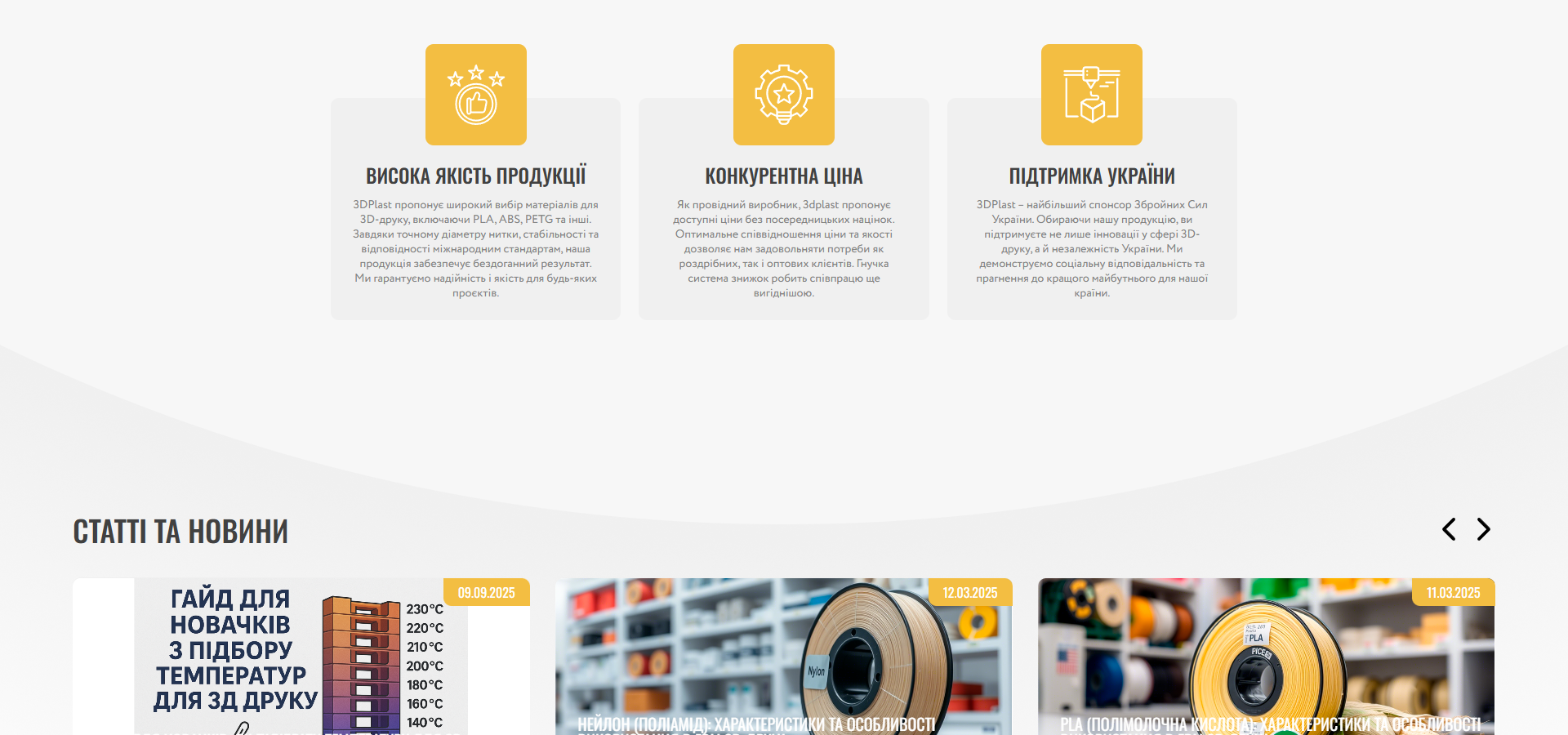
A section with three parallel USP cards: High product quality (compliance with international standards, precise filament diameter), Competitive price (“a leading manufacturer without middleman markups”, flexible discounts for retail and wholesale), and Support for Ukraine — “3DPlast — the largest supporter of the Armed Forces of Ukraine”. The third USP isn’t a cosmetic CSR paragraph, it’s a strong positional claim (“the LARGEST supporter”) that repeats in two other places on the site (in the About section and in a dedicated menu item, “3Dplast helps”). This isn’t a one-off homepage banner — it’s a through-line part of the brand narrative, woven into the navigation and structure.
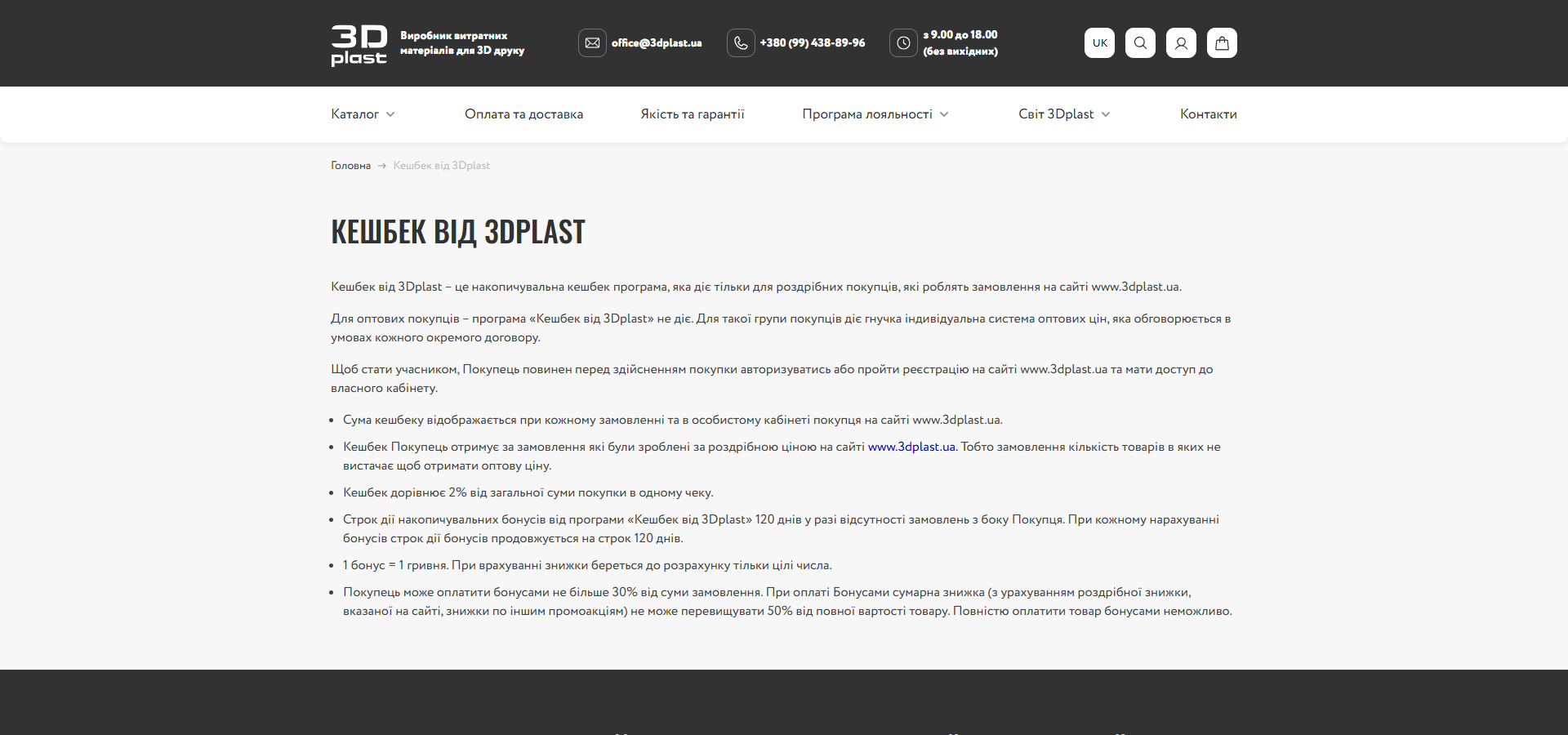
“Cashback from 3Dplast” — a 2% accumulator for retail only, capped at 30% of the payment made in bonuses
A dedicated /cashback page lays out the full rule set of the cumulative cashback programme, aimed EXCLUSIVELY at retail buyers. 6 explicit rules: (1) only signed-in site customers qualify — no bot cashback, (2) wholesale buyers aren’t part of the programme — they get their own “flexible, individually negotiated wholesale pricing system” under contract, (3) 2% of the order total is credited only for retail orders (those not reaching the 10+ unit wholesale threshold), (4) a 120-day bonus expiry in case of inactivity, extended by another 120 days with each subsequent accrual (continuous loyalty), (5) 1 bonus point = 1 hryvnia, whole numbers only, (6) the maximum share of an order payable with bonuses is 30%, and the total discount from all promos combined can’t exceed 50% — paying for an item entirely with bonuses isn’t possible.
“Spool return” — an eco-loyalty hybrid with circular packaging
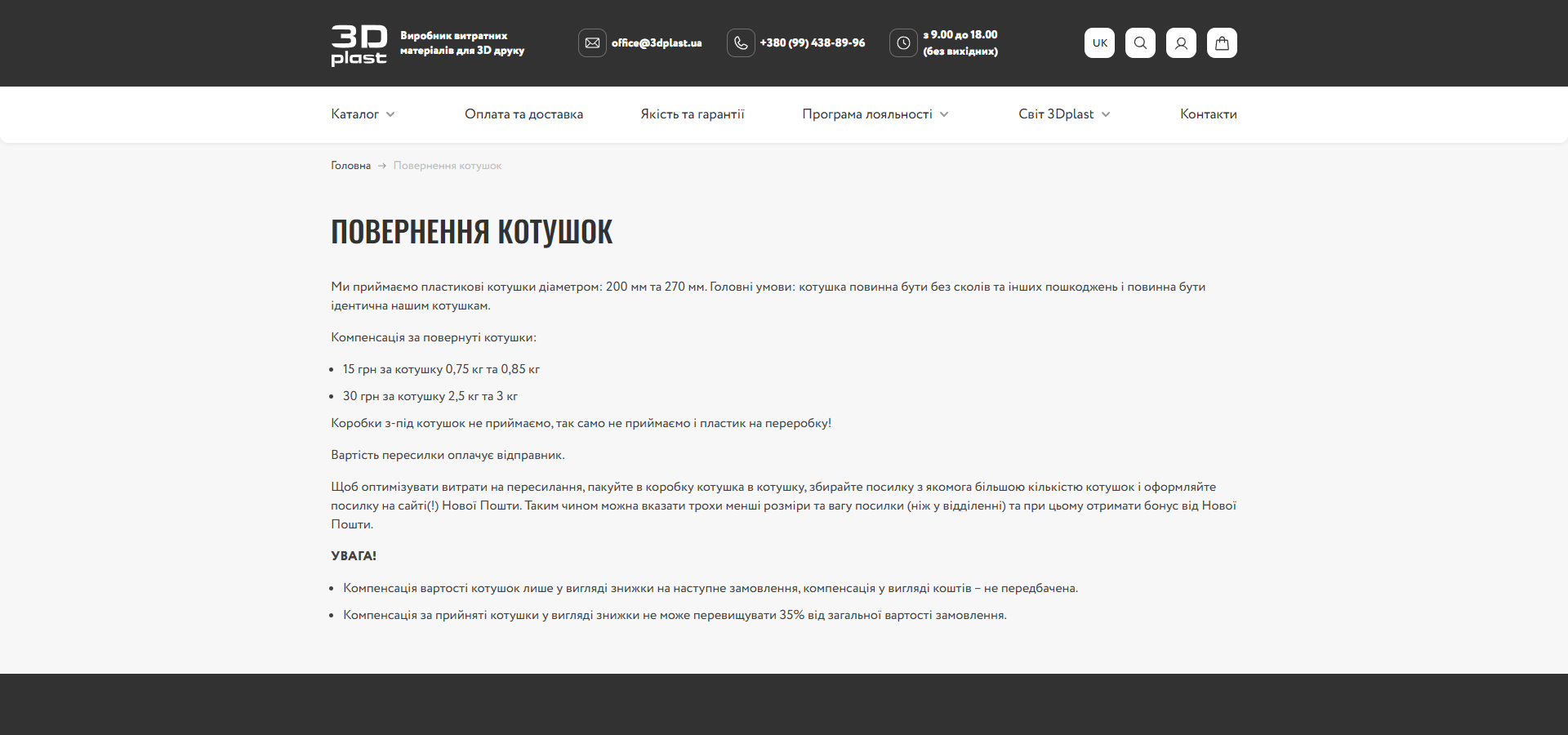
A feature unique to the Ukrainian 3D-printing category — a /return page with a programme for returning plastic spools in exchange for a discount on the next order. The rules: only spools 200 mm and 270 mm in diameter are accepted (the same ones 3Dplast filament ships on), undamaged, and identical to the branded ones. Compensation is 15 UAH per empty 0.75/0.85 kg spool or 30 UAH per 2.5/3.0 kg spool. So for a batch of 10 empty 0.85 kg spools → a 150 UAH discount on the next purchase. Important: compensation is discount-only, never cash, and can’t exceed 35% of the total order. The buyer pays for shipping the spools back via Nova Poshta. A separate tip in the text: “pack spool-inside-spool, book the shipment through the Nova Poshta website for a carrier bonus.”
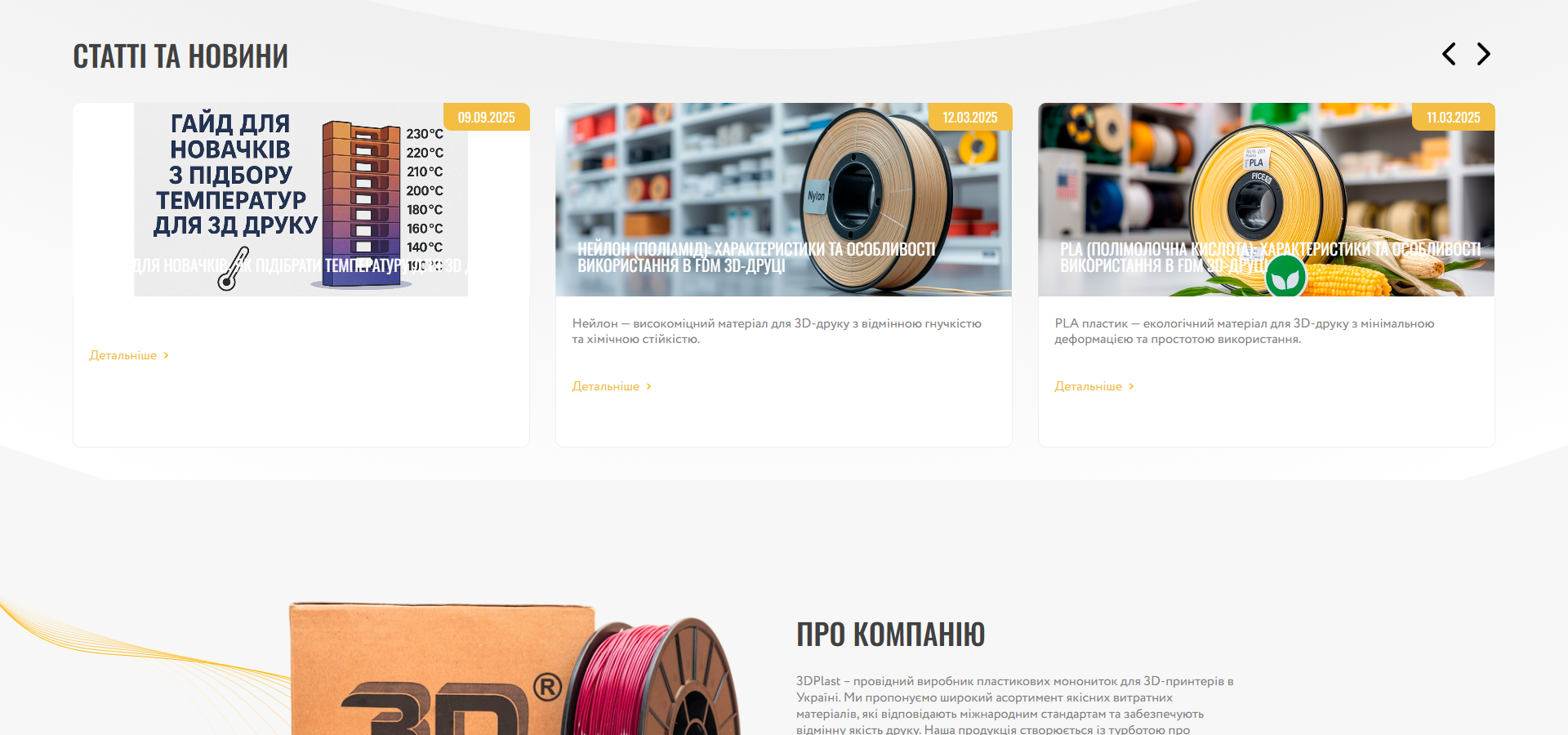
An inline blog stripe with 6 engineering guides on the homepage — content marketing as a long SEO game
On the homepage, a section, “Articles and news”, holds a horizontal slick slider with 7 unique articles: “How to store 3D filament correctly”, “A beginner’s guide: how to choose the right 3D-printing temperature”, “ABS: characteristics and use in FDM 3D printing”, “PETG: characteristics…”, “PLA (polylactic acid): characteristics…”, “Nylon (polyamide): characteristics…”. This isn’t “10 tips for business SEO” filler — it’s technical reference for each filament type from their own nomenclature. Timestamps: October 2024 (a storage guide), March 2025 (4 materials in a row), September 2025 (new — a temperature guide for beginners). The publishing cadence, one article every 2–3 months, is realistic for a manufacturing e-commerce business without content burnout. Each article addresses one of 5+1 typical hobbyist problems: storage / temperature / material choice.
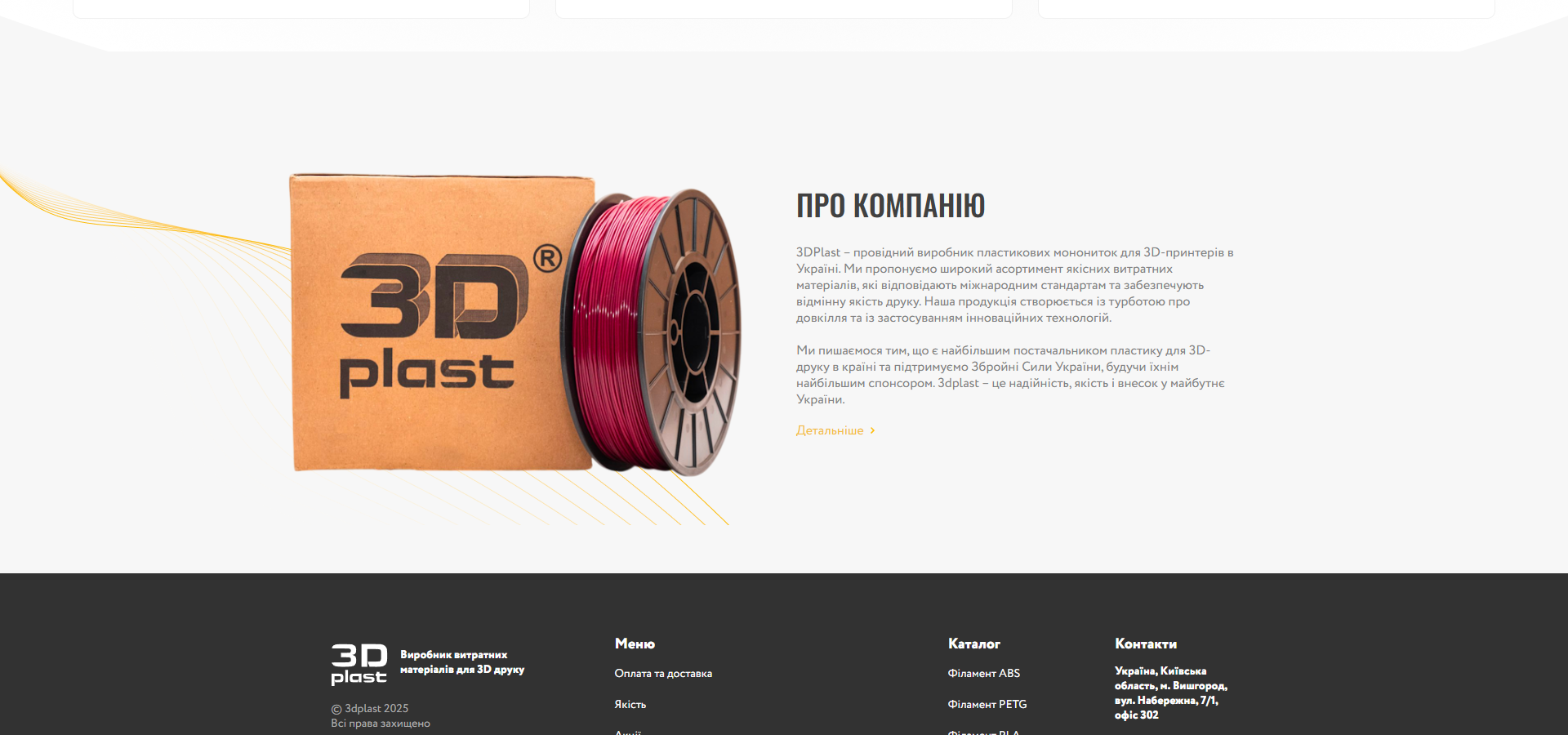
The About section with incidental brand photography — a spool not as a stock shot but a purpose-made shoot
The “About the company” section places, on the left, a photo of the branded 3Dplast kraft box with a red PLA spool (rendered on a light-grey background with characteristic yellow decorative strokes around it). On the right — a two-paragraph text block: 1) a provider claim, “a leading manufacturer of plastic filament for 3D printers in Ukraine, precise filament diameter, compliance with international standards, environmental responsibility”, 2) an Armed Forces claim, “the largest supplier of 3D-printing plastic + the largest supporter of the Armed Forces of Ukraine.” It ends with a “Learn more” button → /information_id=4 (the full “About us” page).
Mobile 390 — a burger nav, a fluid hero slider, a thumb-friendly CTA
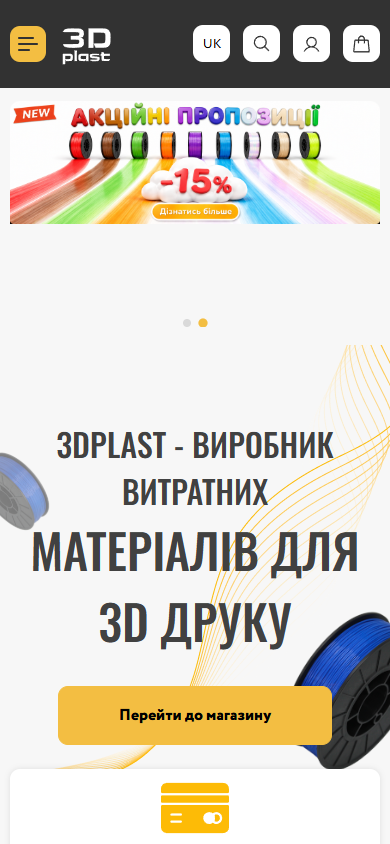
At a 390×844 viewport (iPhone 13), the layout rebuilds from the desktop’s full-width top bar (logo + contacts + phone + hours + 3 languages + 3 icons) into a compact burger bar: just a burger on the left (opening a full-screen overlay with categories), the brand logo centred, and a language switcher + search + account + cart icon (4 buttons) on the right. The hero carousel is fully responsive, with slide 2 shown as a full-width fitted mobile banner (-15% PROMOTIONAL OFFERS with 8 coloured spools). Below the carousel is a bold headline, “3DPLAST — MANUFACTURER OF 3D-PRINTING CONSUMABLES”, with a bright yellow full-width “Go to the store” CTA. A background blue spool decorative shot (from the same studio session as on desktop) partially overlaps the right edge of the content, adding visual depth without overwhelming it.
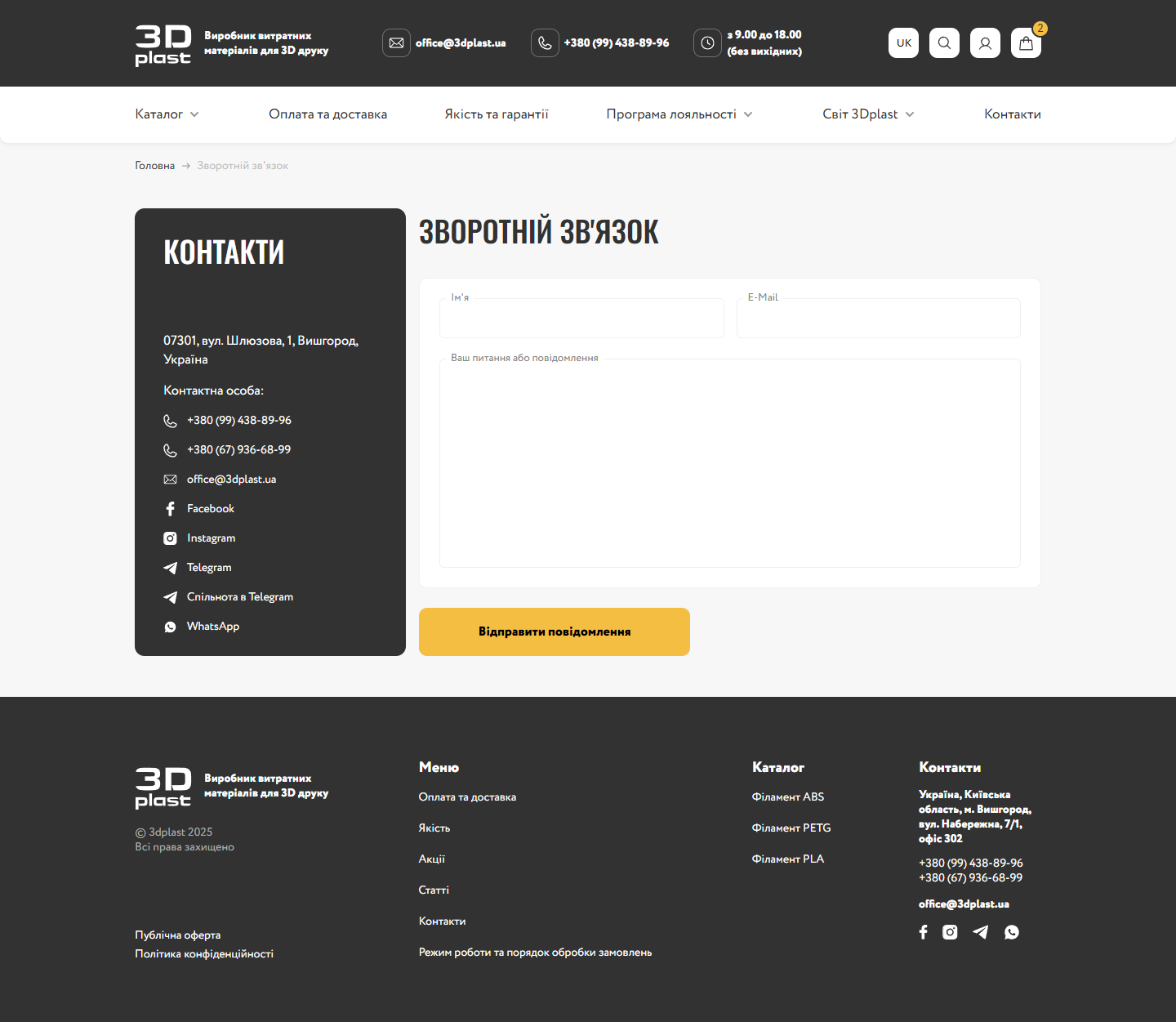
Contacts — a dark card with the production address, 5-channel contact, and an inline feedback form
The /contacts page has a two-column layout without a map embed: on the left, a dark card with white glyphs on the site’s yellow-cell background, on the right, a compact “Feedback” form with three fields. The left block holds a physical address, “07301, Shliuzova St, 1, Vyshhorod, Ukraine” (a production location with a 5-digit postal code, not an office), a placeholder for “Contact person” (empty — a hint of a B2B flow, “get in touch, we’ll assign a manager”), two phone links with phone icons (+380 99 and +380 67), an email link, office@3dplast.ua, and 5 social channels: Facebook, Instagram, a personal Telegram channel (@the3dplast), a separate “Telegram community” group link, and WhatsApp. The right-column form has three fields — Name / E-mail / Your question or message — plus a yellow “Send message” button; no visible captcha, no required phone number. This is deliberately low-friction: any question, even “my PLA keeps snapping, what do I do”, has a path to the office in 3 fields.
“3Dplast helps” — a positioned menu item with a work-in-progress stub page
One subtle nuance: the menu item “3Dplast World → 3Dplast helps” leads to /3dplast-help, whose content currently consists of the title “3Dplast helps” and a single word, “test”. This isn’t a bug — it’s a signal of a public roadmap: the company has already reserved the URL, the menu item, and the “largest supporter of the Armed Forces” positioning at three other points on the site (the USP section, the About section, the footer), but kept its technical honesty — until a content page with concrete figures (“what’s been done for the Armed Forces, who received it, how many tonnes of filament”) is assembled, an honest placeholder sits on the page. The alternative — either hide the menu item until it’s ready, or fill the page with marketing text, “we help”, with no substance — and both options are worse than the current “we’re preparing the content, the space is reserved”.
Summary
3DPlast is a Ukrainian e-commerce flagship in the 3D-printing filament category, built on an OpenCart stack with a full service wrap: 4 material types × 2 diameters × 4 weights in a catalogue with real per-sub-category SKU counts, dual B2C+B2B pricing with a transparent, disclosed wholesale grid right on the product card, engineering-rich descriptions with a temperature profile and honest drawbacks instead of marketing gloss, a cumulative 2% cashback programme with a 120-day continuous-loyalty expiry and a 30% cap on paying with bonuses, a category-unique spool return programme as circular packaging logistics with 15–30 UAH compensation (sometimes more than the cost of making a new one), an inline blog reference of 6 engineering guides on materials and temperature calibration, and a through-line Armed Forces positioning at three points on the site plus an honest work-in-progress placeholder page, “3Dplast helps”. UK/RU/EN multilingual support, payment via LiqPay + IBAN + an invoice for sole proprietors, Nova Poshta delivery with a 13:30 same-day cut-off, jQuery 3.7 + Bootstrap + Slick + Swiper as the technical backbone. In the footer — the same branded kraft box with an ® symbol, returning to the same studio session that supplies about 80% of the site’s product imagery: one photo shoot, four points of reuse, zero stock photos. This is a site where a B2B hobbyist and a B2C amateur both earn the same trust through the same transparency.