CatCode SEO Pack — SEO Module for OpenCart 2.3, 3.x and 4.x
XML-карта, мікророзмітка, canonical, шаблони мета-тегів, редіректи з журналом 404, SEO-URL транслітом і аудит каталогу — в одному модулі.

What each licence includes
| Feature | Free | Pro |
|---|---|---|
| XML sitemap: index, chunks, images, hreflang | ✔ | ✔ |
| JSON-LD structured data: Product, Offer, Breadcrumbs, Organization, WebSite | ✔ | ✔ |
| Canonical without filter, sort, limit and UTM parameters | ✔ | ✔ |
| rel=prev / rel=next and noindex for filter pages | ✔ | ✔ |
| Meta tag templates with placeholders for every page type | ✔ | ✔ |
| Bulk generation: up to 200 rows per run for free, unlimited in Pro | ✔ | ✔ |
| Rules by category, manufacturer and language with priority | — | ✔ |
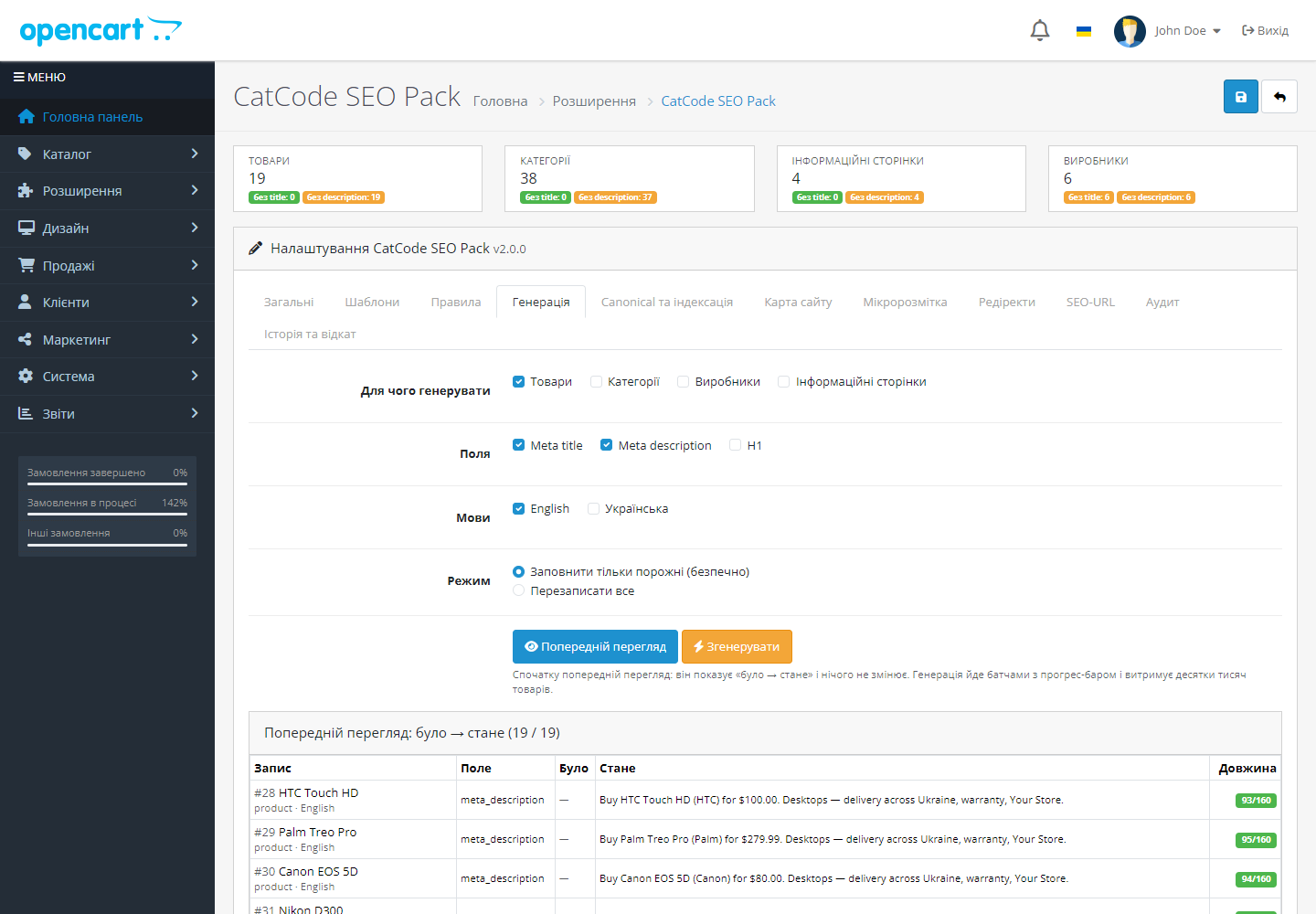
| "Before → after" preview and one-click rollback | — | ✔ |
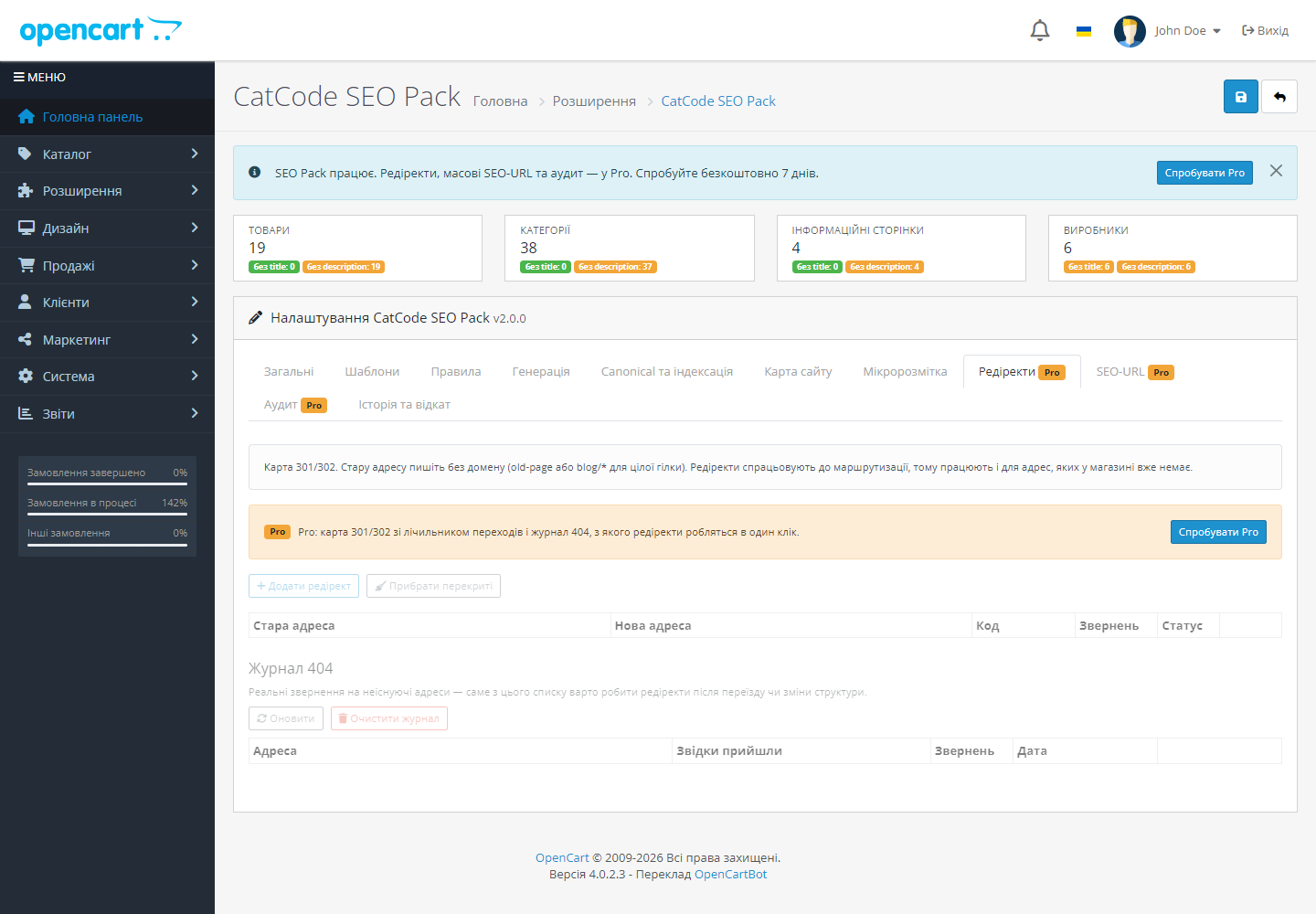
| 301/302 redirects with wildcards and a 404 log | — | ✔ |
| Bulk SEO-URL generation by transliteration (KMU 55/2010) | — | ✔ |
| Audit: duplicate meta, empty and overly long descriptions, products with no clean URL | — | ✔ |
CatCode SEO Pack for OpenCart 3.x and 4.x — all of a shop’s SEO in one module: an XML sitemap, structured data for Google, a canonical on filters, meta tag templates, redirects with a 404 log, bulk SEO-URL generation by transliteration, and a catalogue audit.
Free and Pro
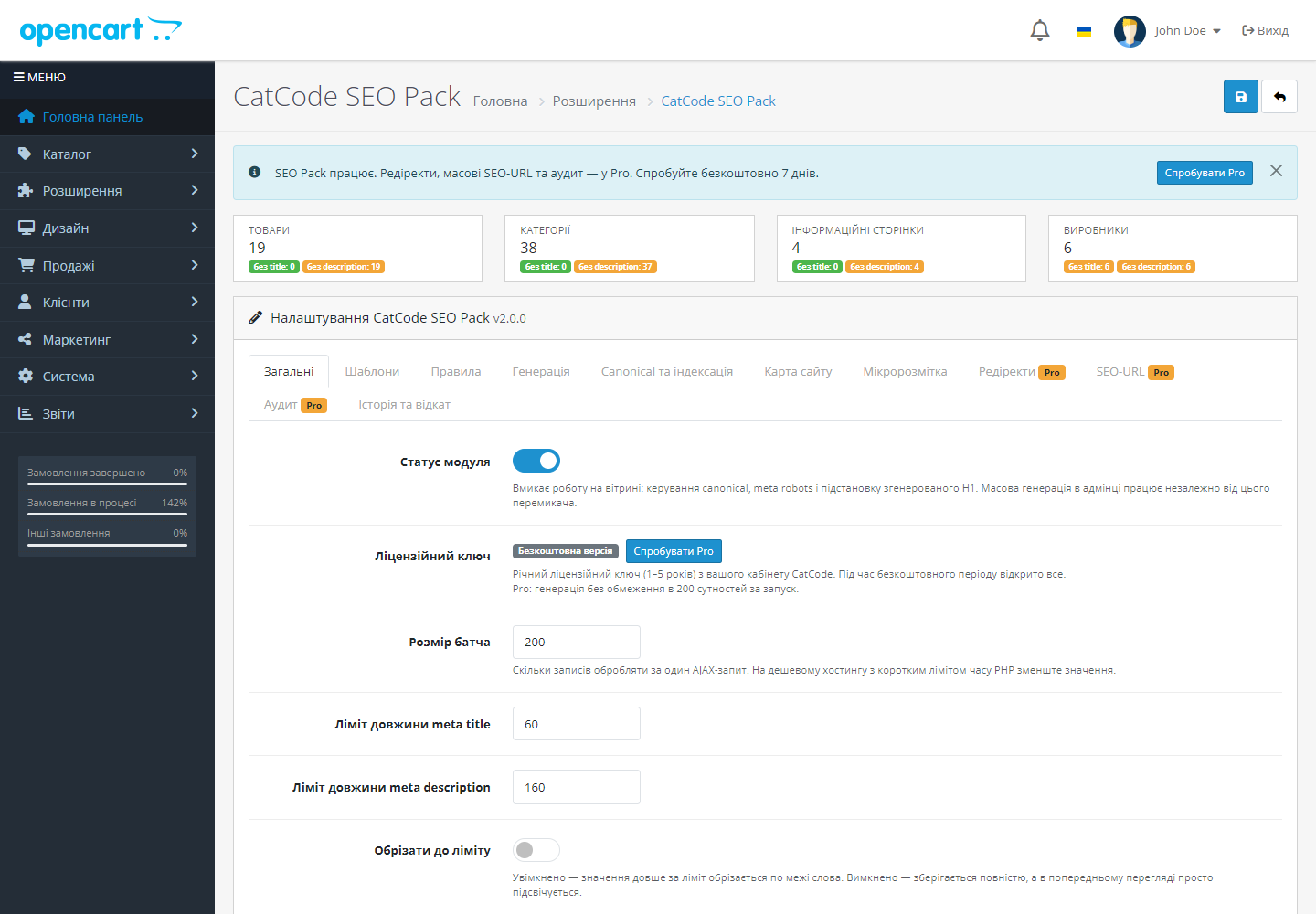
The basic part works with no key and is self-sufficient: an XML sitemap, JSON-LD structured data, canonical and robots, meta tag templates with a limit of 200 rows per run. Pro removes the limit and adds rules by category and manufacturer, a preview with rollback, redirects, SEO-URL generation and an audit. The licence is perpetual: you pay once, with no annual fees.
XML sitemap
An index plus separate files by type, with product images, and on OpenCart 4, hreflang alternates for multilingual shops as well. Rows are read page by page, and the XML is streamed out, so a catalogue of 100,000 items doesn’t assemble a 30-megabyte string in memory. Only what the shopper can see goes into the map: enabled items in the current shop, once their availability date has arrived.
Structured data for Google
JSON-LD with Product and Offer — name, SKU, brand, image, and exactly the price the shopper sees: with any promotion applied, in the storefront currency, with stock availability. AggregateRating is only added when there are approved reviews: a made-up rating is the fastest way to lose a rich snippet. Plus BreadcrumbList, Organization with social profiles, and WebSite with a search box on the homepage.
Redirects and the 404 log
Every address that isn’t found lands in the log along with the referrer and a hit counter — rules are written from facts, not guesswork. A log row turns into a redirect with one click, and wildcard masks for a whole branch (blog/*) are supported. The response is returned before the shop even starts building a page, so the rule also works for addresses that no longer exist in the catalogue.
SEO URLs by transliteration
Bulk generation of clean URLs using the Ukrainian KMU 55/2010 transliteration standard, separately for each language: the Ukrainian page gets a Ukrainian link, the English one an English link. On OpenCart 4, the run also creates the missing route rows for languages that lack them — those missing rows are usually exactly why a clean URL on a second language silently returns the home page.
Catalogue audit
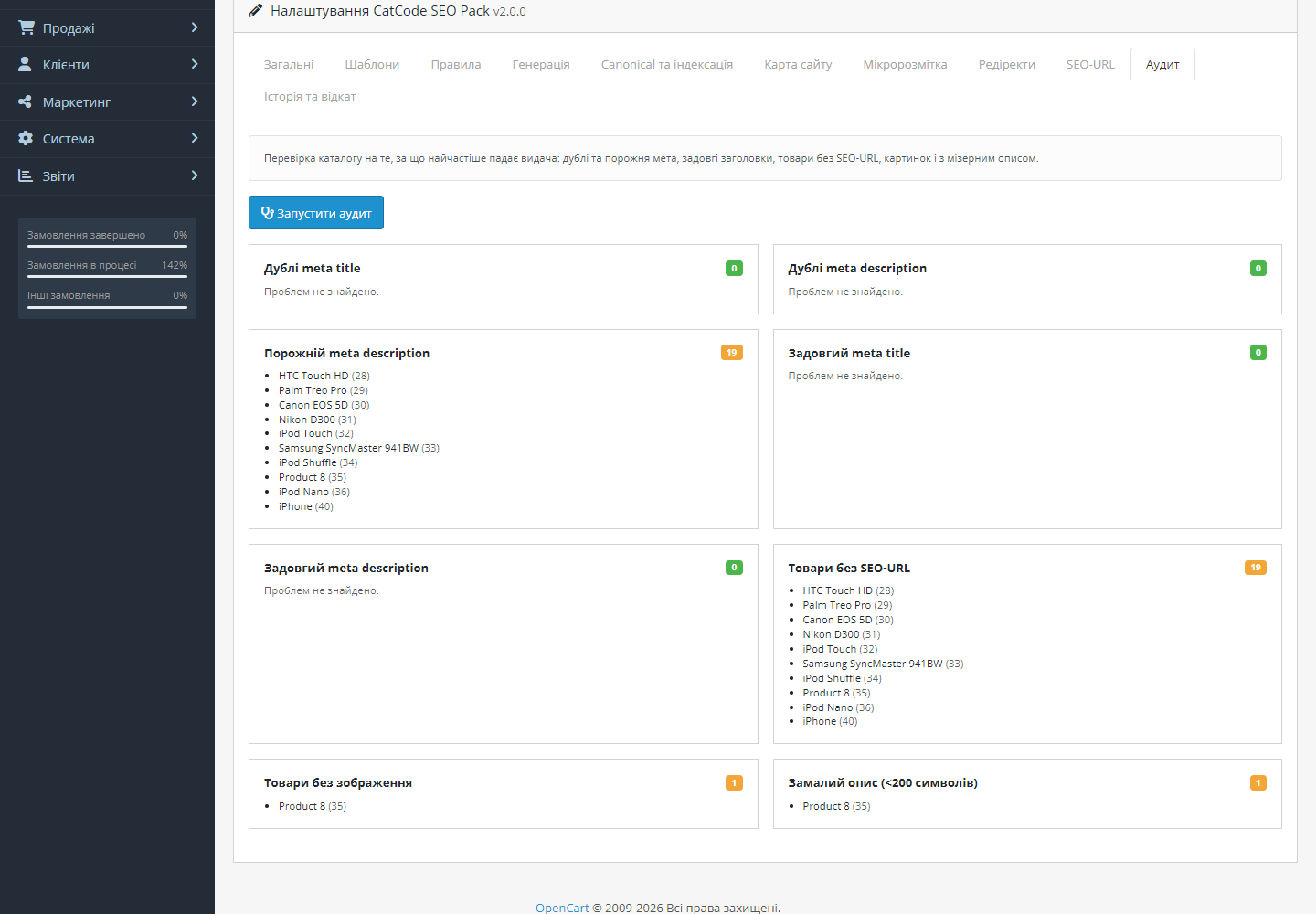
Duplicate titles and descriptions, empty and overly long descriptions, products with no clean URL, no image, or a too-short description — each issue comes with a count and the first ten pages that need fixing.
Two builds: OpenCart 3 and OpenCart 4
Each OpenCart version gets its own build, not a “compatible” compromise. The functionality is the same; the difference is only where the platform differs: in OpenCart 3 the language is stored in the session, not the address, so the sitemap is single-language with no hreflang, and the clean URL keyword must be unique within the shop rather than the language. Redirects in OpenCart 3 are wired through the router event, because its pre-actions provide no events at all.
Meta tag templates
Meta tags are described with a formula using placeholders — product name, category, manufacturer, model, SKU, price, an attribute or option value, shop name, year, page number. Rules can be narrowed by category, manufacturer and language with a managed priority. Generation runs in batches with a progress bar, every run is stored in history, and any run rolls back with one click.
Why a shop needs this
SEO for OpenCart is usually pieced together from four or five separate modules: a sitemap from one author, structured data from another, redirects from a third. They fight over the same spots in the template, and half of it breaks after a shop update.
Here it’s all gathered into one module with a single settings screen — and, crucially, a single point of responsibility for compatibility.
How it works, step by step
1. You turn on the blocks you need: sitemap, structured data, redirects, meta tag templates, URL transliteration.
2. You set title and description templates from product variables — for the whole catalogue at once.
3. You run a catalogue audit: the module shows where meta tags are empty, duplicated, or links are broken.
4. You fix what was found, and keep an eye on the 404 log afterwards to set redirects for real traffic losses.
Price
The licence costs 1,290 UAH, for one domain. The licence is perpetual: you pay once, with no annual fees.
Under the hood
The module doesn’t patch the core — everything runs through OpenCart’s standard events, so a shop update doesn’t wipe out its changes, and removing it leaves no trace in the files.
The sitemap is generated on the fly with a cache, rather than a static file you’d have to rebuild by hand after every catalogue change.
How to install
1. Upload the archive via “Extensions → Installer” and install the module.
2. Turn on the blocks you need — not necessarily all at once.
3. Run a catalogue audit and look at the list of issues.
4. Add the sitemap to Search Console.
Version history
2.0.2 — an XML sitemap with cache, structured data for Google, redirects and a 404 log, SEO URLs by transliteration, meta tag templates, catalogue audit; builds for OpenCart 3 and OpenCart 4; works with no core patches.
Frequently asked questions
What exactly works with no key?
The sitemap, structured data, canonical and robots, and meta tag templates with a limit of 200 rows per run. Pro removes the limit and adds rules, redirects, clean URL generation and an audit.
Will the module overwrite my hand-written meta tags?
Only if you choose the "Overwrite all" mode yourself. By default only empty fields are filled in, and every run can be rolled back.
Is the sitemap available at /sitemap.xml?
Yes, the documentation includes a rule for Apache and nginx. Without it, the sitemap works at the module's direct address — a shop with no access to server configuration isn't left without a sitemap.
Why does a clean URL on the second language return the home page?
OpenCart only creates route rows for the installation language. The module adds them for the other languages itself during generation.
Will it hold up on a catalogue of 20,000 products?
Yes. Generation runs in batches with a progress bar, and the sitemap is streamed out without assembling the whole XML in memory.
Does the licence need renewing?
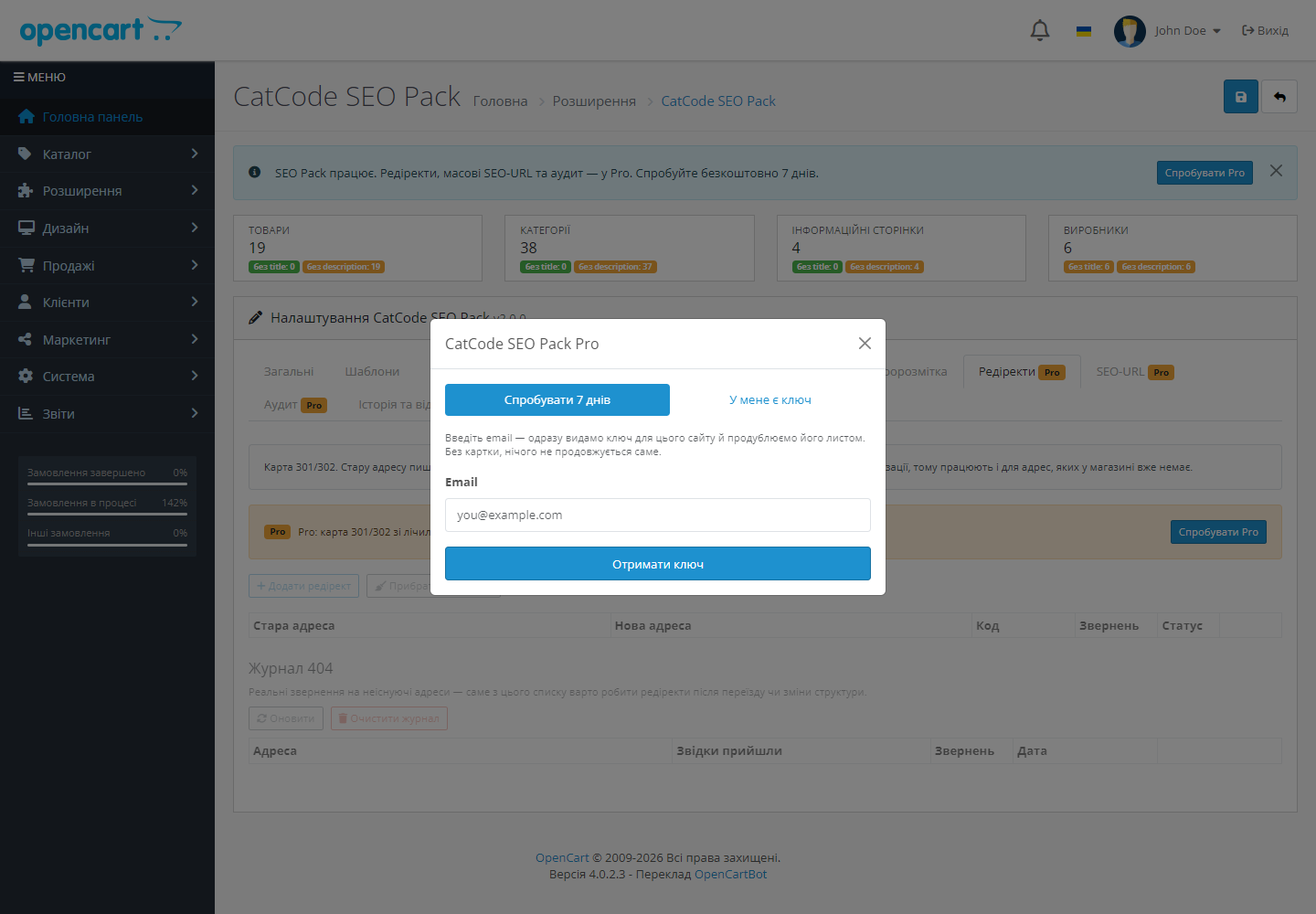
No. For OpenCart the licence is perpetual: one payment, and the Pro features stay with you. Only the 7-day trial ends — after it Pro switches off and the free version keeps working.
Questions about the module?
Message us on Telegram — we reply within the working day. We will help with setup, compatibility and key activation.
No reviews yet. Be the first — right below.
Leave a review
Reviews are moderated before publication, which usually takes up to 24 hours.
No questions yet. Ask one — we answer within 24 hours.
Ask a question
We usually reply within 24 hours during working hours.
Buying the module
—