SEO Templater — bulk meta tag generation for OpenCart 2.3, 3.x and 4.x
Один шаблон із плейсхолдерами замість ручного заповнення тисяч мета-тегів. Плюс коректний canonical на сторінках фільтрів — найпоширеніша SEO-проблема OpenCart.

What each licence includes
| Feature | Free | Pro |
|---|---|---|
| Meta tag templates with placeholders | ✔ | ✔ |
| Separate for products, categories, manufacturers and information pages | ✔ | ✔ |
| Rules by category and manufacturer with priority | ✔ | ✔ |
| "Before → after" preview before applying | ✔ | ✔ |
| Control over title and description length | ✔ | ✔ |
| Bulk generation in batches: up to 200 entries per run; unlimited | — | ✔ |
| Run history and one-click rollback | ✔ | ✔ |
| Canonical without filter, sort, limit and UTM tags | ✔ | ✔ |
| rel=prev / rel=next and noindex for filter pages | ✔ | ✔ |
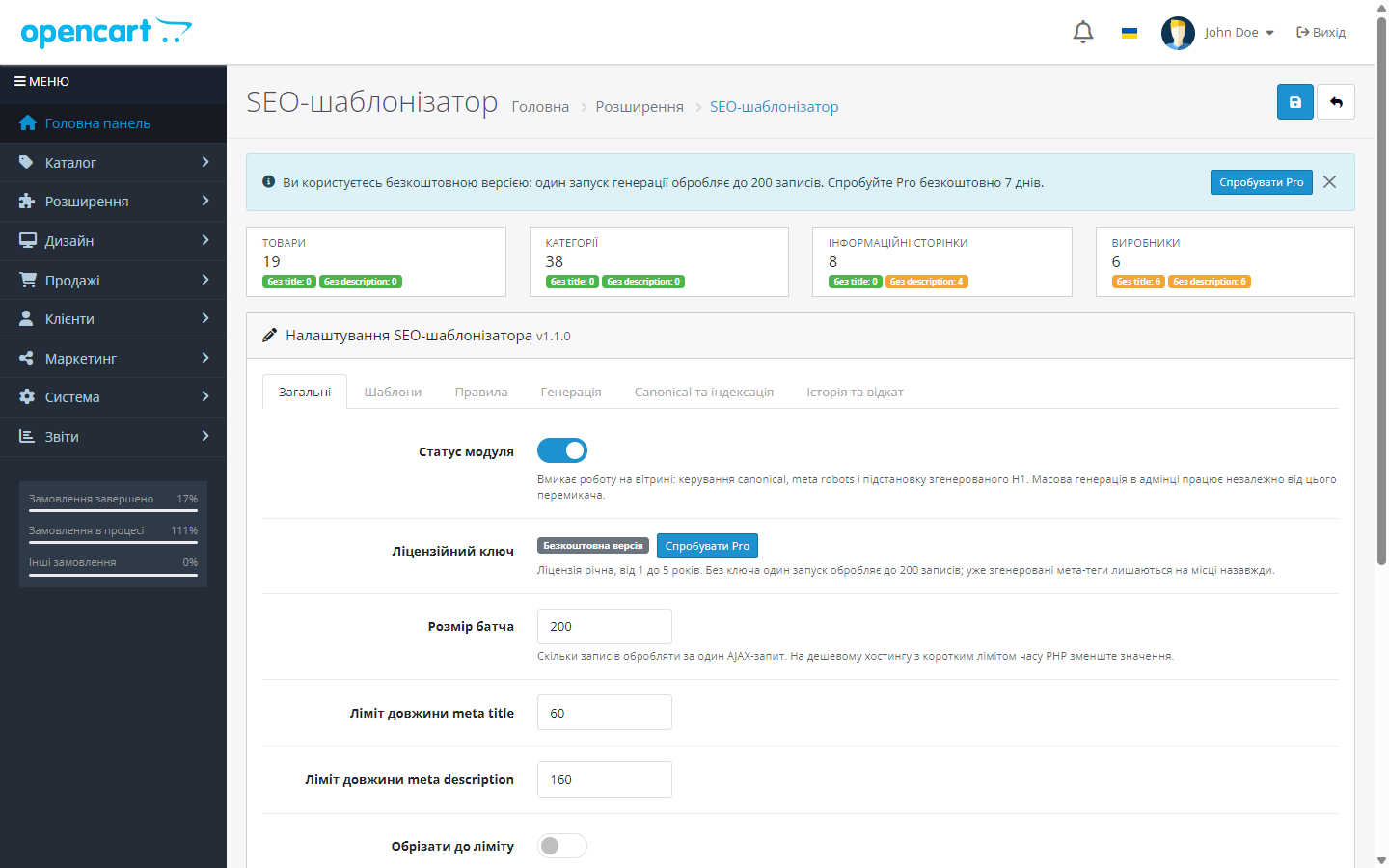
SEO Templater for OpenCart 2.3, 3.x and 4.x solves the two tasks that eat up the most manual work in a store: filling in meta tags across the whole catalogue, and duplicate pages created by filters.
Templates instead of manual work
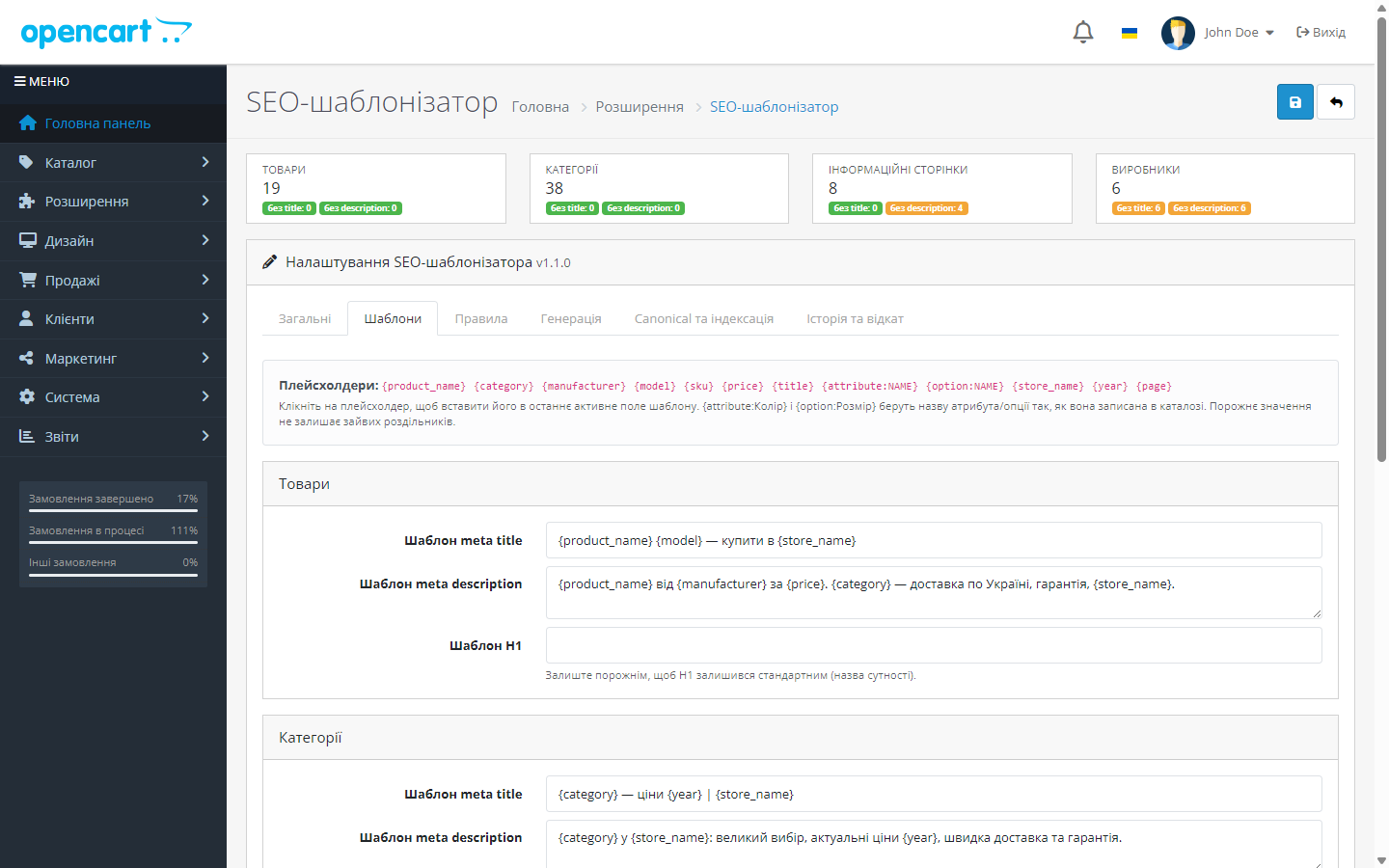
Meta tags are described as a formula with placeholders — product name, category, manufacturer, model, SKU, price, an attribute or option value, store name, year, page number. Separate templates for products, categories, manufacturers and information pages. Rules can be narrowed: one template for a specific category, another for a manufacturer, a third for the rest of the catalogue, with manageable priority.
Look first, then apply
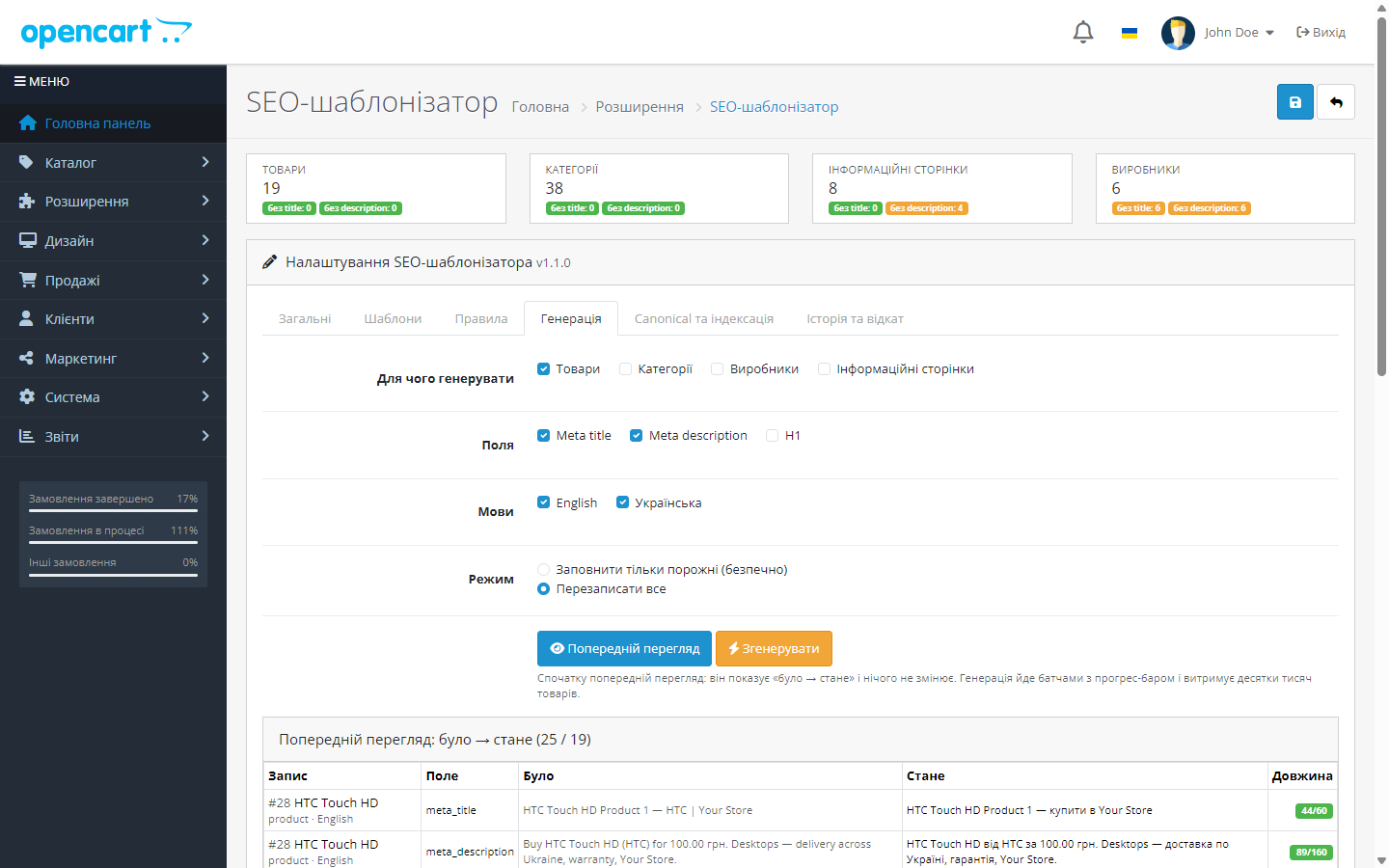
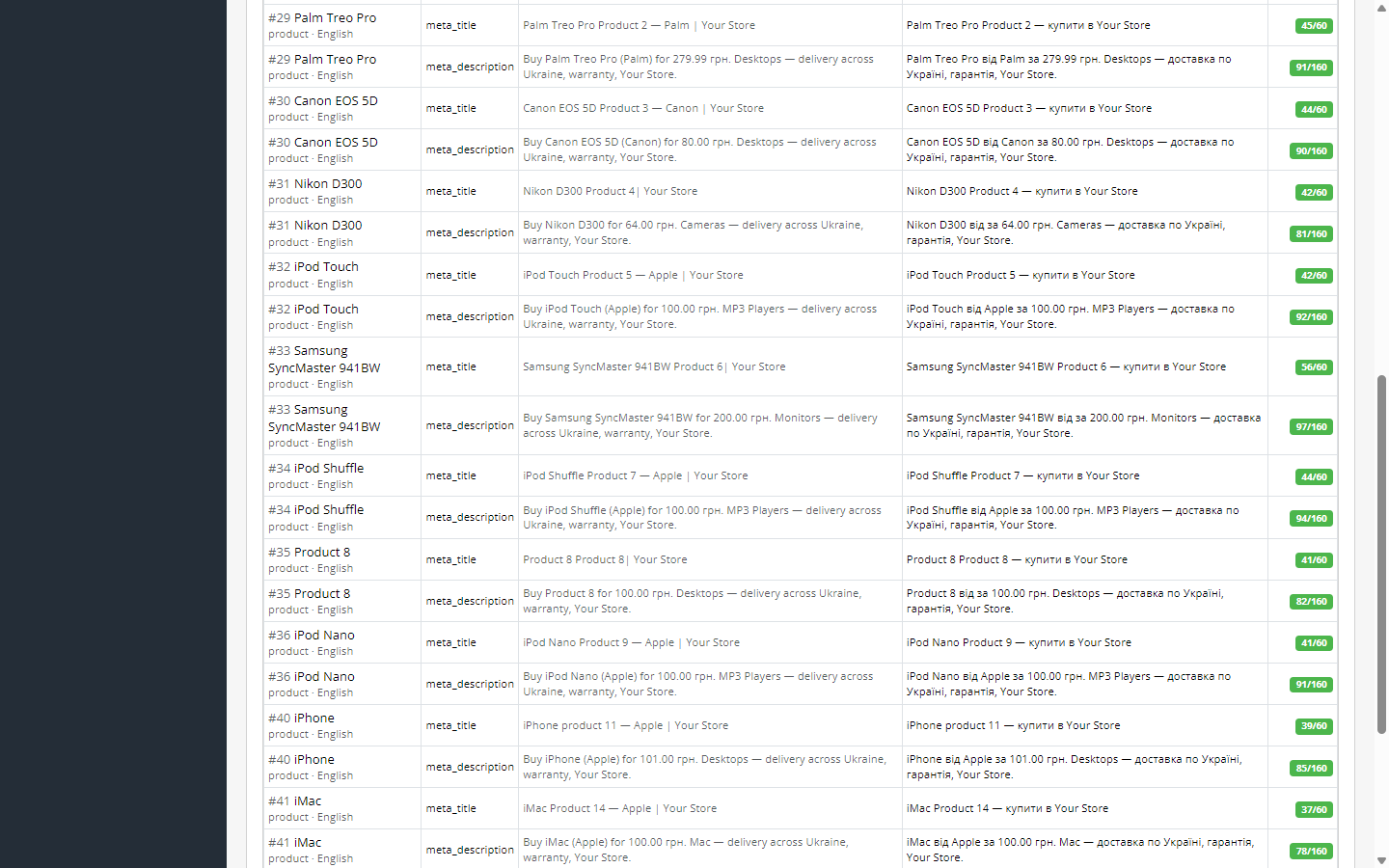
Before generation there’s a preview with a “before → after” list and highlighting for title and description length overruns. There are two modes: fill in empty fields only, or overwrite everything. Generation runs in batches with a progress bar, so a catalogue of tens of thousands of products doesn’t overload the server.
Every run is saved in history together with the previous values, so any generation can be rolled back in one click — the main safety net for bulk edits.
Canonical on filters — OpenCart’s biggest headache
Pages with filter, sort, limit parameters and campaign tracking tags create dozens of duplicates of the same page. The module sets a correct rel=canonical, stripped of these parameters, adds rel=prev and rel=next for pagination, self-canonical on the second and later pages, and lets you close filters off with noindex.
A separate store for H1 and manufacturers
H1 and manufacturer meta tags are stored in the module’s own table rather than overwriting catalogue fields: in OpenCart 4.1, manufacturers have no meta fields at all, and overwriting a product’s name for the sake of H1 would break the catalogue. Values are inserted automatically on the storefront.
Free version and Pro
Free: templates for all entity types, a “before → after” preview, batched generation with a progress bar, run history and rollback, control of rel=canonical, rel=prev/rel=next and noindex on filters — limited to 200 entries per run.
Pro: removes the limit — one run processes the whole catalogue, however many products it has.
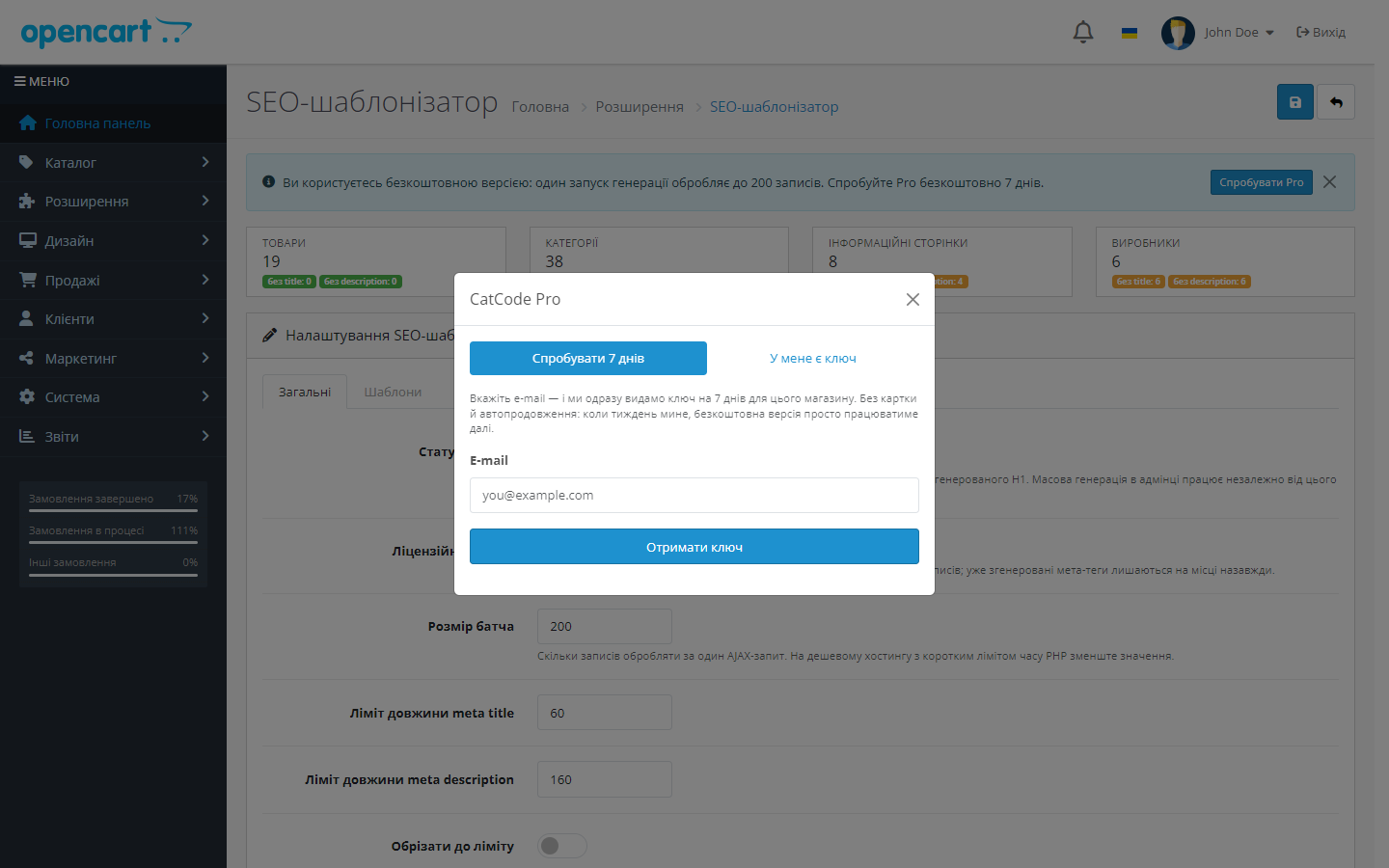
Trial — only on your click. A fresh install switches nothing on by itself: the module works as the free version until you click “Try Pro” yourself. Then a genuine 7-day key arrives at your e-mail. No card, no auto-renewal: once the week is up, the free part keeps working, and meta tags already generated stay in place.
Version history
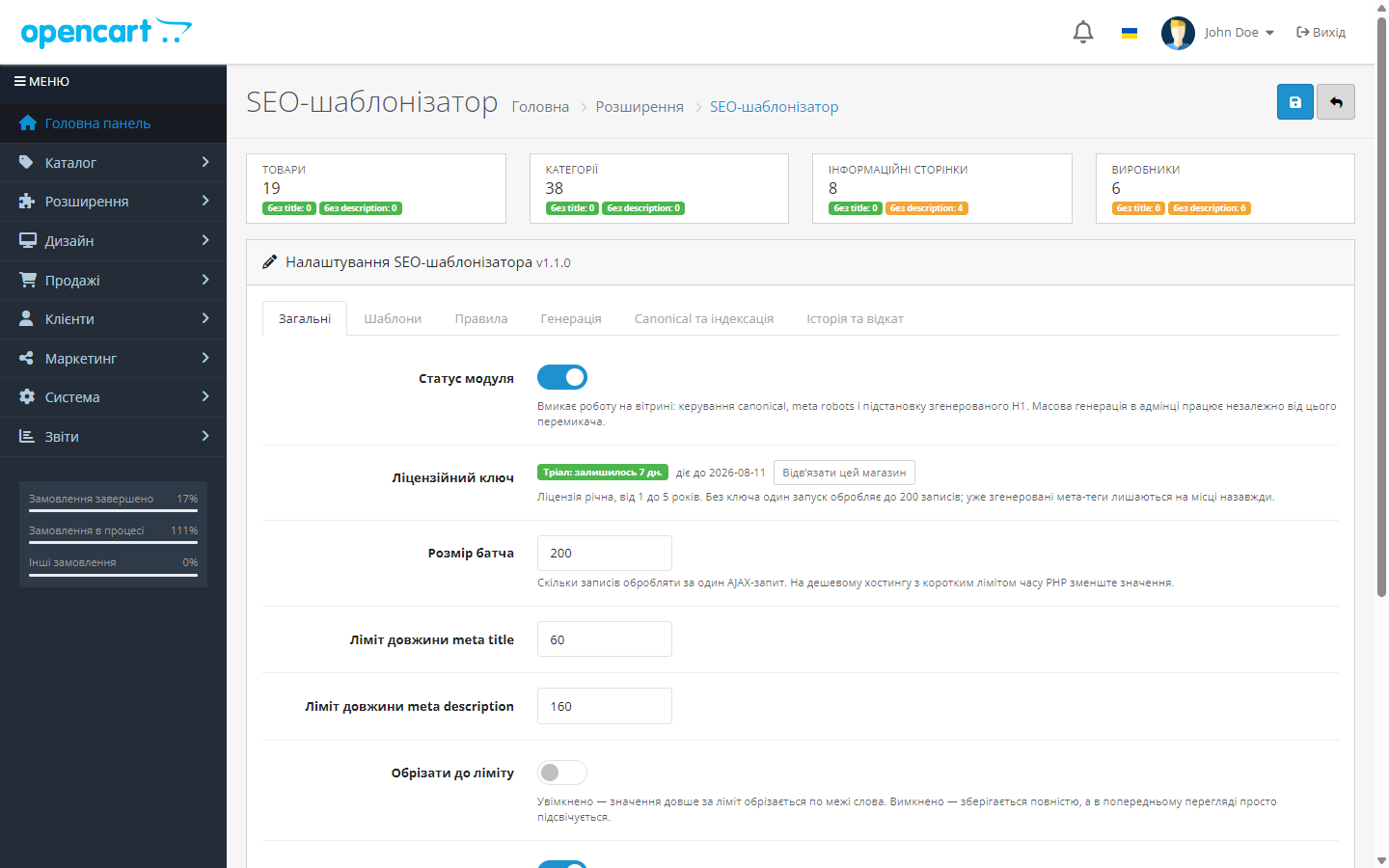
- 1.1.0 (OpenCart 3.x) — the OpenCart 3.0.x build moved to server-side licensing. Previously Pro accepted any key that matched the expected format, and the trial period switched on by itself the first time settings were saved — now a fresh install is a clean free version, and the 7-day trial only starts on a “Try Pro” click. The key is confirmed by the server with a 14-day allowance in case it’s unreachable, and saving settings no longer wipes an activated key. The “General” tab now shows licence status with an expiry date and a “Release” button. Meta tags no longer contain HTML entities: names like
Apple Cinema 30"orLaptops & Notebooksused to be inserted into the description as-is, and Google showed them literally in the snippet. - 1.0.0 (OpenCart 2.3) — a separate build for OpenCart 2.3.0.x: the same templates, rules by part of the catalogue, preview, batched generation with rollback, canonical and noindex. The module doesn’t change any core file — everything runs on OpenCart events, so “Refresh” in Modifications isn’t needed. The extension code in this build is
cc_seometa: OpenCart 2.3 drops the last three characters from a route ending in “tpl”, so the namecc_seotplon this platform would open someone else’s screen. Files are uploaded to the store root manually: the standard 2.3 Installer only works over FTP. - 1.1.0 (04.08.2026) — the licence is verified on the CatCode server, the trial only starts on a click (previously it switched on by itself after installation). Fixed two things that stopped the module working on OpenCart 4.0.x: the settings page crashed on a category tree traversal, and the storefront event handlers required more arguments than 4.0 passes. Meta tags no longer contain HTML entities in product names.
- 1.0.0 (28.07.2026) — first release.
Frequently asked questions
Will the module overwrite meta tags I wrote by hand?
Only if you choose the "Overwrite everything" mode yourself. By default only empty fields are filled.
What if I don't like the result?
Open the "History" tab and click "Restore" — previous values are kept for every run.
Will it handle a catalogue of 20,000 products?
Yes, generation runs in batches with a progress bar rather than one request.
Which placeholders are available?
Product name, category, manufacturer, model, SKU, price, attribute or option value, store name, year and page number.
Won't canonical break my filter pages for buyers?
No. Pages stay accessible, only what search engines treat as the primary address changes.
Questions about the module?
Message us on Telegram — we reply within the working day. We will help with setup, compatibility and key activation.
No reviews yet. Be the first — right below.
Leave a review
Reviews are moderated before publication, which usually takes up to 24 hours.
No questions yet. Ask one — we answer within 24 hours.
Ask a question
We usually reply within 24 hours during working hours.
Buying the module
—