Papertech — a catalogue of printing and packaging equipment
B2B-каталог дистриб’ютора промислового поліграфічного обладнання: 96 моделей, 340 інсталяцій, hero-слайдер на 3 ринки, готові рішення з технічними чипами і акціями.
Context
Papertech is a Ukrainian distributor of industrial printing and packaging-production equipment, operating since 2005. Its specialisations are flexography, offset and digital printing, paper tableware production, corrugated packaging, die-cutting presses, and folder-gluer lines. Its partners are first-tier Asian manufacturers (RMGT, JUNIOR, VEGA, DAYUAN, HPM, ROLAM, YOCO, KUAIYIDA, ECO LED-UV, LUSTER, iECHO, RICOH) as well as European lines sold after inspection with a 12-month warranty. The catalogue holds 96 models, and the installation portfolio covers 340 projects from Lviv to Dnipro.
The brief for the site wasn’t to produce a pretty landing page with a single CTA, but to build a genuine engineering catalogue where a manufacturer from a print shop can pick a specific machine, see its specifications, its current promotional price, and the geography of installations already completed. This is a B2B storefront with a long deal cycle ($10k–$150k+), where the site’s job is to move the client from “looking for equipment” to “left a request with the technologist” through four levels of structure: brand → category → line → model.
Catalogue architecture
Hero slider: three business contexts
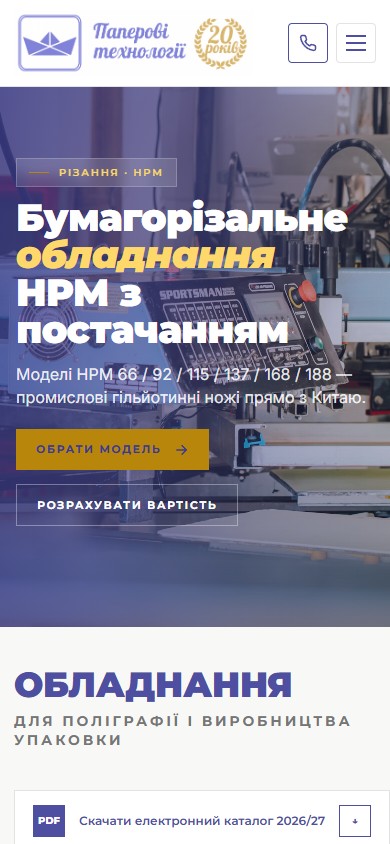
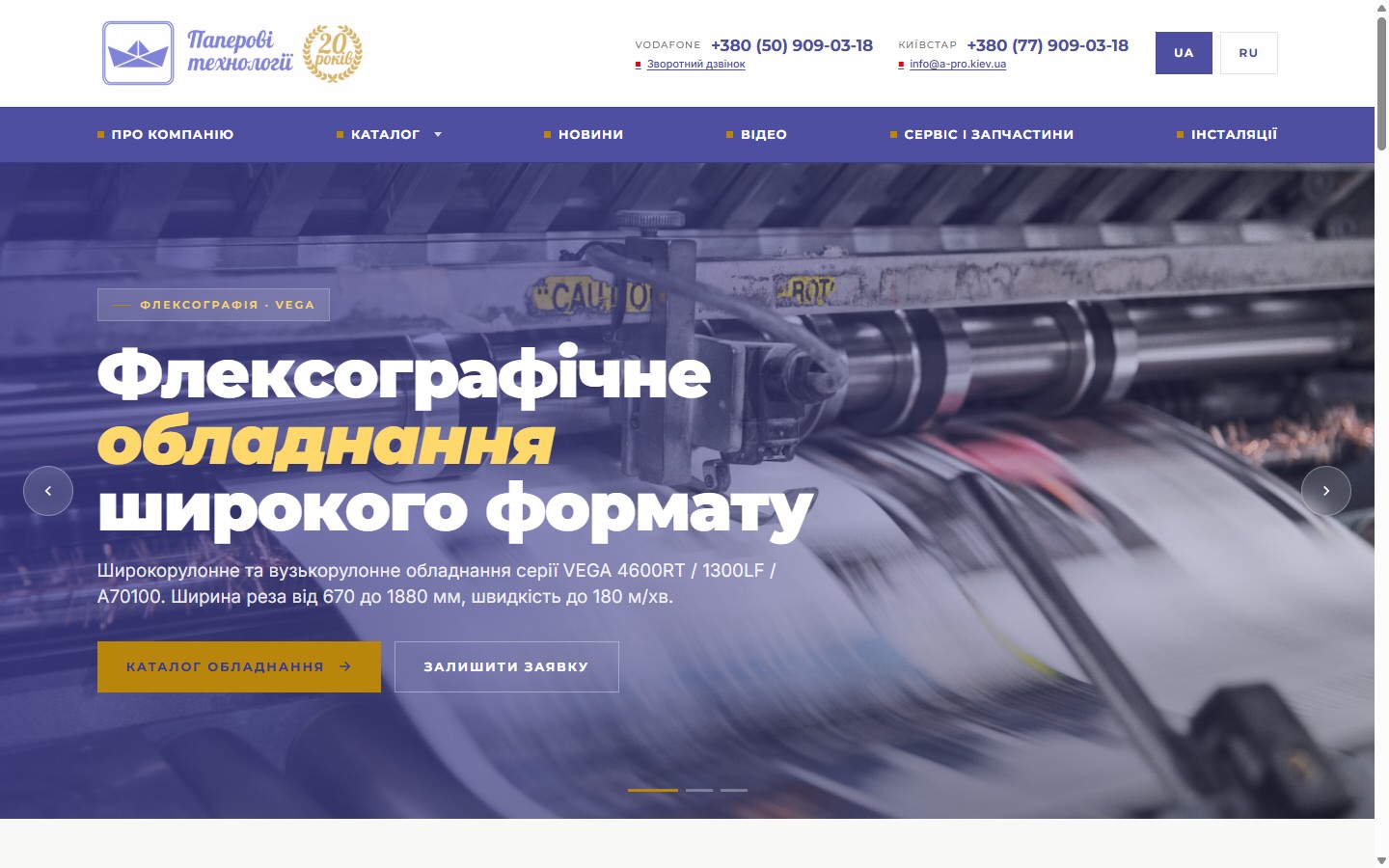
Instead of a single banner, the home page opens with a slider covering three key directions — VEGA flexography (wide-web equipment, the 4600RT/1300LF), turnkey paper cup production (JUNIOR C12H/B16L), and HPM paper-cutting equipment. Each slide has its own tag, its own H1, its own lead with specifications (cutting width, speed, models) and a pair of CTAs: one leads to the brand catalogue, the other to a quick request to a technologist. This covers three different visitor personas without overloading the hero.
Two catalogue bands: offset/digital and cardboard packaging
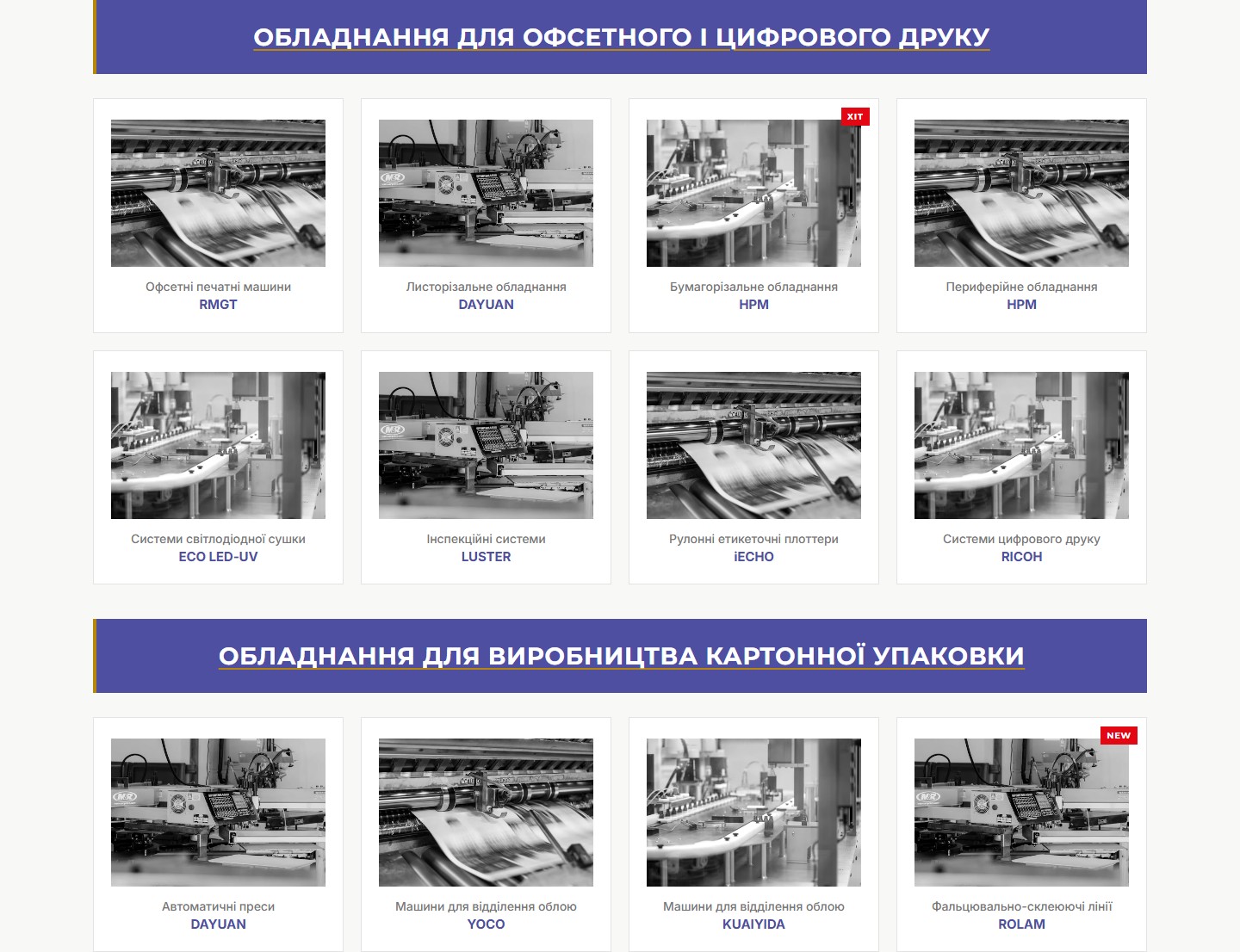
Instead of one single-level grid, the home page carries two branded heading bands: “Offset and digital printing equipment” (8 brands — RMGT, DAYUAN, HPM, HPM peripherals, ECO LED-UV, LUSTER, iECHO, RICOH) and “Cardboard packaging production equipment” (DAYUAN presses, YOCO/KUAIYIDA trim-removal units, ROLAM folder-gluers). Each card carries a black-and-white photo of the machine, a category name, the brand in bold, and a “HIT” or “NEW” badge wherever there’s a promotion or a new arrival.
Ready-made solutions: turnkey lines with specifications
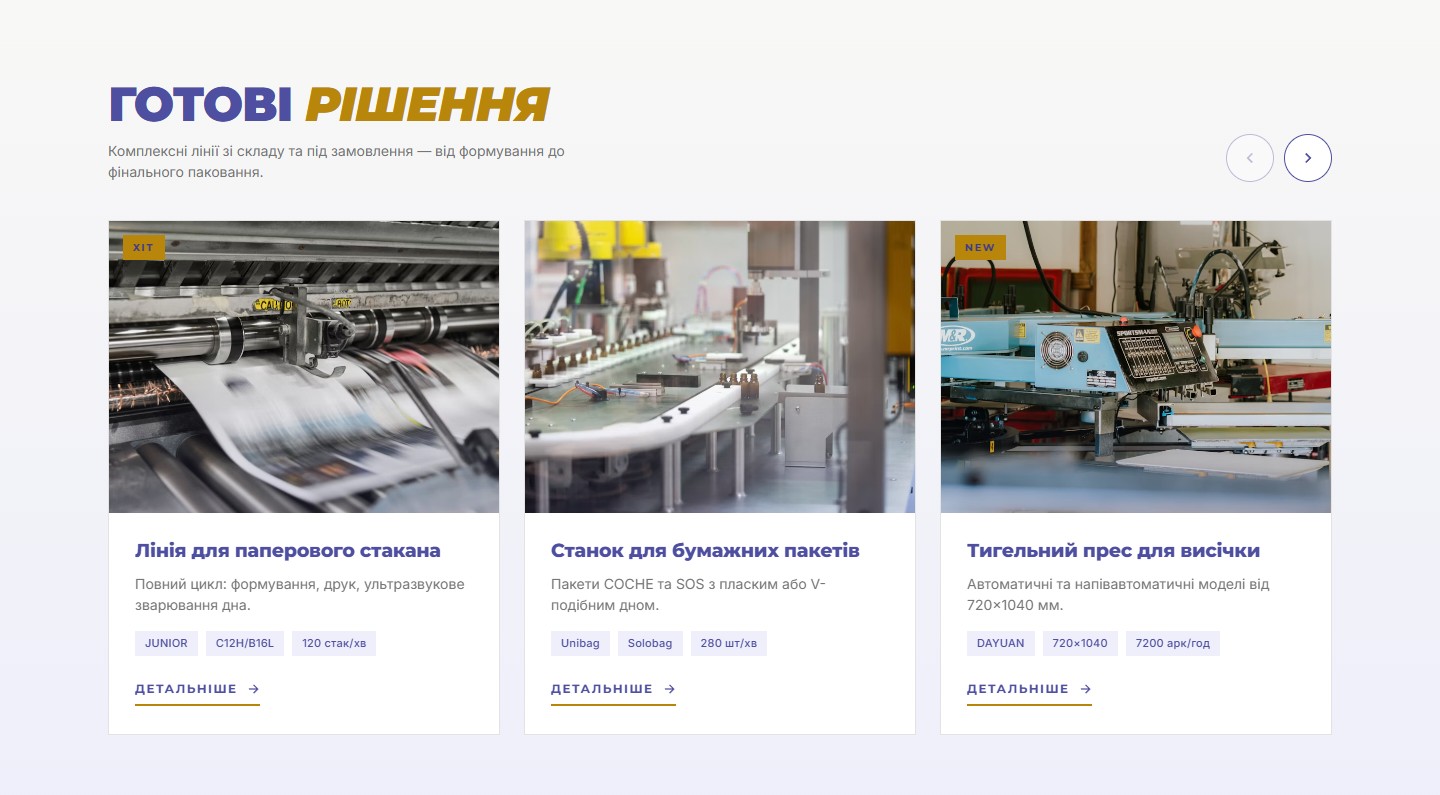
A separate carousel section covers 6 ready-made turnkey lines: a paper cup line (JUNIOR C12H/B16L, 120 cups/min), a paper bag machine (Unibag/Solobag, 280 units/min), a die-cutting press (DAYUAN 720×1040, 7,200 sheets/hour), a corrugated packaging line, screen printing (VEGA A70100), and a folder-gluer line (ROLAM, 4/6-point, 250 m/min). Each card carries 3 chips with key specs (brand / model / output), a “Hit” or “New” tag, and a “Learn more” CTA.
Promotional mechanics
Promotional offers with a price framework
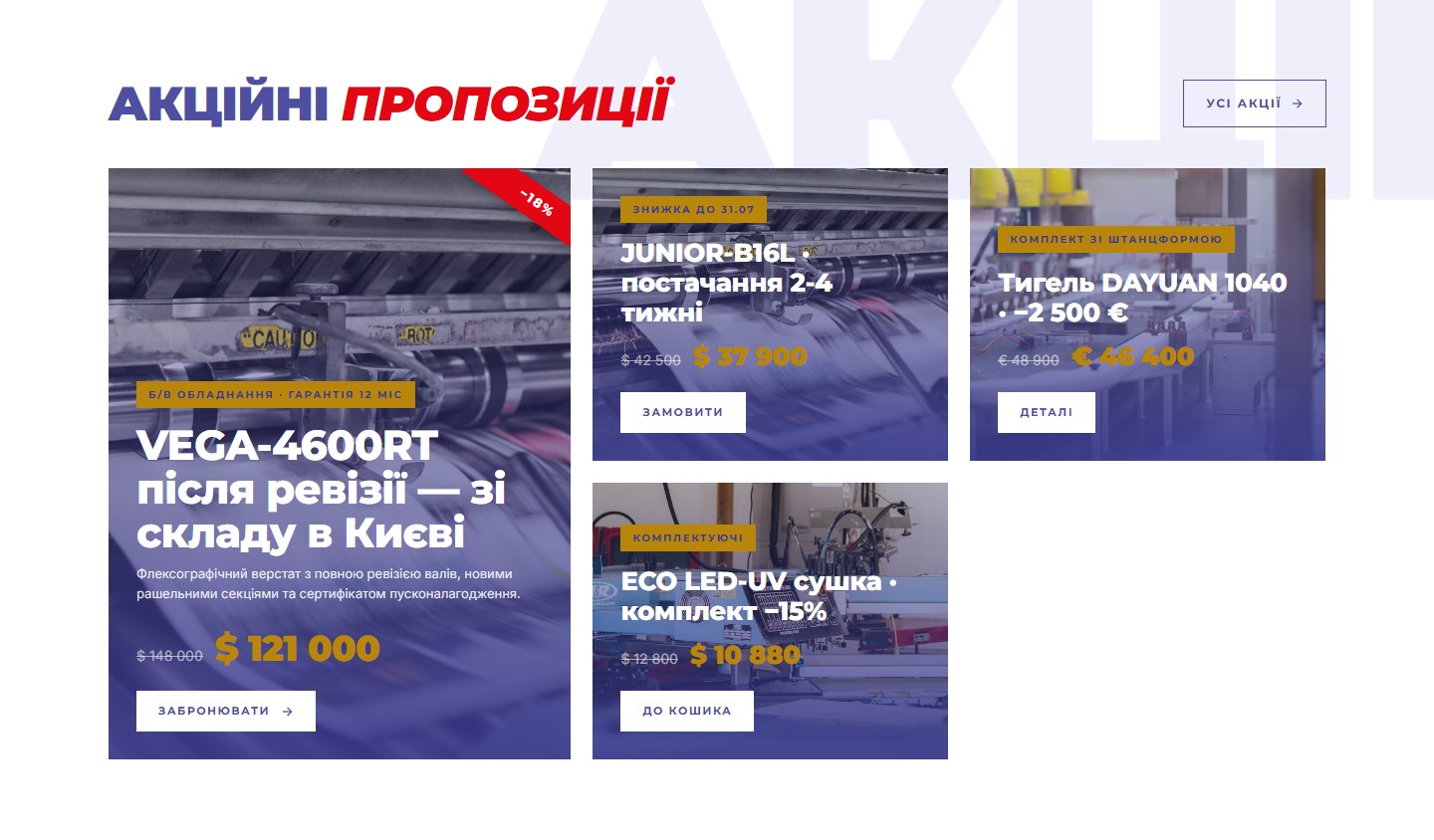
A separate “Promotional offers” section uses an asymmetric grid: one large hero card and three smaller ones. The large one is a used VEGA-4600RT after inspection, “from a warehouse in Kyiv”, with a price arrow $148,000 → $121,000 (a −18% badge) and a “Reserve” CTA. The smaller ones are a JUNIOR-B16L with a temporary discount until 31 July, a DAYUAN 1040 die-cutting press with a die-cutting tool set included, and an ECO LED-UV dryer with a −15% package. Every card follows the same pattern: photo + category badge + old/new price + action button.
An installation map with geotags
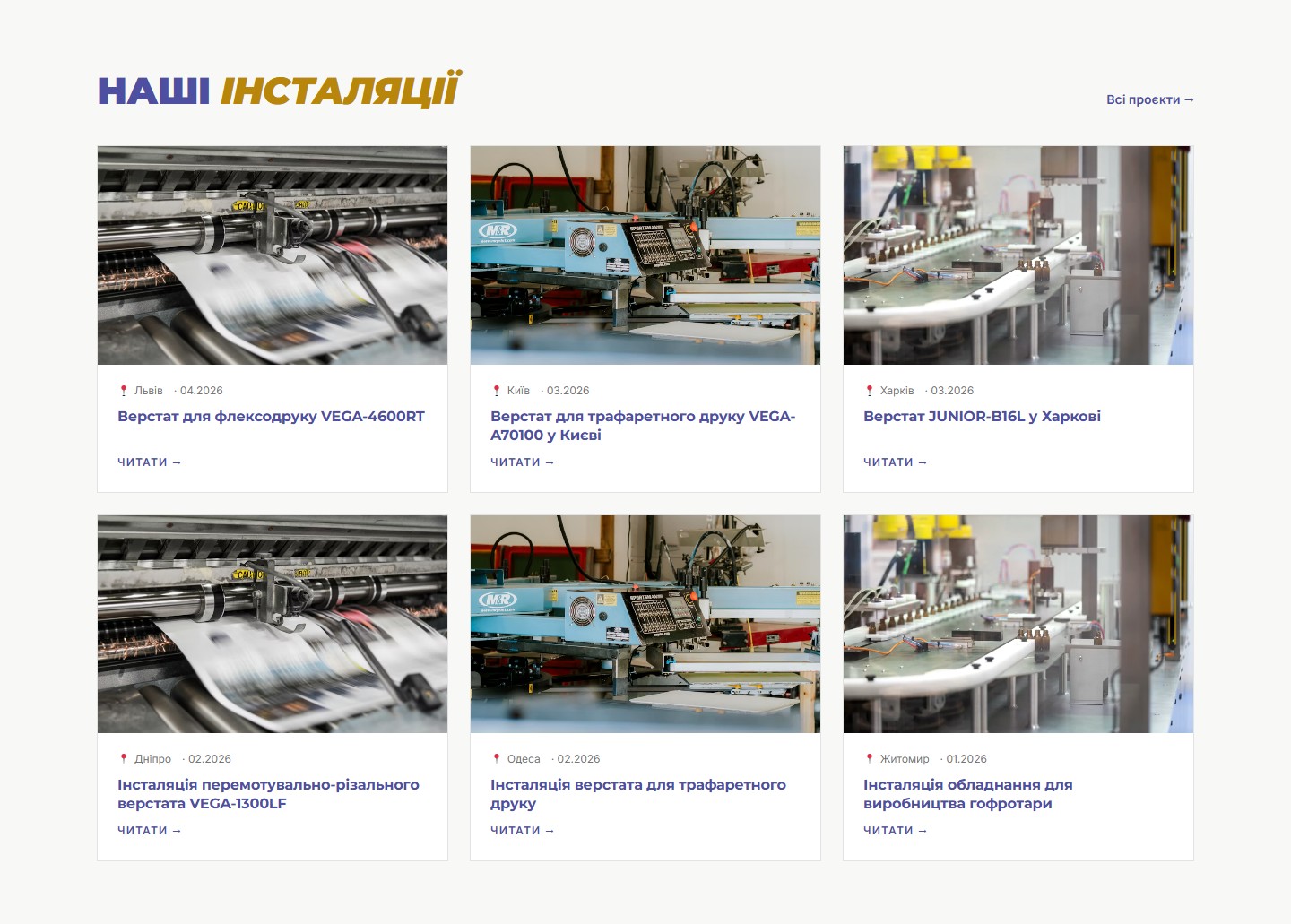
The “Our installations” section shows 6 recent projects in three columns. Each card carries a real photo of the equipment at the client’s site, a brand tag, a geotag (“📍 Lviv / Kyiv / Kharkiv / Dnipro / Odesa / Zhytomyr”), the launch date in MM.YYYY format, and a title. This isn’t just a “portfolio” — it’s proof that the distributor doesn’t just sell equipment but also handles commissioning across the country. From a UX standpoint, it’s social proof for a new visitor who just arrived from a search.
Subpages and site depth
An “About the company” page with its own voice
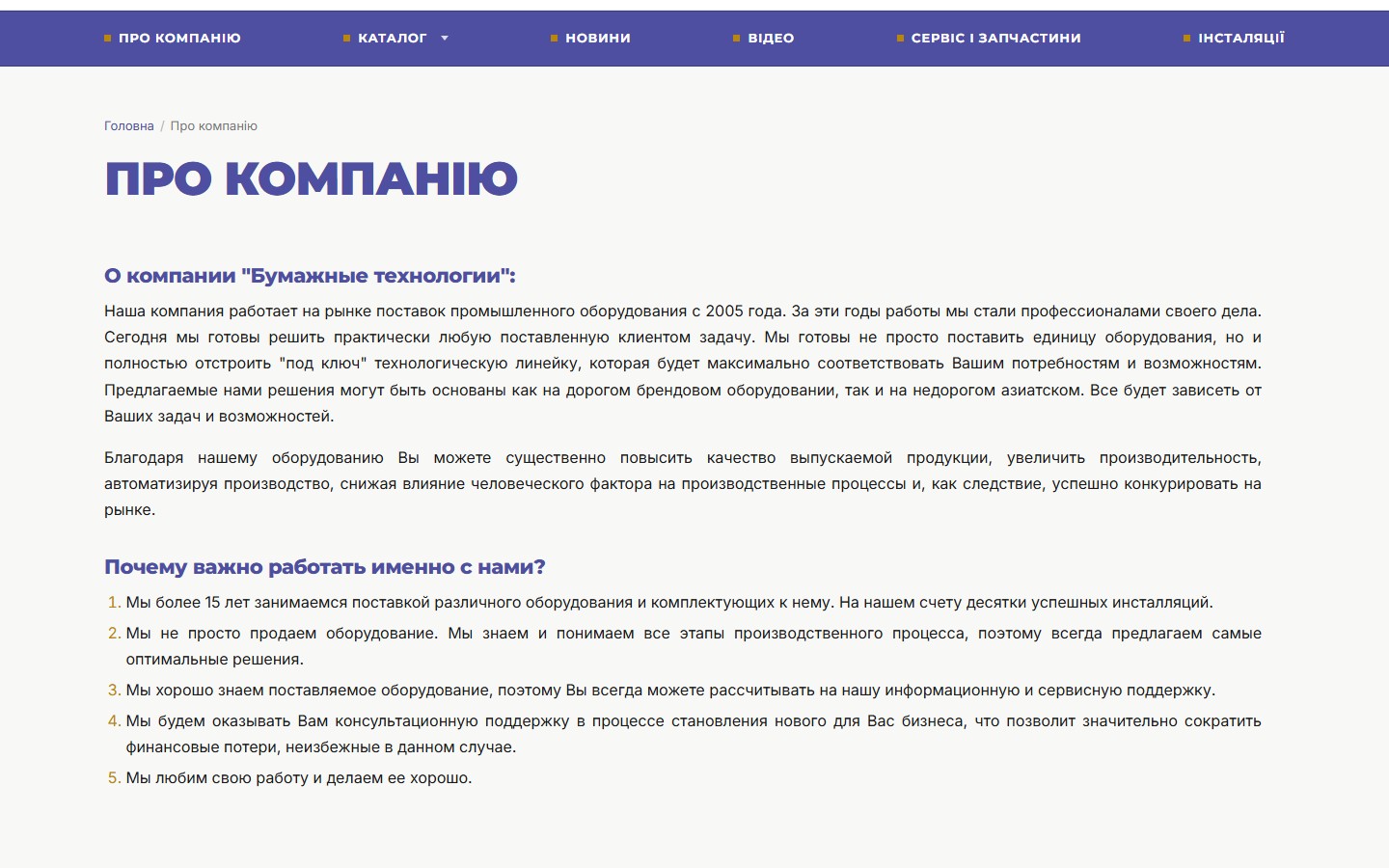
The /company/ page is a separate internal page with a full description of the positioning: why to work with Papertech specifically (15+ years in the market, dozens of installations, technical support, information and consulting assistance), and three blocks — “What we offer / What we guarantee / What we don’t offer”. The last block is a rare move for a B2B site: an honest list of “what we do NOT do” (equipment with a low service life that we can’t supply, that we can’t service) — positioning through refusal.
Catalogue subpages: a hub-and-spoke structure with category routes
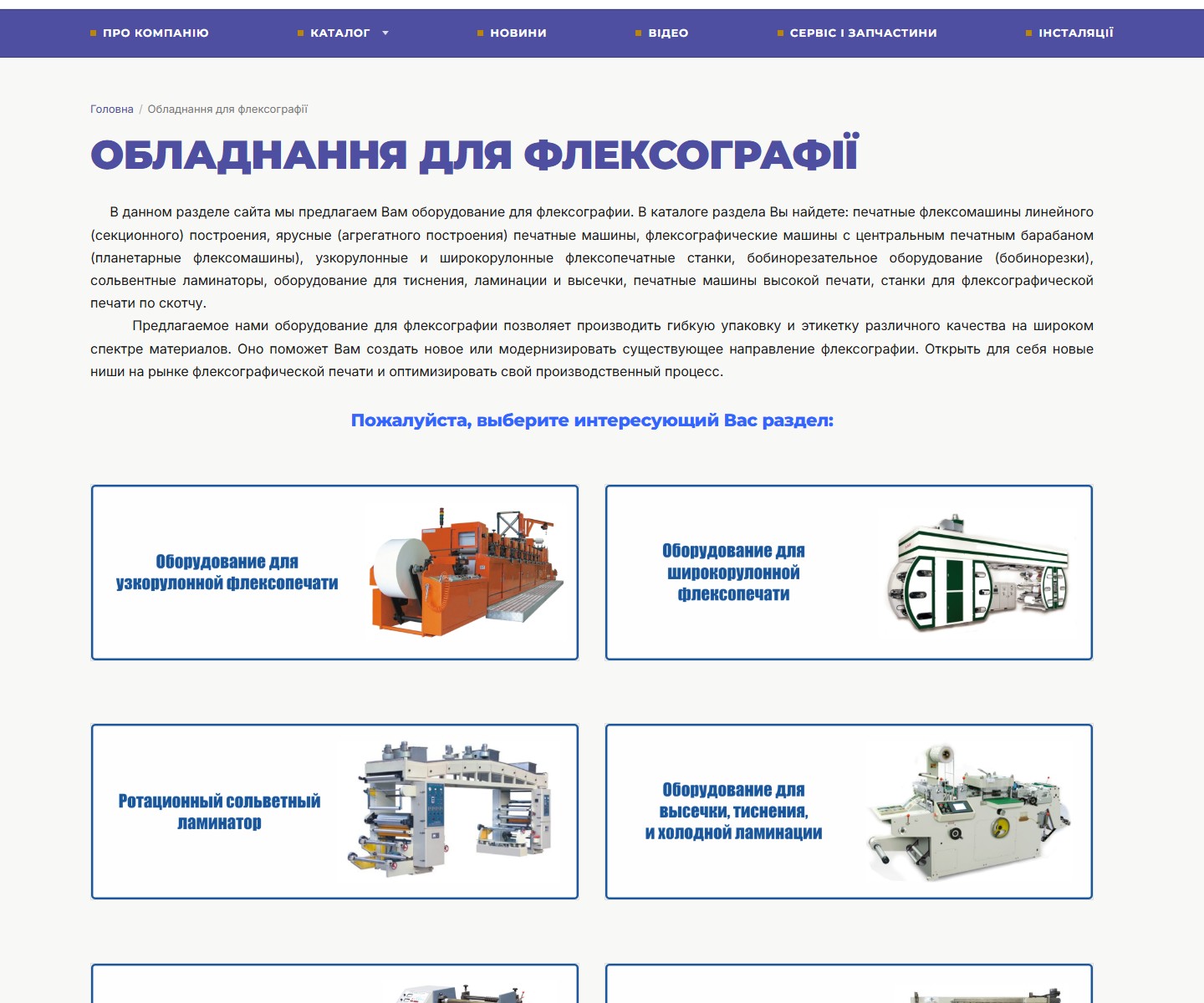
Each of the 4 root sections (“Flexography”, “Screen printing”, “Cardboard packaging”, “Paper tableware”) is its own hub page with its own H1, a descriptive intro paragraph (what it is, what the equipment is for, which production directions it covers) and a grid of subcategories with photos of real machines. Second-level subcategories (for example “Narrow-web / Wide-web / Solvent laminator / Die-cutting and embossing / Slitter-rewinder / Tape printing / Roll die-cutting”) lead to model pages.
Service and spare parts, news, multilingual support
A separate “Service and spare parts” service (/uslugi/postavka-zapchastey/) is aimed at existing clients looking for original parts or a service crew visit. The “News” section (/news/) carries posts about new equipment series, reports from commissioning jobs, and technology experiments. A “Technology” section, with subsections /pc-technology/, /pc-experiment/ and /voprosi_tekhnologii_bumazhnogo_stakanchika/, provides content marketing for people who are still just researching paper cup production. The interface switches between three locales (UA / RU / EN — a separate /about-company-paper-technology/ page), with a URL switcher in the header.
Trust and conversion infrastructure
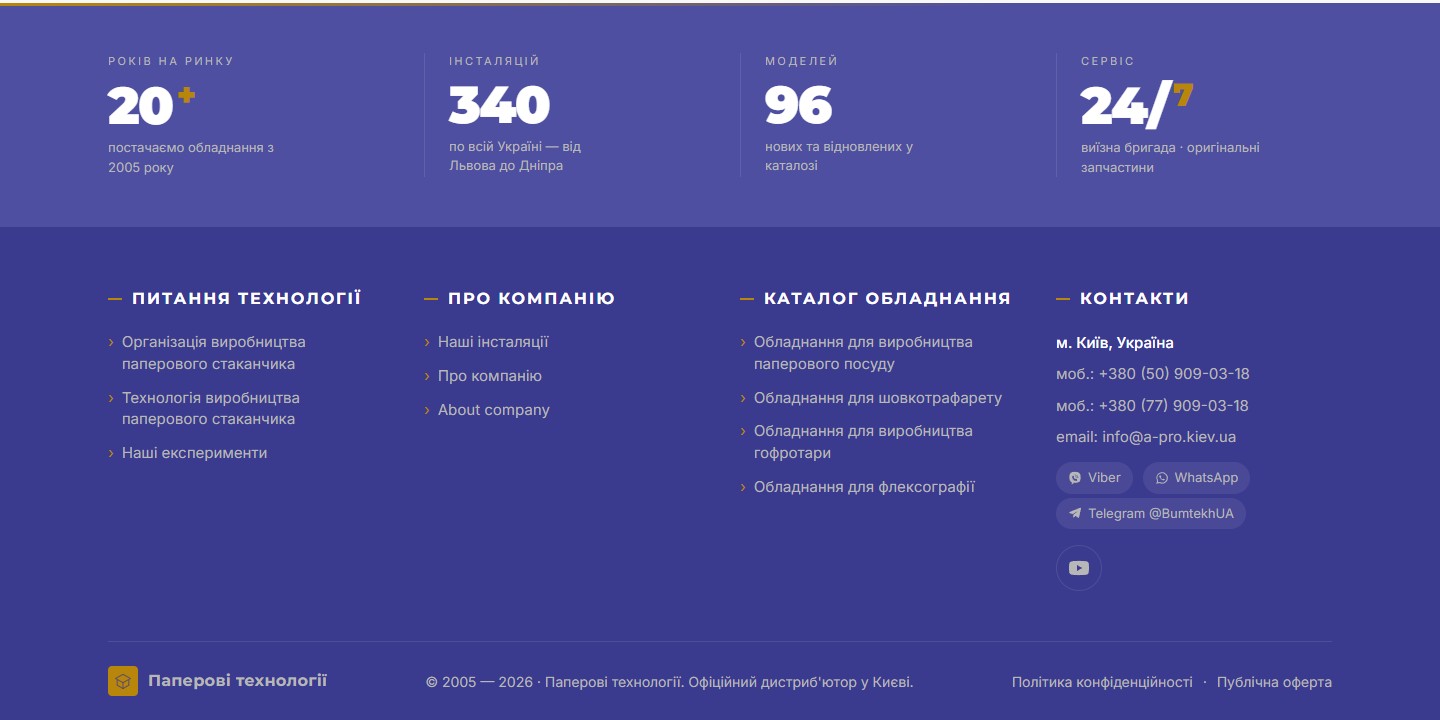
At the bottom of the home page is an info band with 4 key figures on a branded background: “20+ years in the market”, “340 installations”, “96 models in the catalogue”, “24/7 service”. The footer itself has 4 columns (Technology questions / About the company / Equipment catalogue / Contacts) plus a multichannel chat block: Viber, WhatsApp, Telegram @BumtekhUA, YouTube. This covers the different communication preferences of wholesale buyers — from a messenger app to the company’s video catalogue on YouTube.
Result
Papertech got a catalogue that works as an engineering reference, not a marketing landing page. The four-level structure (brand → category → line → model) lets a visitor arriving from a search for “hpm 92” land directly on the model and see its specs; a new persona thinking “I want to set up paper cup production” can go through the ready-made JUNIOR solution with all its specifications. The promotional mechanics (price-arrow deals, badges on hits, geo-tagged installations) act as social proof and triggers for a request. The site is bilingual (UA/RU) with a separate EN page, spans 4 catalogue sections plus service, news and a technology blog, and carries a full package of multichannel communication for B2B clients.