Wordica — an EdTech landing page for a vocabulary-learning Telegram bot
Лендинг Telegram-бота Wordica для запам'ятовування лексики через spaced repetition: 7 готових списків (IELTS, TOEFL, DELE, Cambridge, DELF), 3 тарифи, 8 FAQ.
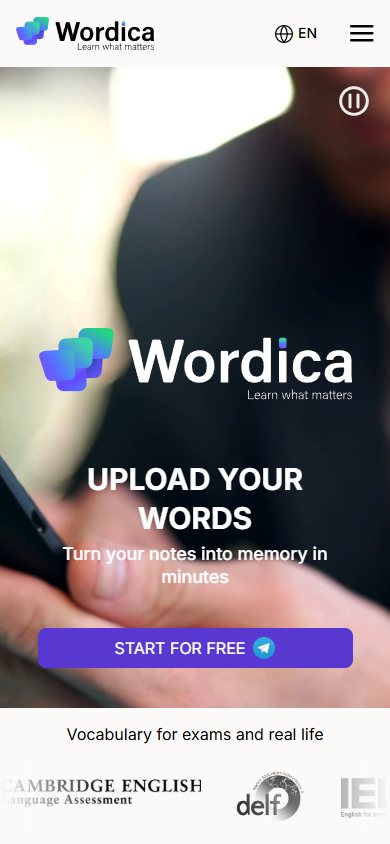
An EdTech landing page for Wordica — a Telegram bot that turns a user’s own words (from photos of notes, text lists, or ready-made expert lists) into a personalised spaced-repetition plan. The page is built as a product tour: a hero with a video demo and a Telegram CTA, three interaction steps, a carousel of seven ready-made lists for the most popular exams, four reviews with ratings, three pricing tiers (Free / Pro €6.99 / For Teachers & Schools) and 8 FAQs. There are no forms on the page — all conversion happens in @wordicabot.
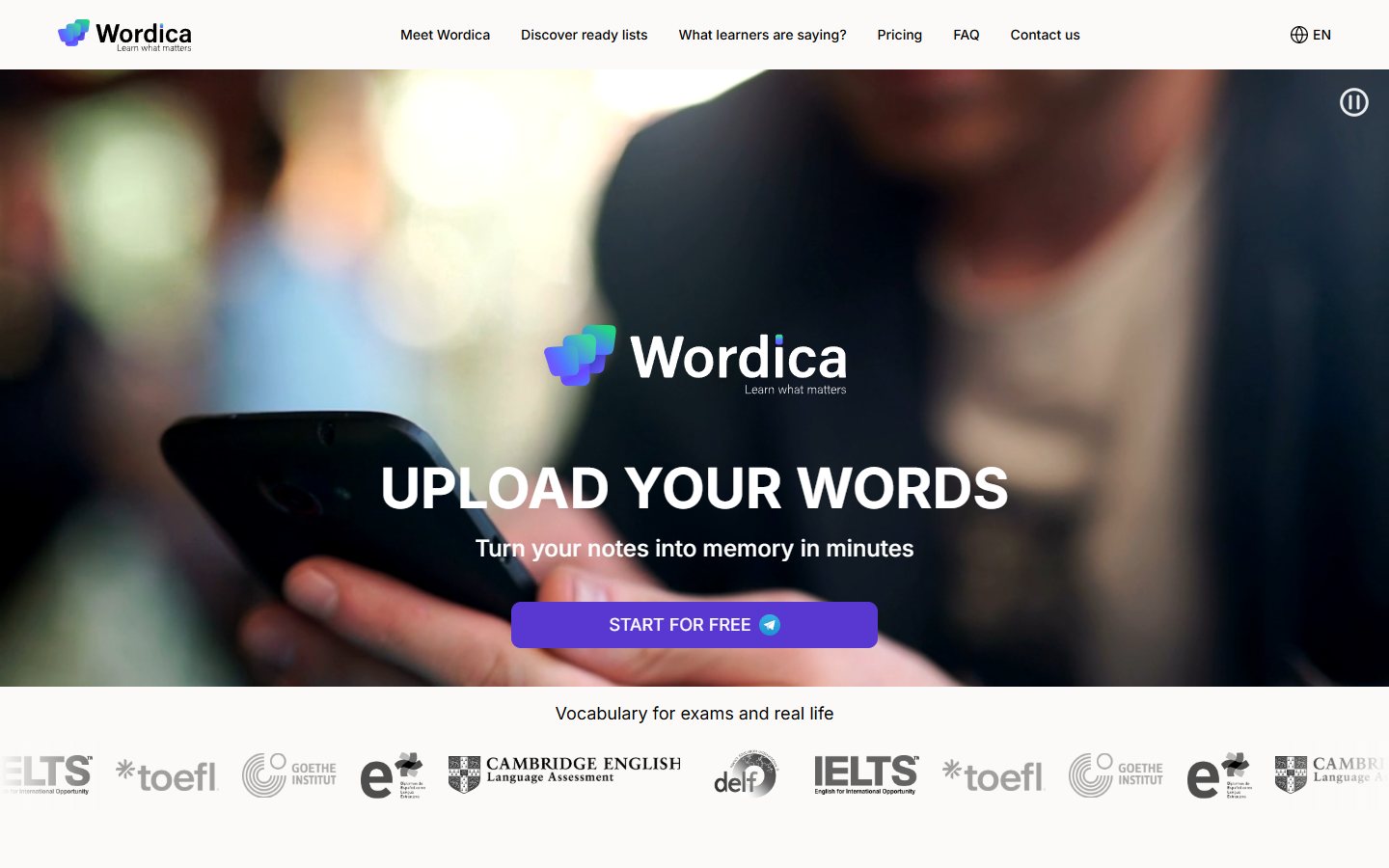
Hero — a photo background with a video demo and one CTA
The first screen is minimalist: a large brand block, “Wordica — Learn what matters”, centred, an H1 “UPLOAD YOUR WORDS”, a subheading “Turn your notes into memory in minutes” and a single CTA button, “START FOR FREE”, with a Telegram icon — the click goes straight to t.me/wordicabot. In the background is a muted video of a person with a smartphone (evoking the mobile use case), plus a compact Play button in the top right to expand the full-screen video. At the bottom of the section is a parallel marquee strip with 6 logos of leading language institutions (IELTS, TOEFL, Cambridge English, Goethe, DELE, DELF) under the lead caption “Vocabulary for exams and real life” — this immediately positions the product as a tool for serious exam preparation, not “just another word list”.
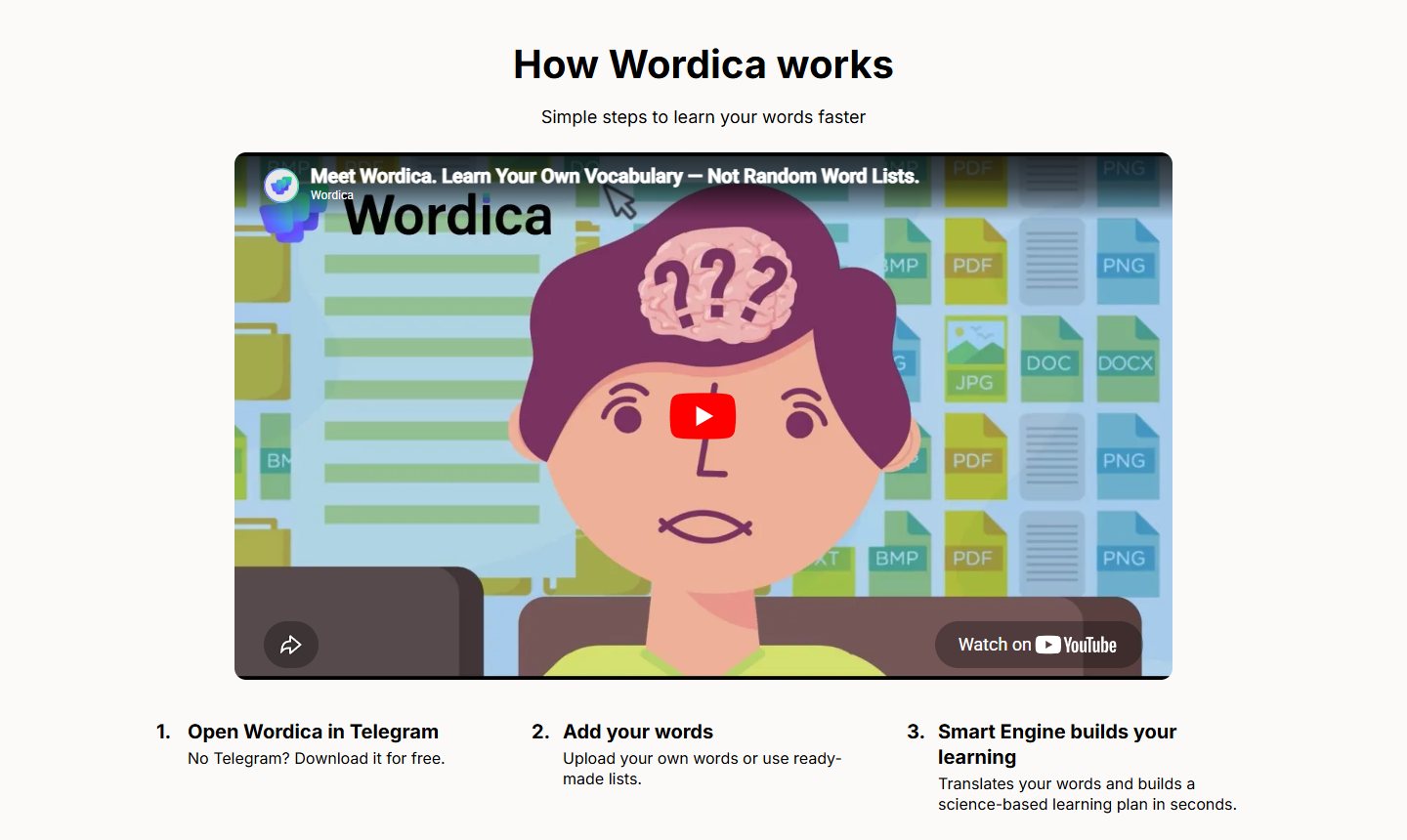
How Wordica works — explainer video + 3 steps
The “How Wordica works” section closes the first objection: “how does this even work, before I go into the bot”. At the centre is an embedded YouTube video, “Meet Wordica. Learn Your Own Vocabulary — Not Random Word Lists”, from the @wordica channel. Below it are three numbered steps in a single row: 1. Open Wordica in Telegram (with a hint, “No Telegram? Download it for free”, for those who don’t yet use the messenger), 2. Add your words (photos of notes or ready-made lists), 3. Smart Engine builds your learning (automatic translation plus a science-based learning plan in seconds). The explainer-video-plus-numbered-list format removes the entry barrier without forcing anyone to read a wall of text.
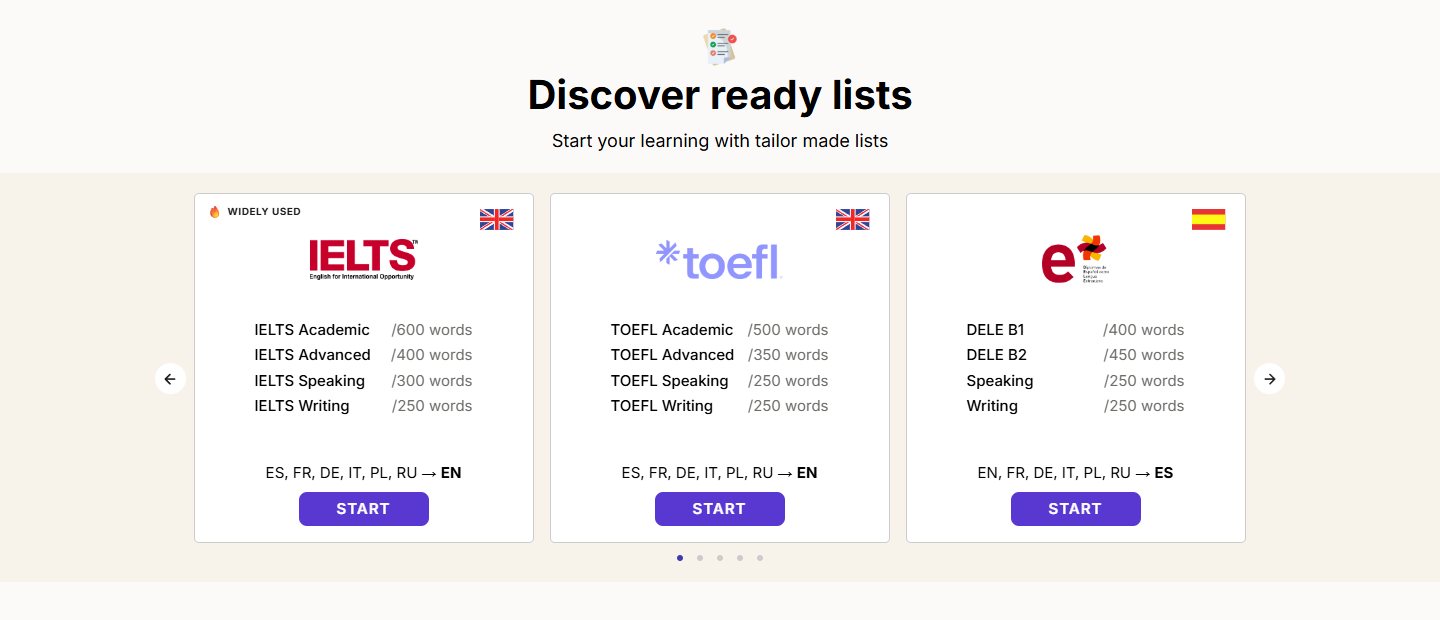
Discover ready lists — a carousel of 7 expert lists
A Swiper carousel instead of a grid
“Discover ready lists” is a Swiper carousel with seven expert vocabulary sets, each in its own card with the language flag and the exam organisation’s logo. IELTS (badged “🔥 WIDELY USED”) — 4 modules of 600 / 400 / 300 / 250 words (Academic, Advanced, Speaking, Writing); TOEFL — the same 4 modules; DELE (Spanish) — B1, B2, Speaking, Writing; Cambridge English — B2 First + C1 Advanced + Speaking + Writing; DELF (French) — B1, B2, Speaking, Writing; Goethe (German) — B1, B2, Speaking, Writing. The seventh card is General (Core Vocabulary 800 / Daily Life 600 / Travel 500 / Living Abroad 600 / Academic 500) for those not preparing for a specific exam. At the bottom of each card is a UI hint about source languages: “ES, FR, DE, IT, PL, RU → EN” (read as “from any of these languages into the target language”).
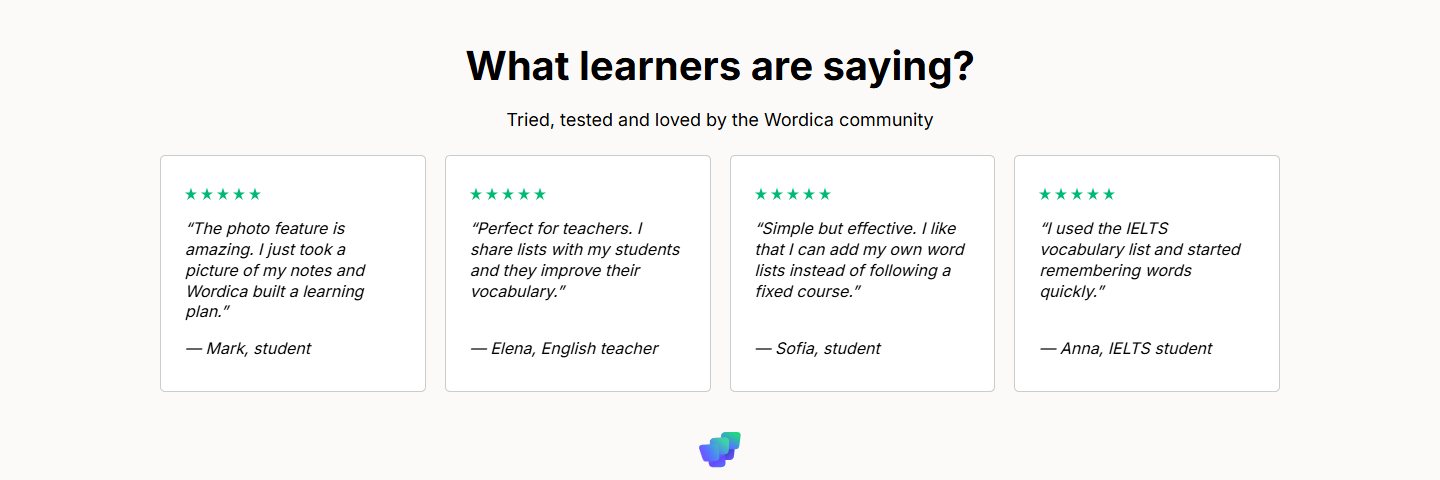
What learners are saying — 4 reviews with roles
Social proof is gathered into four review cards — each with a 5-star rating and the author’s role listed instead of an anonymous quote. Mark, student — on the OCR feature (“The photo feature is amazing. I just took a picture of my notes and Wordica built a learning plan”); Elena, English teacher — on the teacher scenario (lists → students); Sofia, student — on the benefits of a personal list over a fixed course; Anna, IELTS student — a concrete use case around the IELTS vocabulary list. This covers three audiences at once — self-learners, teachers and exam candidates — each of whom sees “their own” voice.
Pricing — Free, Pro €6.99 and For Teachers & Schools
Three tiers, no extra options
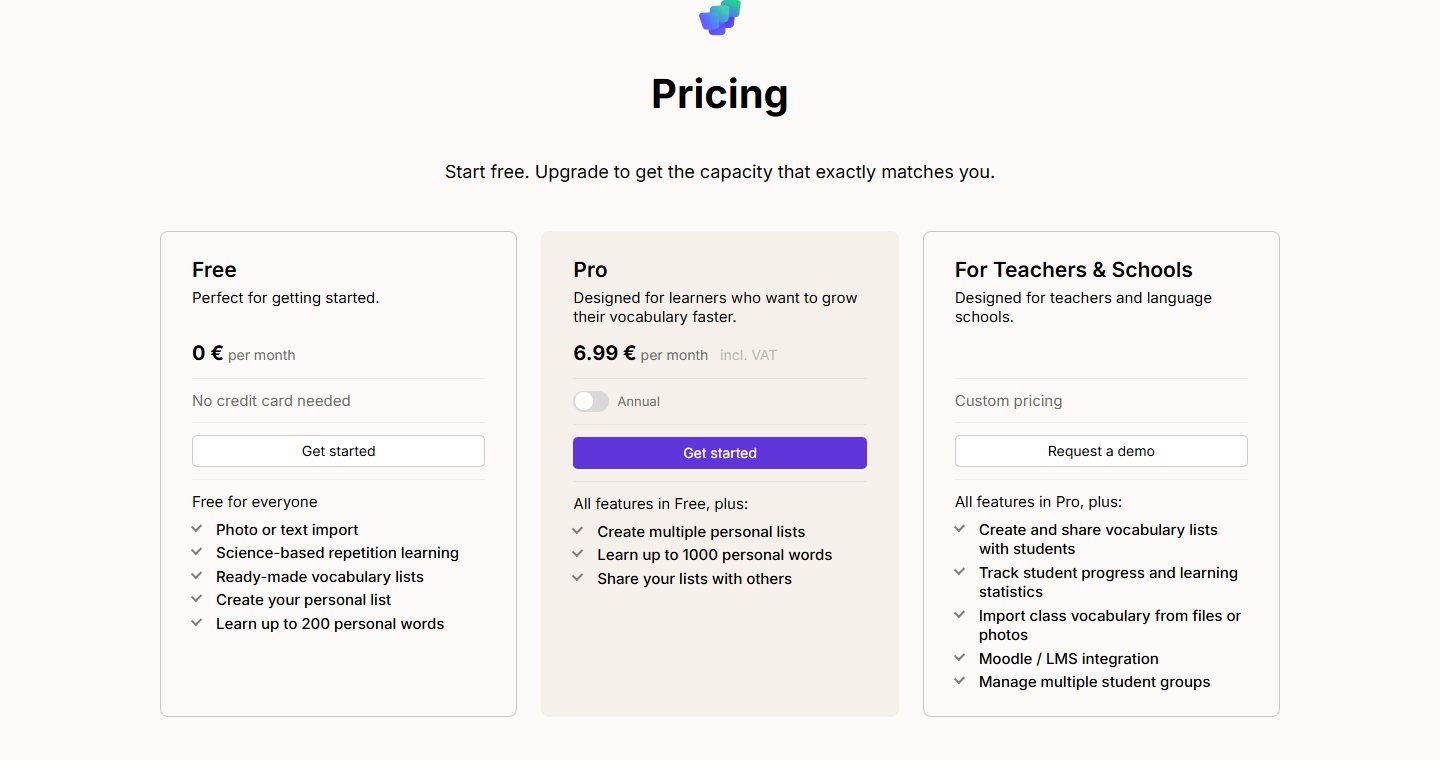
Pricing is reduced to three cards with no dropdowns or configurators. Free — €0/month, no card required, up to 200 personal words, photo import and ready-made lists. Pro — €6.99/month incl. VAT (plus an “Annual — Save 30%” toggle), up to 1000 personal words, multiple lists and the ability to share your own lists. For Teachers & Schools — custom pricing with a “Request a demo” CTA to hello@wordica.io: classroom management tools, progress statistics, importing a class vocabulary from photos, Moodle/LMS integration and managing groups of students. The Pro card is visually highlighted with a darker background as the recommended option. No trial timers, no upsell modals, no extra pricing tiers — three options, each for its own audience.
FAQ — 8 accordion questions on the product and the method
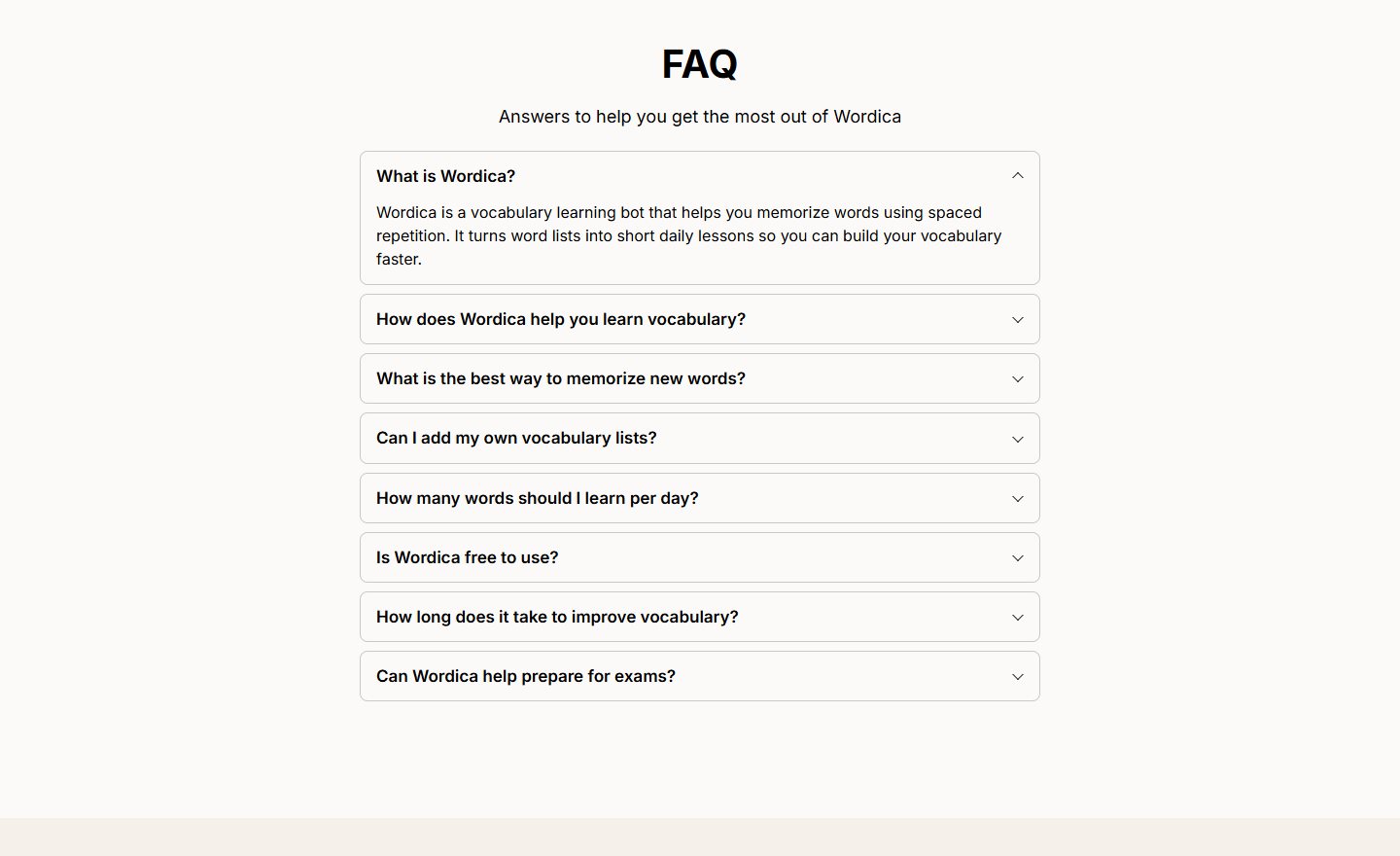
The FAQ section closes the page with 8 questions that do double duty — removing doubts before launching the bot and adding semantic weight for search queries around vocabulary learning: “What is Wordica?”, “How does Wordica help you learn vocabulary?”, “What is the best way to memorize new words?”, “Can I add my own vocabulary lists?”, “How many words should I learn per day?”, “Is Wordica free to use?”, “How long does it take to improve vocabulary?”, “Can Wordica help prepare for exams?”. The first question is expanded by default with an answer about spaced repetition — the methodological foundation the bot is built on, which other answers refer back to. The rest are a simple click-to-expand accordion, with no nested sub-items.
Technical stack
Static HTML with no CMS — a fast first render, zero hosting cost, and full control over the markup with no template constraints. Swiper.js powers the Discover ready lists and Reviews carousels — no heavy jQuery-slick. A custom main.js handles the burger-menu logic, the FAQ accordion, and the language switcher (the UI currently supports EN, with other interface languages to follow). An embedded YouTube iframe carries the explainer video from the brand’s own @wordica channel. The client-side marketing stack: Google Tag Manager (G-YWL8N11SN3), Facebook Pixel (1521155276036359) and TikTok Pixel (D82S2OJC77U9FQKB65P0) — set up for three-way performance marketing with remarketing. Locale detection runs via User Agent plus a language picker in the header. CTA conversion is entirely moved off the site into Telegram (@wordicabot), which reduces the page to a pure presentation layer with no backend.