What each licence includes
| Feature | Free | Pro |
|---|---|---|
| Price, old (struck-through) price and stock sent to Epicentr Marketplace via the official API | ✔ | ✔ |
| WooCommerce sale price sent as the price, regular price as the old price | ✔ | ✔ |
| Variations sent separately, each with its own SKU and stock | ✔ | ✔ |
| Matching products by SKU or by Epicentr product ID | ✔ | ✔ |
| Price with or without tax, matching what the customer sees | ✔ | ✔ |
| Stock threshold and behaviour for backorders | ✔ | ✔ |
| Only products changed since the previous submission are sent | ✔ | ✔ |
| Batches of up to 1,000 products per request | ✔ | ✔ |
| Processing status collection: updated, unchanged, rejected, not found | ✔ | ✔ |
| Status of the last submission on the product and variation edit page | ✔ | ✔ |
| List of products that failed to update, with the reason in plain language | ✔ | ✔ |
| Batch log | ✔ | ✔ |
| "Check connection" button — the token is verified before the first submission | ✔ | ✔ |
| Dashboard token stored encrypted | ✔ | ✔ |
| HPOS compatibility | ✔ | ✔ |
| XML file of new products with attributes from the Epicentr directory | ✔ | ✔ |
| Store categories linked to Epicentr categories, with a source for every attribute | ✔ | ✔ |
| Report: which products did not get into the file and which attribute is missing | ✔ | ✔ |
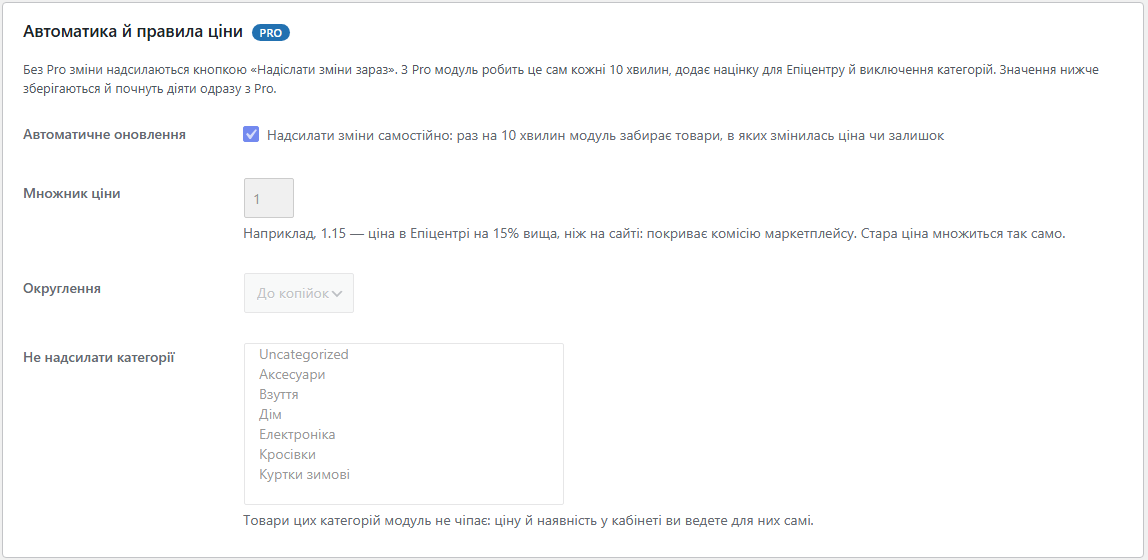
| Automatic updates every 10 minutes | — | ✔ |
| Price multiplier with rounding to the hryvnia | — | ✔ |
| Category exclusions from sync | — | ✔ |
| New products file for all categories with a daily rebuild | — | ✔ |
Epicentr: Price and Stock Sync is a WooCommerce plugin that sends the price, the old (struck-through) price and the stock status of your store’s products to the Epicentr Marketplace seller dashboard through the official API. Change a price, run out of stock, launch a sale — the dashboard gets the same update, with no file exports and no manually editing product listings.
The plugin doesn’t change descriptions of products already in the dashboard. It updates what changes daily: how much something costs and whether it’s in stock. The listings in the dashboard stay yours — the plugin just keeps prices and stock in sync with WooCommerce.
The plugin also helps with new products. The public Epicentr API can’t create products, so the plugin builds an XML file for the dashboard import: it takes categories and attributes from the Epicentr directory, values from your products, and shows which required attribute is missing. After moderation, prices and stock of those products keep syncing through the API.
Why a store needs this
A seller on Epicentr runs two catalogues: their own store and the marketplace dashboard. The price gets changed in WooCommerce, but in the dashboard it stays the old one until someone gets round to updating it by hand. A product runs out on your site, but Epicentr keeps selling it, and the order has to be cancelled.
Every cancellation hurts the seller’s rating, and a price lower than the one on the website eats into margin. Across a few hundred SKUs, manual reconciliation can’t keep up with the changes, especially when the same stock is sold by both the website and the marketplace.
The plugin removes that reconciliation: it sees what changed on a product and sends only that to the dashboard.
Live demo
Epicentr has no sandbox: the API only opens with a live seller dashboard token, so a demo submission on someone else’s account isn’t possible. Instead of a demo, the plugin has a “Check connection” button: you paste your token and immediately see whether the dashboard accepted it, before the first submission.

What the admin gets
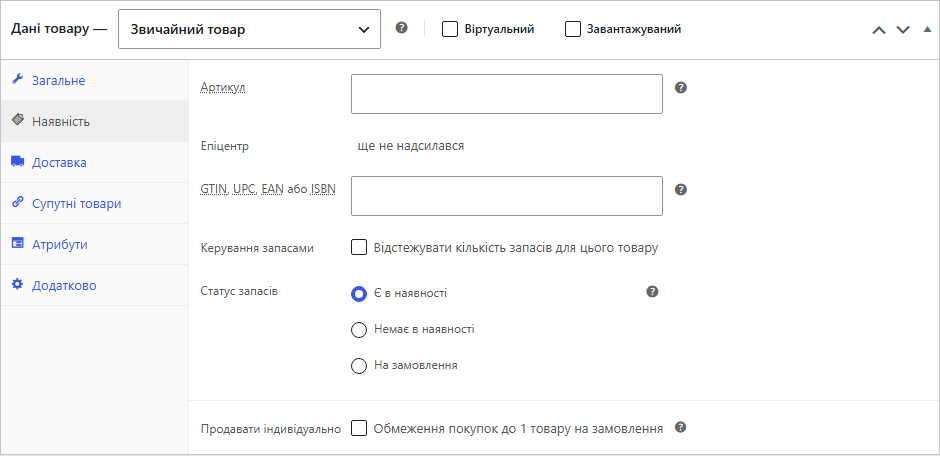
A settings page under the WooCommerce menu: connection, what to send, automation, sync, a list of products that failed to update, and a batch log. On every product’s and every variation’s edit page, next to the SKU, there’s an “Epicentr” line showing what last happened with that product.
What exactly gets sent
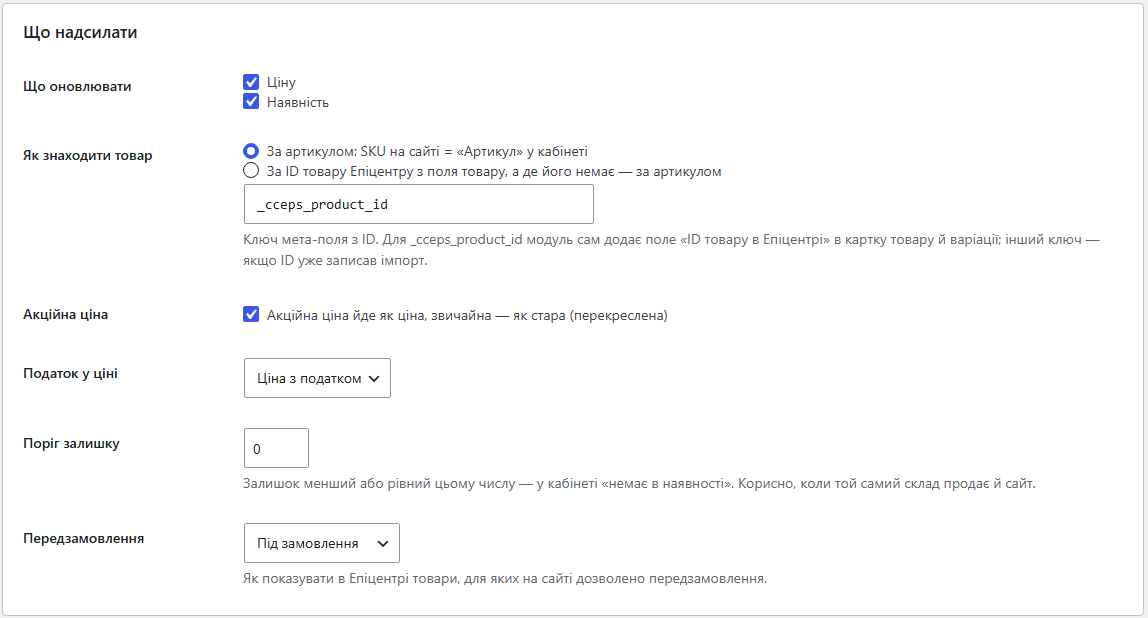
Price. Taken with or without tax, as you choose, so it matches what the customer actually sees. Epicentr only accepts prices in hryvnia, so the plugin sends price only when the store’s currency is UAH; otherwise only stock status is sent.
Old price. If a WooCommerce sale price is active on a product, it goes across as the price, and the regular price goes across as the struck-through old price.
Stock. “In stock” stays in stock. Out of stock becomes “out of stock.” For products with backorders allowed, you can choose how they’re shown in Epicentr. A stock threshold helps when the same warehouse serves both the website and the marketplace: stock at or below the threshold is already treated as “unavailable.”
Matching the product. By SKU: the site’s SKU must match the “Article” in the dashboard. Or by Epicentr product ID: the plugin adds an “Epicentr product ID” field to the product and variation edit pages, and if an import has already recorded the ID elsewhere, you can point it to your own meta key.
Variations. A variable product in Epicentr is a set of separate listings, so each variation is sent with its own SKU, price and stock.
How it works, step by step
1. You paste the dashboard token and click “Check connection.” The token is found in the dashboard: Company Settings → the API tab.
2. You click “Send changes now.” The plugin walks the catalogue in chunks of up to 20 seconds so it doesn’t hit a hosting timeout; on a large catalogue you click the button again and the pass continues from where it left off.
3. Changed products are batched up to 1,000 items and sent to Epicentr. Products with no changes since the previous submission are skipped.
4. Epicentr doesn’t apply changes instantly. “Update statuses from Epicentr” collects the result: what was updated, what was already the same, what was rejected.
5. Products with a problem land in a “Products that failed to update” list with a plain-language explanation.
In Pro, steps 2–4 happen on their own: changing a product or its stock queues it, and every 10 minutes the plugin sends the queue and collects the results.
Products that failed to update
The dashboard doesn’t always accept a change, and the reason matters. No product with that SKU exists in the dashboard — codes need reconciling. The product is part of an Epicentr promotion — the price can’t be changed while the promotion runs. The product has no SKU — there’s nothing to match it by.
The plugin shows this in plain words, not an API response code. The same set of values isn’t resent until you change the product, so the dashboard doesn’t get the same error every 10 minutes.
Batch log
Every submission goes into a log: when, whether by button or automatically, how many products, and what happened to them. A batch Epicentr is still processing waits for its status to be collected, after which it closes with a summary. The log can be cleared with one button.
New products with attributes
Epicentr accepts a new product only with the required attributes from its own directory: brand, country, volume — each category has its own set and its own value codes. By hand that is a spreadsheet of hundreds of rows. The plugin turns it into three steps:
- Directory. A button loads Epicentr categories through the API; attribute sets and list values are loaded only for the categories you use.
- Links. For a store category you pick an Epicentr category by searching its name, and for each attribute you choose where the value comes from: an attribute, the brand, GTIN, a meta field, weight and dimensions (converted to grams and millimetres), or one value for all products. List values are matched by name, and mismatches like “Рінгель” → “Ringel” are matched by hand.
- File. The plugin builds XML in the Epicentr import format and lists the products that did not get into the file, with the reason: no photo, an empty required attribute, a value missing from the directory. Upload the file in the dashboard: Import → File → Update all.
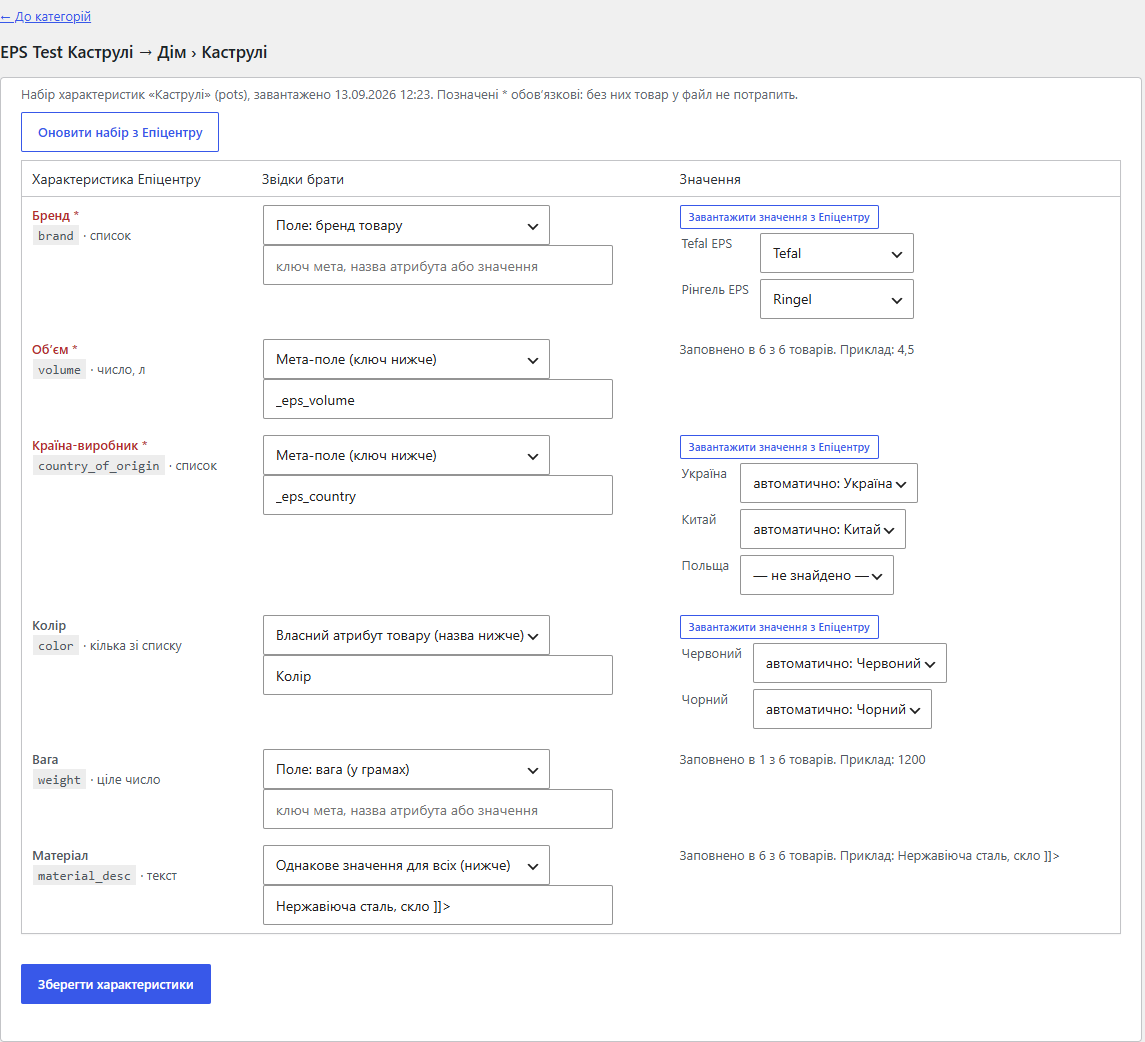
Without Pro the file is built for one store category; with Pro, for all of them, and it rebuilds itself daily.
Free version and Pro
The free version handles sync with a button: price, old price, stock, variations, skipping unchanged products, status collection, status on the product page, a list of problem products and a log. There’s no limit on the number of products.
Pro removes the manual part and adds rules:
— automatic updates: every 10 minutes the plugin picks up products whose price or stock has changed;
— a price multiplier with rounding to the nearest hryvnia — for example, a 15% higher price on Epicentr to cover the commission; the old price is multiplied the same way;
— a new products file for any number of categories, rebuilt daily;
— category exclusions — products whose price and stock you manage yourself in the dashboard are left untouched by the plugin.
Pro can be tried free for 7 days, no card required.
Pricing
The Pro licence costs 990 UAH per domain. The licence is annual (1–5 years available): it covers updates and support for that period.
Technical requirements
WordPress 6.2 or later, WooCommerce, PHP 7.4 or later. The plugin is compatible with HPOS — WooCommerce’s separate order tables. Outbound HTTPS access to the Epicentr API is required, and the store currency must be UAH for prices to be sent.
Under the hood
The plugin works through Epicentr’s official Merchant API endpoints for updating prices and stock — no dashboard scraping, no simulated login. The token is stored in the database encrypted.
What was actually sent and what the dashboard replied is stored in the product’s metadata, so the plugin knows what changed and doesn’t send anything unnecessary. The change queue lives in a single option and is capped in size; the log keeps the last 30 batches. Automation runs on WP-Cron.
The plugin adds nothing to the storefront — the customer never sees it and it can’t slow the site down.
How to install
1. Upload the archive under Plugins → Add New → Upload Plugin, and activate it.
2. WooCommerce → “Epicentr: Price and Stock” — paste the dashboard token and click “Check connection.”
3. Choose how to match products: by SKU or by Epicentr product ID.
4. Click “Send changes now,” then a few minutes later “Update statuses from Epicentr.”
If the API tab isn’t visible in the dashboard, access to updating prices and stock is granted by your Epicentr category manager.
Version history
1.1.0 — XML import file for new products with attributes: the Epicentr category and attribute directory through the API, category links, value sources, list value matching and a report of products that did not get into the file. Without Pro — one category; with Pro — all of them and a daily rebuild.
1.0.0 — first release. Price, old price and stock sent to Epicentr Marketplace via the API, variations, matching products by SKU or Epicentr ID, tax-inclusive pricing, stock threshold, backorders, skipping unchanged products, batches of up to 1,000 records, status collection, status on the product page, a list of products that failed to update, a batch log, HPOS compatibility. Pro adds automatic updates every 10 minutes, a price multiplier with rounding, and category exclusions.
Frequently asked questions
Where do I get an Epicentr API token?
In the seller dashboard: Company Settings → the API tab. If the tab isn't visible, or the dashboard says you don't have permission for the action, access to updating prices and stock is granted by your Epicentr category manager.
Can I test the plugin without a seller dashboard?
No. Epicentr has no sandbox — the API only opens with a live dashboard token. The "Check connection" button shows whether the dashboard accepted the token, before the first submission.
Does the plugin create products in Epicentr?
Not through the API: the public Epicentr API only updates price and stock. The plugin builds new products into an XML file with attributes from the Epicentr directory, and you upload it in the dashboard (Import → File → Update all). After moderation, prices and stock of those products keep syncing.
How does the plugin match a product in the dashboard?
By SKU: the site's SKU must match the "Article" in the dashboard. Or by Epicentr product ID — a separate field for it appears on the product and variation edit page.
How do variable products work?
Each variation is sent separately with its own SKU, price and stock — the same way it's set up in the Epicentr dashboard.
What happens to a product taking part in an Epicentr promotion?
While the marketplace promotion is running, Epicentr won't allow the price to change. The plugin will show this in the list of problem products, while stock will keep updating as usual.
My store's currency isn't hryvnia. Is that a problem?
Epicentr only accepts prices in hryvnia, so with a different store currency the plugin will only send stock status.
Questions about the module?
Message us on Telegram — we reply within the working day. We will help with setup, compatibility and key activation.
No reviews yet. Be the first — right below.
Leave a review
Reviews are moderated before publication, which usually takes up to 24 hours.
No questions yet. Ask one — we answer within 24 hours.
Ask a question
We usually reply within 24 hours during working hours.
Buying the module
—